Magnetic mixer improves 3D bioprinting
Baku, February 11, AZERTAC
3D bioprinting, in which living tissues are printed with cells mixed into soft hydrogels, or “bio-inks,” is widely used in the field of bioengineering for modeling or replacing the tissues in our bodies, according to MIT News.
The print quality and reproducibility of tissues, however, can face challenges. One of the most significant challenges is created simply by gravity — cells naturally sink to the bottom of the bioink-extruding printer syringe because the cells are heavier than the hydrogel around them.
“This cell settling, which becomes worse during the long print sessions required to print large tissues, leads to clogged nozzles, uneven cell distribution, and inconsistencies between printed tissues,” explains Ritu Raman, the Eugene Bell Career Development Professor of Tissue Engineering and assistant professor of mechanical engineering at MIT. “Existing solutions, such as manually stirring bioinks before loading them into the printer, or using passive mixers, cannot maintain uniformity once printing begins.”
In a study published Feb. 2 in the journal Device, Raman’s team introduces a new approach that aims to solve this core limitation by actively preventing cell sedimentation within bioinks during printing, allowing for more reliable and biologically consistent 3D printed tissues.
“Precise control over the bioink’s physical and biological properties is essential for recreating the structure and function of native tissues,” says Ferdows Afghah, a postdoc in mechanical engineering at MIT and lead author of the study.
“If we can print tissues that more closely mimic those in our bodies, we can use them as models to understand more about human diseases, or to test the safety and efficacy of new therapeutic drugs,” adds Raman. Such models could help researchers move away from techniques like animal testing, which supports recent interest from the U.S. Food and Drug Administration in developing faster, less expensive, and more informative new approaches to establish the safety and efficacy of new treatment paths.
“Eventually, we are working towards regenerative medicine applications such as replacing diseased or injured tissues in our bodies with 3D printed tissues that can help restore healthy function,” says Raman.
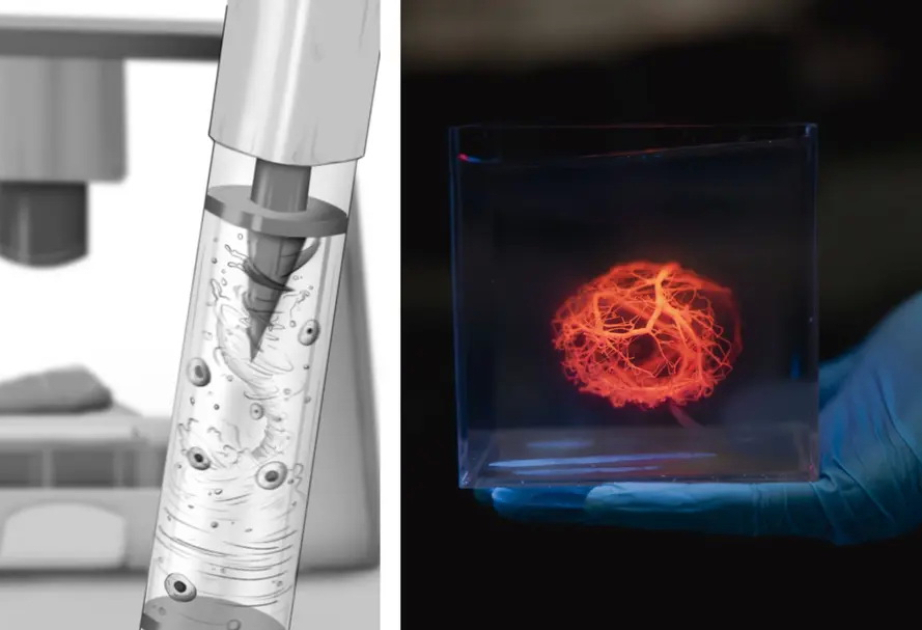
MagMix, a magnetically actuated mixer, is composed of two parts: a small magnetic propeller that fits inside the syringes used by bioprinters to deposit bioinks, layer by layer, into 3D tissues, and a permanent magnet attached to a motor that moves up and down near the syringe, controlling the movement of the propeller inside. Together, this compact system can be mounted onto any standard 3D bioprinter, keeping bioinks uniformly mixed during printing without changing the bioink formulation or interfering with the printer’s normal operation. To test the approach, the team used computer simulations to design the optimal mixing propeller geometry and speed and then validated its performance experimentally.
Other news in this section


