Colorful villages of Azerbaijan: Khinalig



Baku, Mach 1, AZERTAC
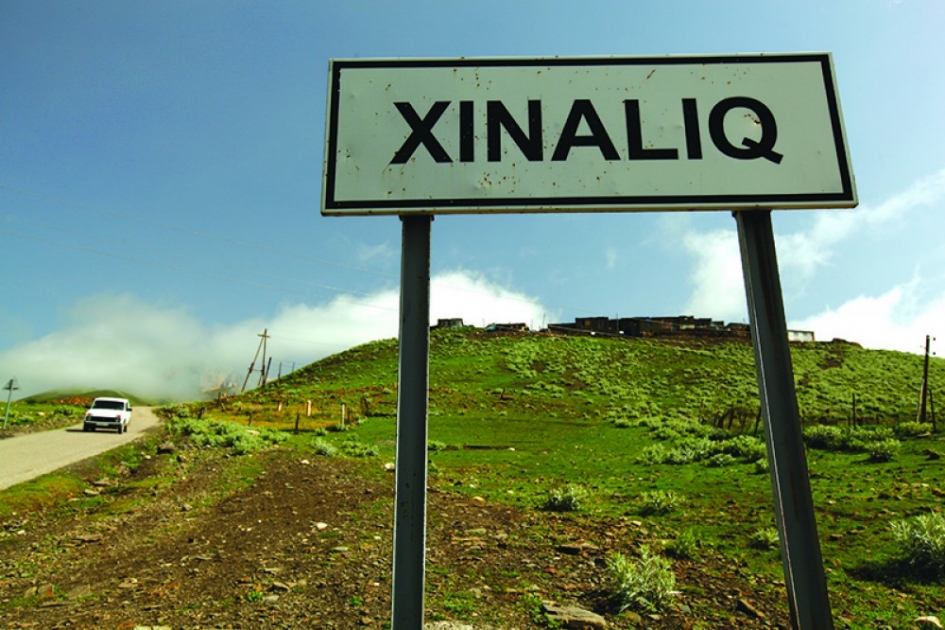
65 km from the center of Guba - one of the northern regions of Azerbaijan, there is an ancient mountain village - Khinalig. The territory of the village is declared a state historical-architectural and ethnographic reserve, due to which it is compared with an open-air museum.
Here the traditional way of life and original architecture are preserved. And the locals speak their own unique language, for the study of which ethnologists from all over the world come here. Finally, tourists go to Khinalig to enjoy the hospitality of the locals and the beauty of the mountain scenery under the immense starry sky.
Portrait from life
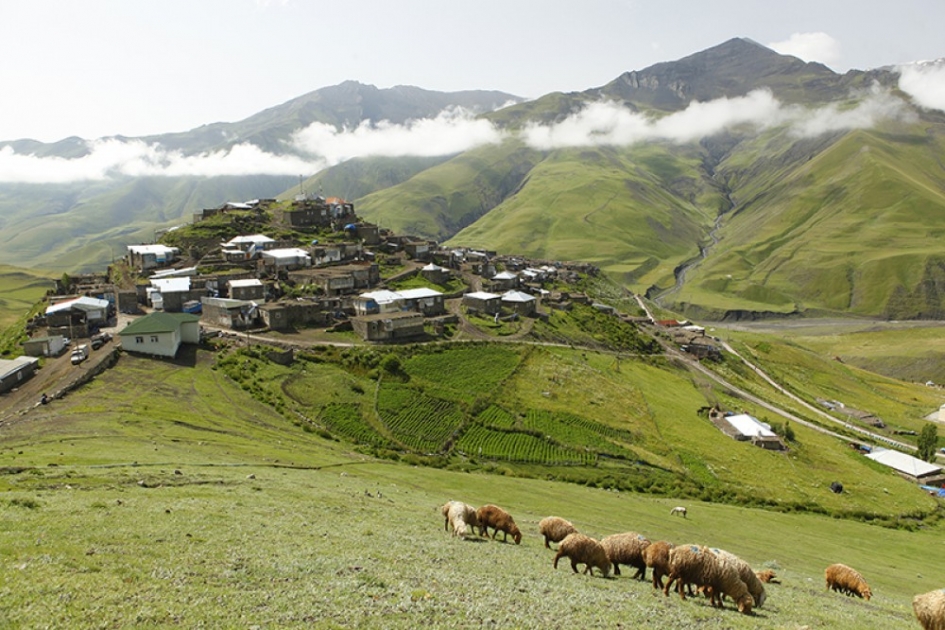
Located on one of the peaks of the Caucasus, Khinalig village, huddled in the mountains of Gizil Gaya, Shahdag, Tufandag and Khinalig, on the left bank of the Gudialchay river, at an altitude of 2,200 meters above sea level. Situated directly opposite Khinalig, Tufandag mountain has special significance for the villagers. According to one of the legends, on this mountain are the ruins of an ancient settlement, destroyed 1000 years ago by a powerful earthquake. It is believed that the inhabitants of that village founded the present Khinalig.
In the local climate, trees do not grow, only grasses and shrubs, as well as agricultural crops cultivated by local people. The cold in this locality comes already in the early autumn. Winter is severe and snowy - frost can reach minus 30 ° C.
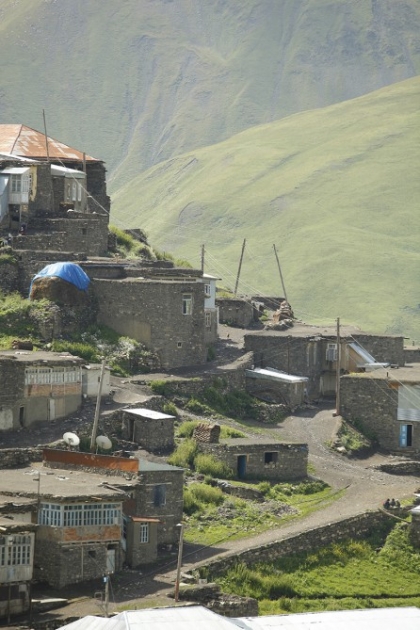
The unique image of Khinalig is formed by ancient stone houses built by terraces: the roof of one house serves as a courtyard for another located above. Since the slopes here are very steep, the houses are lined tightly. In the courtyards there are small gardens. Houses here are ancient - they are at least 200-300 years old. In general, the village has more ancient buildings, as well as many ancient ruins. In the Khinalig reserve, the construction of new buildings is forbidden, therefore the village retained its pristine architecture.
Until now, houses in Khinalig are heated with dung, which is made from pressed manure. Once this type of fuel was widely distributed in Azerbaijan. It is made here like this: manure, mixed with straw, is filled into special shapes and compacted. The resulting bricks are dried under the sun and then piled into improvised walls. These bricks are the main fuel used by the Kynaligi. It is considered qualitative and does not require any expenses.
It is curious that the Khinalig people call their village "Ketsh", themselves - "Kyat" or "Kettid", and their language - "Ketsh mitsl". The name "Khinalig" has been used since the 50's and 60's. and it happened, whether from the cliffs of the color of henna, located here, or from the name of the Hun tribe.
Origin of identity
The residents of the village of Khinalig rank themselves as a separate ethnic group. Ethnologists consider this people, related to the ancient tribe of Utii, who lives in the village of Nij in Gabala, belongs to the Shahdag ethnic group. To our days, a short mountain road from Khinalig to Gabala has been preserved. Until the middle of the last century, the villagers used this road to go to the neighboring district for shopping.
Khinalig's people are distinguished by a strong physique, usually of short stature, with chestnut hair, brown or blue eyes. Representatives of this ethnic group have their own original language. The first report on the Khinalig language is found in European sources - in the records of the German ethnographer Roderich von Erckert. In his book "Languages of Caucasian Origin," published in 1895 in Vienna in German, he analyzes the subject of the grammar and phraseology of the Khinalig language. To study the Khinalig language in the twentieth century a special branch of the Institute of Linguistics of the USSR was opened in the village. The linguists who worked here compiled the alphabet of this language on the basis of Latin script. According to some information the alphabet contains 72 letters, and on the other 77.
The population of the village of Khinalig currently does not exceed two thousand people. Residents of the village were able to maintain their traditional way of life. Here there are their customs, which have become an integral part of life and are closely related to the environment. Weddings and other ceremonies are also held in accordance with the rites handed down from generation to generation.
Up to the middle of the twentieth century, tribal relations were maintained in Khinalig. Each of the tribe who lived on this territory, differed from the other by the management system, had its own quarters, cemeteries, mosques and holy places. And now the villages here are divided into quarters, each of which once had a separate genus. Sometimes these quarters played the role of an administrative unit. Each quarter had its own aksakals (elders). Today in Khinalig live mainly representatives of four genera.
Since the road to the city was long and difficult, the villagers went there only once or twice a year, in the warm season - they sold their produce, bought food and other necessary provisions and returned home.
Residents of Khinalig are very religious. In the pre-Islamic period, the kinaligi were fire-worshipers. Currently there are about ten mosques in the village, some of which are over 1000 years old.
Magnet for travelers
Since the villagers are engaged mainly in sheep breeding, weaving is widespread here. The shawls, made in Khinalig from woolen yarn, were once famous in the entire Guba district. Nearby villages bought these shawls for tailoring. In the olden days in the villages, the caftan, made of woolen cloth, was the subject of a national costume, which could be afforded mostly by wealthy people. In Khinalig, as well as in many other settlements of the northern region of Azerbaijan, jorabs are widely used. These colored thick woolen socks perfectly warm in winter cold.
One of the main activities of the local population is also the collection of medicinal plants. They are harvested for their own needs, and for sale to tourists.
Since August in Khinalig, the season of honey begins. Mountain honey has a unique taste and aroma. Inhabitants of the village call honey a panacea for 70 misfortunes. In autumn, the goat meat season comes. Meat of animals grazing on local pastures is also highly valued.
Travelers, who are attracted by this distinctive village, usually rent accommodation in the homes of local residents, who are very hospitable. Fans of ecotourism can stay in tents.
On the mountain road from the village, after going through the Shah Yailagh plateau, you can reach the Gyzyl Gaya mountain range (3,700 m). From here it is close to the mountain Lezghian village of Laza, located on the bank of the river Gusar. Distance of 30 km to this village can be overcome on horseback or on foot along a mountain path.
Villagers can also organize a hiking trip to the plateau of Shah Nabat, where national wrestling competitions, horse competitions, as well as bazaars are held for tourists.
The village of Khinalig is known not only for its ancient traditions, but also for the fact that in these places they saw ... Yeti. It was in 1988 when the young hunter Babaali Babaaliev, who is still alive, has sat down in one of the caves in the vicinity of Khinalig in anticipation of the mountain goats who come here to enjoy rock salt. The snoozed hunter woke up from the fact that someone had blocked the entrance to the cave. Babaali asserts that a large shaggy man-like creature stared at him silently. The hunter, stunned with horror, could not move, his hands did not obey him and he could not make a step to reach the rifle that lay next to him. After standing a little, the creature retired away. After that incident, Babaali was in shock for a long time, could not come to himself and eschewed the places where the exciting meeting took place.
Instead of an afterword
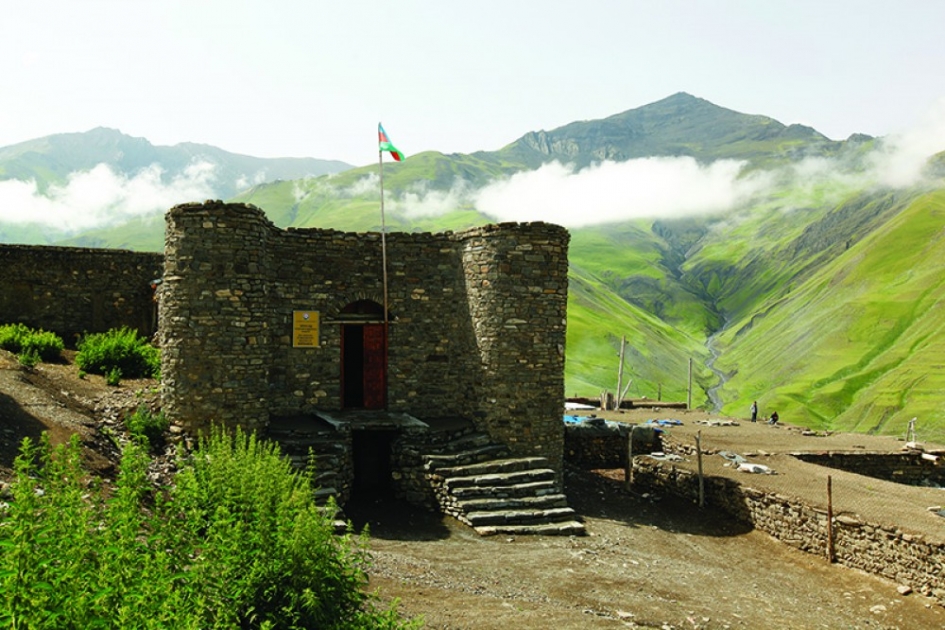
When visiting the remarkable village of Khinalig, do not forget to visit the local historical and ethnographic museum, opened here in 2001. Its unique exhibits will allow you to fully get acquainted with the ancient and extraordinarily fascinating history of Khinalig.
In two halls of the museum, a total area of 160 square meters, traditional kitchen utensils, clothes, carpets, coins, weapons, photos of famous people from the village and other interesting exhibits are on display.
Fans of mountain tourism can get all the necessary information about the features of the trip to Khinalig in the Guba Tourist Information Center located in the very center of Guba.
Emil Eyyubov
Other news in this section


