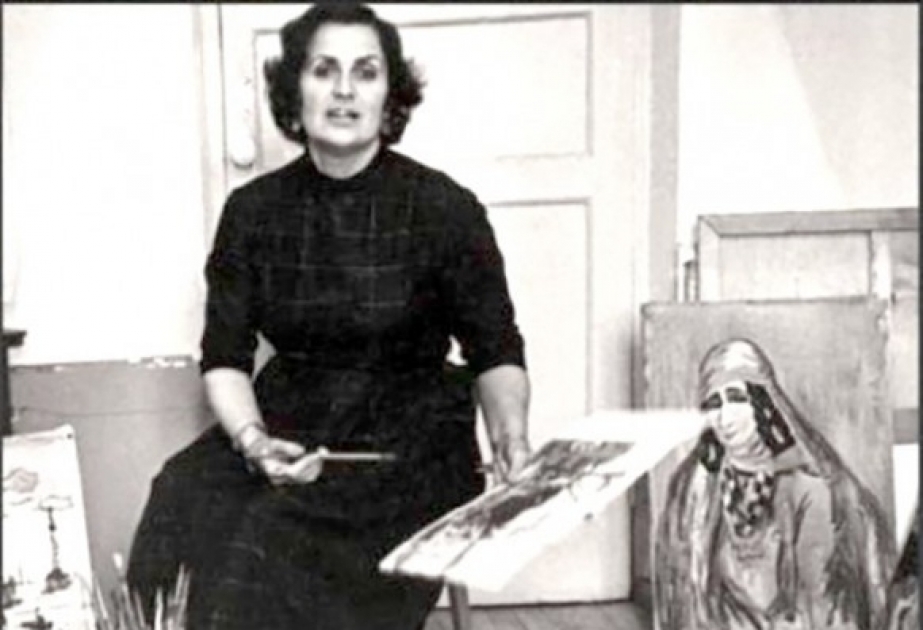
Maral Rahmanzade – Azerbaijan’s first professional artist, master in national graphic art
Baku, February 15, AZERTAC
The visual arts of Azerbaijan are known for many big names of people who worked in different times and left a mark on the culture of the Azerbaijani people.
Azerbaijan’s first professional artist - Maral Rahmanzade, who has become a master in national graphic art, was one of them.
People’s Artist of Azerbaijan Maral Rahmanzade, who was born in Mardakan, Baku, in 1916, is one of the first female Azerbaijani artists who obtained a professional artistic education.
Rahmanzade studied at the Azerbaijan State Technical School of Arts and later at the Moscow State Institute of Arts.
While studying at the Moscow State Academic Art Institute, Rahmanzade was taught by eminent artists such as Lev Bruni, Dmitry Moor and Vladimir Favorsky. One of the eminent Russian artist and art critic Igor Grabar described Maral Rahmanzade as “a very talented Azerbaijani girl”.
Rahmanzade started her career as a graphic artist creating posters with patriotic content during the years of the Great Patriotic War. She continued with illustrations for Khatai's “Dahname”, Jafar Jabbarly's “Gulzar” and “Maiden Tower”, M.S. Ordubadi's “Knife and pen”, A. Zograbbekov's “The Land of Fire”.
A new theme that the artist often returned to with revised styles - oil features strongly in Maral Rahmanzade’s work during post-war reconstruction, as she was the first artist who went to work on the "Oil rocks”, the first offshore oil platform in Baku. While there, she was observing the oilmen's working days, their everyday life resulting into a series of graphic works, in which she experimented with the medium of linocut, engraving, watercolor and mixed media. These works are dedicated to the great labor of the hardworking oilmen and are considered to be milestones of Azerbaijani graphic art.
Upon returning to Baku, the painter converted impressions from the trip into numerous graphic pictures. The romance of the oilmen’s labour and the tensions evoked by their working environment found their remarkable expression in her lithographs such as “Oil Rocks” (1956-1957), “On the Tanker” (1954), “Going on Shift” (1956-1957); and in the pictures “In the storm" (1950s), “Offshore well” (1956-1957) etc. painted in watercolours.
Rahmanzada became also famous for her paintings with industrial and mountain views. She depicted constructions of the gigantic factories in Sumgayit and Rustavi as well as documented her travels to the highest parts of Azerbaijan in her prominent “Khinalig” series.
The artist has significantly contributed to the development of the Azerbaijan national school of art. Thus, Maral displayed her love for the native country - Azerbaijan, in a series of works called “My Azerbaijan” (1965-1982), highlighting the special environment of each region: Lachin, Guba, Nakhchivan, Absheron, Lankaran as well as Khinalig village, in paintings and graphics.
Rahmanzade was at the forefront of Azerbaijan’s art scene and her pieces adorn many world-renowned museums and have been featured in several high profile international exhibitions in England, France, Italy, Japan, Australia and her home, Azerbaijan. Exhibitions included (1957) “The first All-Union print exhibition”, Moscow, Russia, (2006) “Q Gallery”, Baku, Azerbaijan and (2016) “Maral Rahmanzade”, “100th anniversary exhibition Azerbaijan” at the National Museum of Art, Azerbaijan, Baku.
Throughout her career, Maral Rahmanzade also illustrated prestigious literary works, including “Eugene Onegin” by Alexander Pushkin and “A Hero of Our Time”’ by Mikhail Lermontov.
Maral Rahmanzade was named People’s Artist of Azerbaijan in 1964 and received the Laureate of the State Prize of the Republic in 1965.
Her works not only played an exceptional role in the development of national fine arts, but also played an important role in educating the Azerbaijani youth in the spirit of patriotism.
Maral Rahmanzade died in Baku on March 18, 2008.
Other news in this section


