Road to Shanghai Communique relived 50 years on
Groundbreaking document paved way for normalization of Sino-US relations
Cui Tiankai, 70, the longest-serving Chinese ambassador to the United States, little knew 50 years ago the extent to which US President Richard Nixon's ice-breaking trip to China would affect the world in coming decades, according to chinadaily.com.cn.
The same applied to Cui's thoughts on the China-US joint communique, also known as the Shanghai Communique, which was issued during the visit.
When Nixon arrived in Beijing on Feb 21, 1972, Cui was working as a tractor driver in a rural area of Heilongjiang province, helping grow wheat and soybeans.
"It was big news for us that the president of the United States was coming to China. We had a sense that something might happen and that there could be some changes in the relations between China and the United States, but we did not know exactly what those changes might be," Cui said.
"We were certainly not aware of the broader, more fundamental changes, that might be taking place in the world. We were certainly not aware of the changes that would affect our personal lives in the coming decades."
The senior diplomat engaged with three US administrations during his time in Washington as ambassador from April 2013 to June last year, and watched as Sino-US relations plunged to historical lows, marred by a trade war, escalating tensions and a highly politicized pandemic.
The Shanghai Communique was something new in diplomacy, as the two countries agreed to state different views in the same document. As a political document signed by two sovereign states, it should be honored and implemented, Cui added.
With a view to working toward the normalization of joint relations, the Shanghai Communique was issued by China and the US hours before Nixon ended his week-long China visit on Feb 28, 1972.
Together with the Joint Communique on the Establishment of Diplomatic Relations and the Joint Communique on Arms Sales to Taiwan, the Shanghai Communique constitutes the foundation for the development of China-US relations.
The US acknowledges in the Shanghai Communique that "all Chinese on either side of the Taiwan Straits maintain there is but one China and that Taiwan is a part of China." The Taiwan question has been the most sensitive in China-US relations.
China and the US also acknowledged their differences in the Shanghai Communique, but agreed on the Five Principles of Peaceful Coexistence, including non-interference in the internal affairs of other states.
Secret trip
Henry Kissinger, who served as assistant for national security affairs to the US president from January 1969 until November 1975 and was behind Nixon's historic China visit, remembers how the Shanghai Communique originated.
He made a secret visit to China from July 9 to 11, 1971, to prepare the ground for Nixon's visit and the normalization of Sino-US relations.
Kissinger's secret trip came as China and the US had been locked in a prolonged confrontation since the founding of the People's Republic of China in 1949, while the Kuomintang, led by Chiang Kai-shek, fled to Taiwan after losing the civil war. After assuming office as US president in 1969, Nixon opted for improved ties with China, in response to domestic considerations as well as changed dynamics in the global political arena.
In October 1971, Kissinger returned to China with a draft joint communique that the US thought would be appropriate to issue at the end of Nixon's visit.
"When I left the United States, we had drafted a standard communique, as it is issued at practically every meeting of countries that deal with each other, which indicated that we were making progress in our relations, but that was not very specific," Kissinger said.
Premier Zhou Enlai made clear that such an approach was unacceptable because "this will not express the magnitude of the occasion of the two heads of these two major countries meeting", Kissinger said.
"It was therefore proposed to us that we do something that has never been done in any major negotiation and, to the best of my knowledge, has not been done in any other negotiations, namely, that both sides should state their own point of view, however differently but very clearly, so that the world could understand the basic point of view."
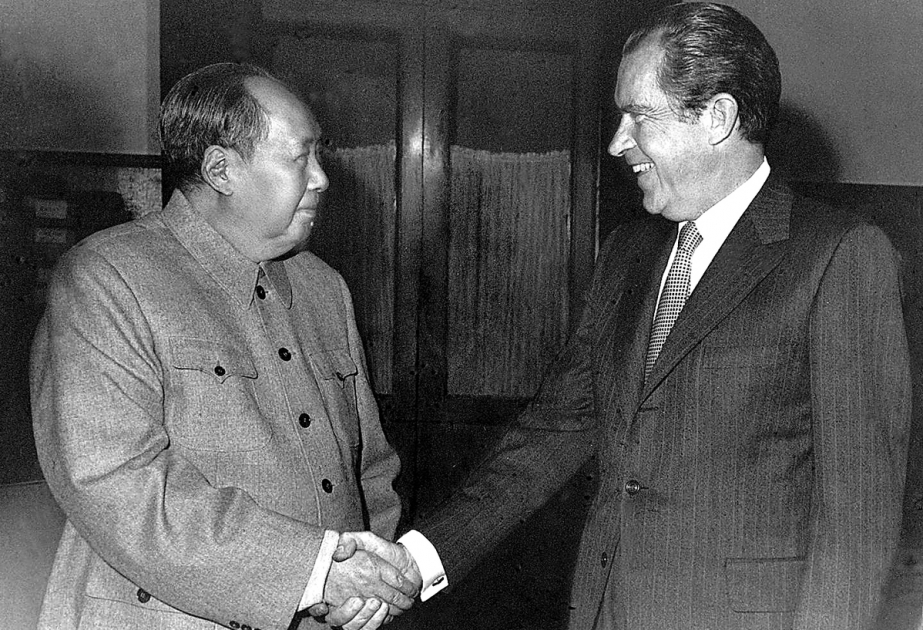
Tang Wensheng, who served as interpreter for Chairman Mao Zedong's meeting with Nixon, said Nixon and his party were invited to meet Mao at his residence in Zhongnanhai, the leadership compound in Beijing, just after they had arrived and finished lunch.
Due to Mao's health, the meeting was expected to be for 15 to 20 minutes, but it lasted more than an hour, Tang said.
"The conversation itself was certainly not embroiled in bickering over minor issues, but was rather one between leaders of two great countries, who had vision and took the long view, with the big picture in mind," Tang said. "Although each side knew that they had vast differences and a history of animosity, they had come together for an earnest exchange of views on the strategic level so as to seek common ground and a better future."
On the first day of Nixon's visit, Zhou hosted a welcoming banquet for him at the Great Hall of the People. In his toast, Zhou said the door to China-US friendly exchanges had finally been opened, but also acknowledged "fundamental" and "great "differences in terms of social systems and governments of the two countries.
"However, these differences should not hinder China and the US from establishing normal state relations," he said. "China and the United States need to be clear about their differences and find common ground so as to reach a new starting point in bilateral ties."
Nixon responded by saying it was their common interests that transcended the differences between the US and China that brought them together. "As we discuss our differences, neither of us will compromise our principles. But while we cannot close the gulf between us, we can try to bridge it so that we may be able to talk across it," he said.
Speaking about how Nixon and Kissinger impressed her, Tang said they struck her as being men of vision and courage. "They stated clearly on more than one occasion that they came to China out of the interest of the United States. They also understood that for that interest there was need for a sustainable relationship with China."
She spoke highly of the significance of the Shanghai Communique, the most important result of Nixon's trip to China, describing it as a milestone in the history of Sino-US relations that laid the groundwork for the development of these relations over the years.
"Even after half a century, it still stands out as a constant reminder of what the basic foundation of these relations is, and how it is possible to make the seemingly impossible become possible," Tang said. "History will have its ups and downs, but eventually it always goes forward. We just have to work for the better, because that's in the interest of us all."
China and the US have since built one of the world's most intertwined relationships. The trade volume between the two countries grew from less than $100 million in 1972 to more than $755 billion last year. People-to-people exchanges are even more lucrative.
Kissinger, who became the 56th US secretary of state from September 1973 to January 1977, said those connected with the origins of US-China relations have taken the view that the two sides agreed to a gradual evolution, which was then spelled out in subsequent communiques, but that both sides would maintain the view that the US would not adopt policies to undermine the one-China principle.
"I hope and expect that the eventual solution will be worked out by discussions between our two sides without pressure from either side, on the basis of what is beneficial in a way to mankind. Because I think it is important for humanity that China and the United States have the greatest capacity to undermine order in the world, work together not on every point that we will have many disagreements, but we will work together on the basic principle that we will work for peace and order. And in the conduct of our relations with each other, we will work out the solutions on the basis of mutual respect and equality," Kissinger said.
During a virtual summit with US President Joe Biden in December, President Xi Jinping said the most important event in international relations over the past 50 years was the reopening and development of China-US relations, which has benefited the two countries and the whole world.
"The most important event in international relations in the coming 50 years will be for China and the US to find the right way to get along," he said. Xi put forward three principles for China and the US to uphold in the new era: mutual respect, peaceful coexistence and win-win cooperation.
Observers said that with the future in mind, the two nations should draw wisdom and strength from their "ice-breaking" history to bring ties back on track and work for the sound and steady development of bilateral relations.
Dennis V. Hickey, a distinguished professor emeritus at Missouri State University, said Nixon's trip to China provided the foundation for the eventual establishment of diplomatic relations and shaped the broad contours of US policy toward Taiwan.
Former vice-foreign minister Fu Ying said the Shanghai Communique crystallized the kind of strategic vision and diplomatic wisdom of the two countries in a particular international environment, and is an exemplary model for successfully handling complicated international relations.
Fu said in an opinion piece provided to China Daily, "On the occasion of the 50th anniversary of President Nixon's visit to China, we should cherish the memory of those predecessors, learn from the experiences over the past 50 years while keeping our eyes on the future, and think about what kind of a new paradigm the two countries should establish for the next 50 years in order to maintain the stable development of China-US relations and ensure continued cooperation."
Looking back to what Nixon called "the week that changed the world", Charles Freeman, chief US interpreter during Nixon's visit to China, said that being part of it had given him a long-term commitment to China and enabled him to take part in the shaping of Sino-US relations in their most "malleable and creative" years.
"To recall this (the Nixon trip) is to remember the narrowness and precariousness of the strategic reasons that brought the US and the People's Republic of China together. We were starting from complete estrangement and reaching for a common understanding," said Freeman, who was US assistant secretary of defense from 1993-94.
Other news in this section


