Astronomers find evidence of a cataclysmic collision between exoplanets
Baku, March 13, AZERTAC
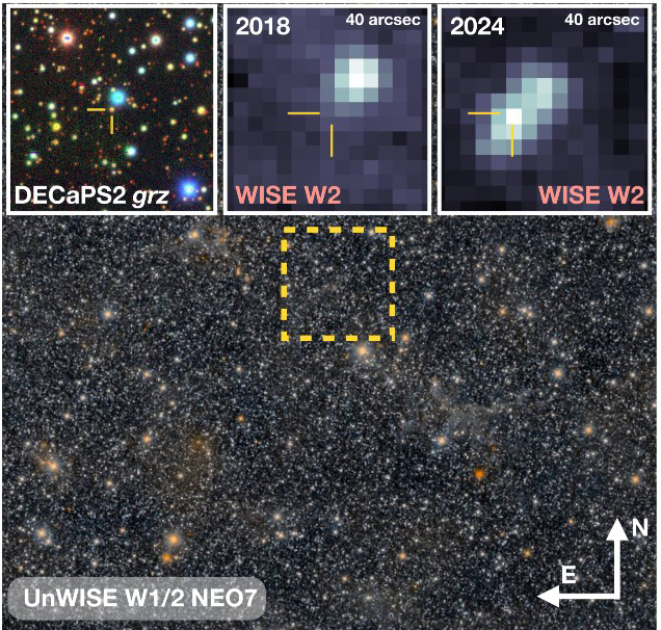
Astronomers have collected evidence of a violent collision between two planets in a distant star system. The first clues of this cataclysmic event came when a rather boring star began behaving very oddly, according to Space.com.
The collision seems to resemble the event in our history in which a planetary body slammed into Earth and created the moon.
The star in question is Gaia20ehk, an ordinarily stable main-sequence star like the sun located around 11,000 light-years away with a steady and predictable light output. Until 2016, that is, when something very strange started to happen."
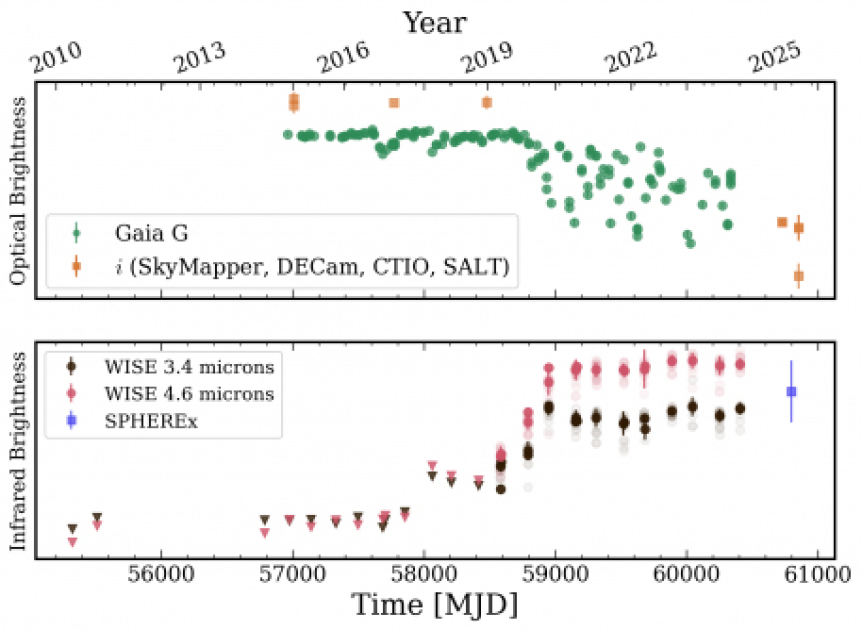
The star's light output was nice and flat, but starting in 2016, it had these three dips in brightness. And then, right around 2021, it went completely bonkers," team leader and University of Washington researcher Anastasios Tzanidakis said in a statement. "I can't emphasize enough that stars like our sun don't do that. So when we saw this one, we were like 'Hello, what's going on here?'"
Tzanidakis and colleagues discovered that the flickering of Gaia20ehk wasn't intrinsic to the star itself, but was the result of copious amounts of rock and dust passing in front of it as it orbited the star.
"It's incredible that various telescopes caught this impact in real time," Tzanidakis explained. "There are only a few other planetary collisions of any kind on record, and none that bear so many similarities to the impact that created the Earth and moon. If we can observe more moments like this elsewhere in the galaxy, it will teach us lots about the formation of our world."
Planets form from collisions and mergers between increasingly large chunks of material called planetesimals around young stars. During the chaos that represents the infancy of planetary systems, such impacts are common. However, over the course of 100s of millions of years, these turbulent conditions settle, resulting in a stable solar system like ours.
Though planetary collisions are probably quite common, seeing them in distant planetary systems is no mean feat, requiring a lot of patience and a huge amount of good fortune. The colliding planets also have to orbit their star directly between it and our view for debris from a collision to cause dimming events, which can take many years to unfold.
"Andy's unique work leverages decades of data to find things that are happening slowly — astronomy stories that play out over the course of a decade," team member James Davenport, a University of Washington scientist, said. "Not many researchers are looking for phenomena in this way, which means that all kinds of discoveries are potentially up for grabs."
As such, spotting such an event is extraordinary to say the least. In fact, seeing such events is so rare that when Tzanidakis and team first saw the fluctuation in brightness of Gaia20ehk, they couldn't account for the short dimming periods, followed by chaotic fluctuations. It was something never seen before.
The researchers could only clear up this mystery when they investigated Gaia20ehk with different telescopes using infrared light.
Other news in this section


