Japan party leaders clash over consumption tax in debate ahead of election
Baku, January 26, AZERTAC
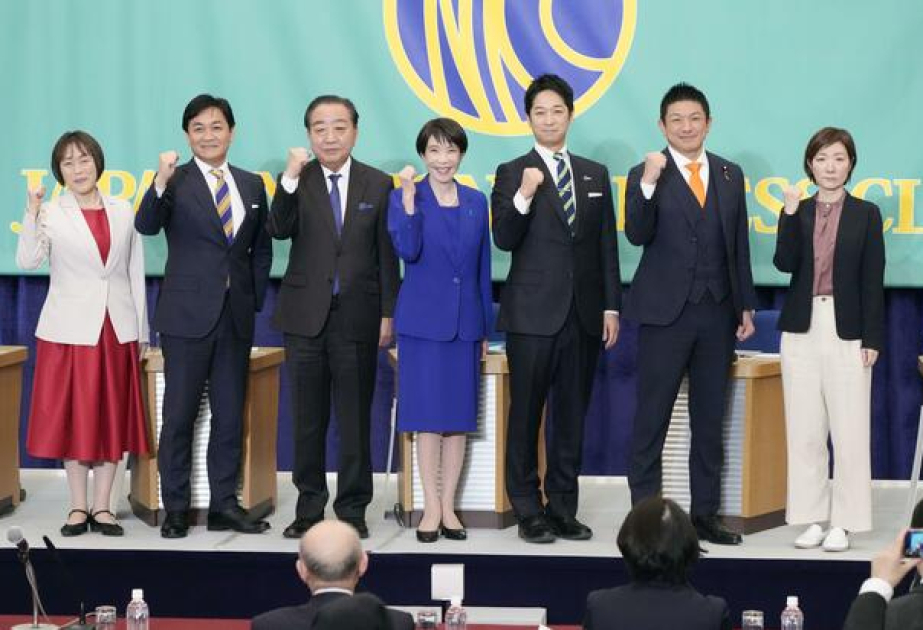
Leaders of the ruling and opposition parties clashed Monday over issues ranging from consumption tax and diplomacy to Prime Minister Sanae Takaichi's decision to dissolve the House of Representatives for a snap general election next month, according to Kyodo News.
At a seven-way debate held the day before the start of official campaigning for the Feb. 8 general election, Takaichi, who heads the Liberal Democratic Party, touched on a key topic of great public interest, saying she hopes to realize a two-year exemption of food products from consumption tax "as soon as possible."
If a nonpartisan national council for integrated taxation and social security reforms reach a conclusion about the changes in the system by summer, "we would be able to submit related bills to an extraordinary parliamentary session" expected in fall, said Takaichi, who took office in October.
She added, though, that such a timeline was not included in her party's campaign pledge, and did not elaborate on what her idea was on funding to make up for the revenue loss when the food tax is suspended, saying those topics should be discussed at the national council.
In an apparent attempt to differentiate itself from the LDP, Yoshihiko Noda, co-leader of the newly formed opposition party, the Centrist Reform Alliance, emphasized that his party will carry out the tax relief plan by utilizing profits from a government-backed fund and without relying on issuing deficit-covering bonds.
Noda, a former prime minister and a former Constitutional Democratic Party of Japan leader, also said that his party aims to implement a zero consumption tax on food "in the fall," calling it "the most effective policy" to curb the impact of rising living costs.
With many ruling and opposition forces pledging to suspend consumption tax on food in their campaign, how to secure alternative funding and when the suspension would be introduced have been in focus amid prolonged price increases and concerns about Japan's fiscal health that are affecting financial markets.
The lower house election, the first under the premiership of Takaichi, who is known for her hawkish security views and dovish fiscal stance, comes after she abruptly dissolved the powerful house at the outset of the ordinary parliamentary session on Friday.
The LDP's coalition with the Japan Innovation Party, formed in October, aims to maintain a majority in the lower house, while the Centrist Reform Alliance, launched by the CDPJ and the Komeito party, the LDP's former coalition partner for 26 years, attempts to challenge the conservative ruling camp.
As for diplomacy, some opposition leaders criticized Takaichi for "saying nothing" to policies under U.S. President Donald Trump's administration, including the country's recent intervention on Venezuela and pressure on Greenland.
Takaichi countered that she has built a close relationship with Trump and Japan has conveyed its views to its close security ally.
She is also positive about holding direct talks with Chinese President Xi Jinping, saying that doing so would help the neighboring country "correctly understand Japan's position."
Tokyo-Beijing ties have worsened following Takaichi's remarks in November suggesting Japan's defense forces could act in the event of a contingency involving Taiwan, which China sees as a renegade province to be reunified with the mainland, by force if necessary.
Some opposition leaders also reiterated their criticism against Takaichi for dissolving the lower house before parliament was to enact an initial budget for fiscal 2026, starting April, designed to support inflation-hit households.
How the post-election framework of the ruling bloc should be structured was also taken up during the debate at the Japan National Press Club in Tokyo.
Takaichi said she will "pursue the possibility" of cooperating with the Democratic Party for the People given that the rising opposition force's policies have a "high affinity" with the "responsible yet aggressive" fiscal stance she has been pushing for.
The DPP, once seen as a potential coalition partner before the current ruling bloc was formed, helped enact an extra budget for the current fiscal year through March. It was also willing to cooperate in passing the fiscal 2026 initial budget that incorporated the party's signature policy to raise the tax-free annual income threshold.
DPP head Yuichiro Tamaki said the trust relationship with the LDP is "wavering" because it is almost certain that the initial budget will not pass by the end of March due to the lower house dissolution.
When asked whether his party would join the LDP-led coalition, Tamaki said he will still think about what would be the best move in achieving the party's policies.
The debate was also joined by JIP co-leader Fumitake Fujita, Tomoko Tamura, leader of the Japanese Communist Party, Sohei Kamiya who heads the Sanseito party and Reiwa Shinsengumi co-leader Akiko Oishi.
Other news in this section


