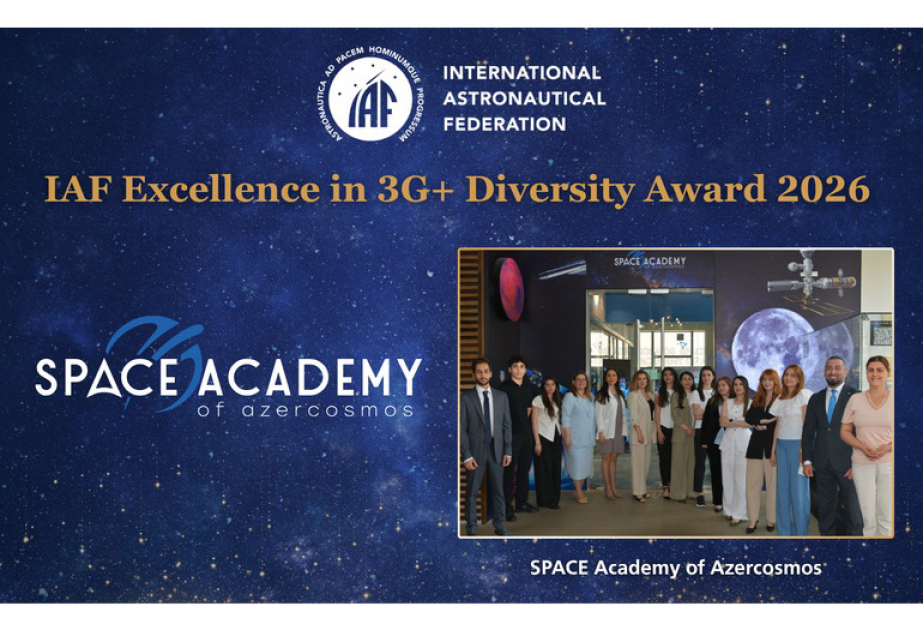
Space Academy of Azercosmos receives IAF Excellence in “3G+” Diversity Award 2026
Baku, August 8, AZERTAC
The International Astronautical Federation (IAF) has announced that the Space Academy, operating under the Space Agency of the Republic of Azerbaijan (Azercosmos), received the IAF Excellence in 3G+ Diversity Award 2026.
SPACE Academy of Azercosmos is Azerbaijan’s national platform for developing the country’s future space workforce through education, scientific excellence, engineering and international cooperation. As one of the world’s fully institutionalized national space academies and a full member of the International Space Education Board (ISEB), the Academy has established a sustainable national ecosystem that connects education with research, innovation and industry while expanding equitable access to space opportunities across the country.
Today, the Academy coordinates Azerbaijan’s largest integrated space education network, bringing together 18 universities, 17 universities participating in the Azerbaijan National Science Team, 12 Regional Education Departments, more than 2,000 schools, over 310 schools in Baku, 33 Youth Houses, 9 youth organizations, 6 innovation centres and 7 government institutions. This ecosystem creates a continuous pathway from school education to scientific research, engineering, entrepreneurship and international engagement.
Since its establishment, SPACE Academy has successfully designed and implemented 26 international education, science and innovation programmes, engaging more than 12,500 students, educators, researchers and young professionals across six continents. Rather than delivering standalone educational activities, the Academy has developed a long-term national model that integrates formal education, non-formal learning, scientific research, engineering practice and international collaboration into a single human capital ecosystem.
Diversity is embedded throughout this model. SPACE Academy has institutionalized the International Astronautical Federation’s 3G+ Diversity Framework - Gender, Geography and Generations across its governance, programme design and educational delivery. The Academy has achieved 51% female participation while ensuring nationwide engagement across urban and rural communities, different age groups and educational levels. Diversity is therefore measured through participation, accessibility and measurable outcomes rather than policy commitments alone.
The Academy has also transformed education into engineering capability. 672 students from 41 schools contributed to Azerbaijan’s first school-built PocketQube satellite, successfully launched into orbit, while the national university engineering programme currently engages 14 universities, 43 multidisciplinary engineering teams and more than 600 students in CubeSat development. These initiatives establish a continuous engineering pathway from school education to advanced satellite systems development.
Scientific excellence represents another measurable outcome of the Academy’s ecosystem. Through the Azerbaijan National Science Team, national participation at the International Astronautical Congress increased from 214 scientific abstracts in 2023 to 345 in 2024, 632 in 2025 and 814 in 2026, with 211 papers accepted following international peer review. According to Azercosmos, these achievements have strengthened the international visibility of Azerbaijani research, increased Scopus-indexed publications, and supported improved research performance within internationally recognized university ranking systems, including QS and Shanghai (ARWU) indicators.
The Academy also contributes to international educational cooperation through large-scale initiatives connecting Azerbaijani students and educators with the global space community, while creating opportunities for scientific exchange, engineering practice and professional development. Its programmes are designed to ensure broad participation, long-term sustainability and equal access to high-quality space education regardless of gender, geography or generation.
Today, SPACE Academy measures its impact through measurable national outcomes: 12,500+ participants engaged, 26 international programmes implemented, 52 universities connected, more than 2,000 schools involved, 814 International Astronautical Congress abstracts generated, 211 internationally accepted scientific papers in 2026, 51% female participation achieved, and a nationwide ecosystem that continues to expand opportunities for future scientists, engineers, educators and innovators.
Through this integrated approach, SPACE Academy has established a sustainable national model that unites educational excellence, scientific achievement, and the IAF 3G+ Diversity Framework to strengthen human capital and cultivate a diverse, inclusive, and globally connected space community. As the Gateway to Central Asia, SPACE Academy serves as a trusted platform for knowledge transfer, innovation, and cross-border collaboration, inspiring future generations while expanding its vision to establish Space Academies across the GCC and Central Asia. Together, these academies will empower local talent, accelerate regional space capabilities, and foster a shared ecosystem where knowledge, opportunity, and innovation flow seamlessly across borders," the Federation noted.
Other news in this section


