Swiss scientists pioneer 3D printing with live organisms
Baku, December 20, AZERTAC
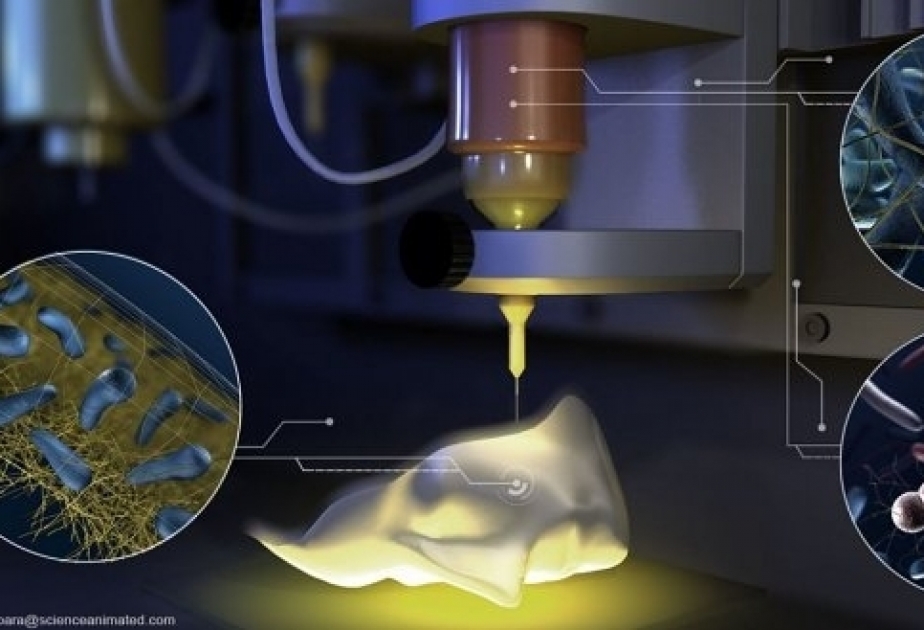
A 3D printing platform incorporates living bacteria into the ink, resulting in structures with a range of useful properties that can be targeted for biomedical, environmental, and sanitation applications, according to Swissinfo.ch.
Research into three- and four-dimensional printing methods has been advancing rapidly in recent years, but materials scientists at the Swiss Federal Institute of Technology ETH Zurich have added a brand new twist - by adding bacteria to their ink. This technique allows them to generate “living materials” with different biochemical properties, depending on the organisms used.
So far, the researchers, led by Andre Studart in ETH Zurich`s Laboratory for Complex Materials, have developed four different inks using different concentrations of Pseudomonas putida and Acetobacter xylinum. Both species are harmless to humans, and indeed have very useful properties: P. putida can break down toxic compounds used in the chemical industry, and A. xylinum secretes a type of bacterial cellulose that relieves pain and retains moisture, making it perfect for medical applications.
"Printing using bacteria-containing hydrogels has enormous potential, as there is such a wide range of useful bacteria out there," said Patrick Ruhs, an ETH Zurich professor of complex materials, in an institute press statementexternal link. “Most people only associate bacteria with diseases, but we actually couldn't survive without them.”
Ruhs is a lead author on a paper presenting this research, which was published last week in the journal Science Advancesexternal link.
Other news in this section


