Presidents of Azerbaijan and Germany made press statements VIDEO






Baku, April 2, AZERTAC
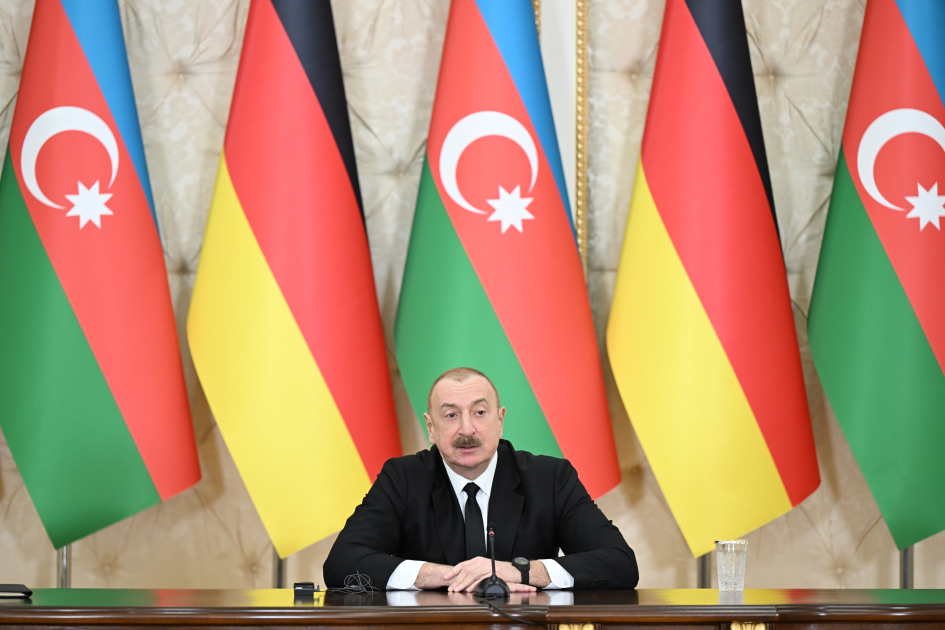
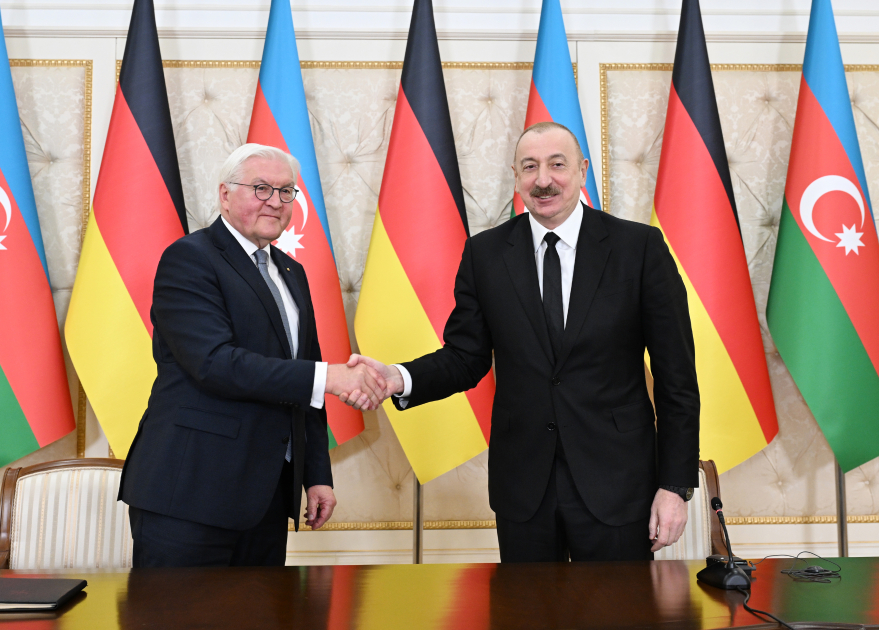
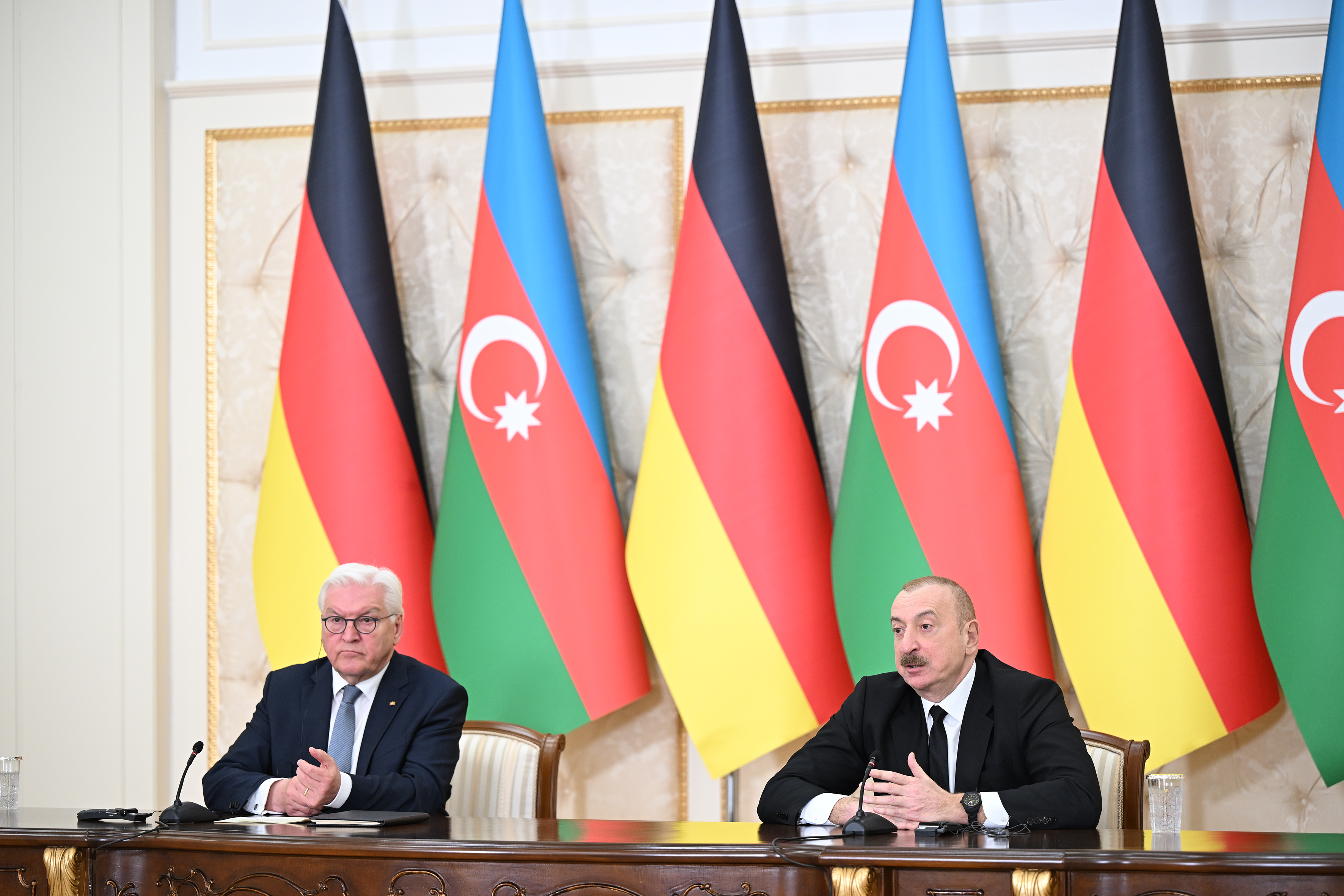
Ilham Aliyev, President of the Republic of Azerbaijan, and Frank-Walter Steinmeier, President of the Federal Republic of Germany, made press statements and responded to journalists’ questions.
The President of Azerbaijan made the statement first.
Statement by President Ilham Aliyev
- Dear Mr. President,
Dear guests, ladies and gentlemen,
Mr. President, first of all, I would like to once again sincerely welcome you to Azerbaijan. I am pleased that there is a regular political dialogue between us. Last April, we met during my visit to Berlin, and I am delighted that you have accepted my invitation to come to Azerbaijan on an official visit.
Both during our one-on-one conversation and during the talks with delegations, the further development of German-Azerbaijani relations was discussed. I am absolutely convinced that this visit will give a positive impetus to our relations. The results achieved in the economic sphere are certainly reassuring for us. In January and February of this year, our trade turnover increased nearly threefold. The primary reason for this has been the increase in the volume of crude oil exported from Azerbaijan to Germany. Therefore, we believe that we should take more active steps in the coming years to diversify our trade, especially in the field of renewable energy, where German companies have extensive experience and Azerbaijan has a very large program and ambitious plans. We intend to increase the production of renewable energy to 6 gigawatts by 2030 through foreign investments, and this goal is quite realistic. Part of this volume will be exported to Europe.
As you may be aware, Azerbaijan hosted the COP29 international climate conference last year. We also had active cooperation with Germany in this direction. More than 77,000 participants representing 197 countries were registered at COP29. The conference was rich in successful results. The only country that did not participate was Armenia. This, of course, is regrettable, especially under the current circumstances. At a time when a process of normalization between Azerbaijan and Armenia is successfully underway, it was incomprehensible for the Armenian side to boycott this international conference. Today, this issue was also discussed, and Azerbaijan's position was communicated to the German side.
Azerbaijan’s lands were subjected to Armenian occupation for 30 years. Our people were subjected to ethnic cleansing. One million Azerbaijanis were left homeless due to Armenian aggression, and approximately twenty percent of our land was occupied. Unfortunately, international organizations did not take any tangible steps on this issue. Azerbaijan resolved this conflict itself and restored international law on the battlefield and at the political level. It was this historic victory that paved the way for peace negotiations. I believe that today, the positions of Azerbaijan and Armenia have come quite close to each other in achieving peace.
At the same time, other international issues were also discussed today, including the US-EU tensions, the tensions between Russia and the West. All these issues are naturally affecting the whole world, and it was quite important for me to have such a sincere exchange of views.
I want to say again that I am confident that this visit will have positive results. This is the first official visit of the President of Germany to Azerbaijan in the history of our bilateral relations. I am confident that the outcomes of the visit will bring our countries even closer together.
Welcome once again!
X X X
Then, the President of Germany made the statement.
Statement by President Frank-Walter Steinmeier
- My dear colleague, Mr. President, on behalf of the entire German delegation, I would like to express my sincere gratitude for this kind invitation and for the hospitality extended to us. We are very pleased. You noted that this is not my first time in Azerbaijan, but this is my first time in this capacity. This is my first visit as President. I have been to Azerbaijan many times before, but the last time I was here in 2016, so nine years have passed. The situation in the world is changing very rapidly now. From a geopolitical point of view, so many changes have occurred in the last nine years that my visit to Azerbaijan in 2016 seems like a long time ago. I am glad that we are meeting again today and have had a very broad exchange of views. In fact, we have always had such exchanges. Perhaps not in Baku, but we have met in other places and talked on the phone. We met at the Munich Security Conference, and I also remember your visit to Berlin perfectly well. We had a discussion at last year’s meeting, and I am glad to be visiting your country today in response to your visit.
Mr. President, we have talked about the history of relations between our countries. First of all, we can recall the settlement of Swabian peasants here in Azerbaijan and the creation of winemaking traditions. They were involved in the development of agriculture. Of course, they also made a significant contribution to industrialization. German organizations, large companies participated in the development of industry, in copper mining, in the construction of an electricity grid. Many Germans have lived in Azerbaijan. I recall this because it is important to know the long history of our relations, the long history of the relations between Germany and Azerbaijan. I am very pleased that there is great interest in the German language and education in Germany in Azerbaijan. Azerbaijani youth are very interested in studying in Germany, and I believe that we should expand our relations precisely in the field of scientific cooperation.
I am very pleased with the exchange we have had. I am glad that we have always been able to speak openly with each other. We have been able to speak openly both on issues where we have common views and those where our positions differ. Both sides have spoken openly and held talks with each other during our extensive conversations. We are currently living in a world where very rapid and dramatic changes are taking place. Mr. President, you have already mentioned the criteria that bring our countries closer together. We also have a common interest in protecting international law and developing the world in a regulated manner. We do not want to leave a disorderly world for future generations.
We have also discussed issues of strategic importance to us. At the same time, we discussed prospects for economic cooperation. You have already mentioned several criteria. In 2022, Azerbaijan played a major role in Germany. When the gas supply we received from Russia had stopped, Azerbaijan took on a great responsibility, and I would like to thank you very much for that. I understood from your words that in addition to gas, there is also a need for expanding infrastructure here. So we need to work on improving the infrastructure in Europe. Because it is not sufficient. In a nutshell, we will have homework after these meetings.
I am very glad that Azerbaijan has developed into an important place. Very important trade routes pass through your country, which, in turn, can serve as a basis for the unification of the world. We have talked about our economic and trade relations. Your country plays a role in Germany's trade relations not only with Central Asia, but also with the Far East, including Southwest Asia and China. We know that the possibilities of the existing roads are limited. The roads passing through your country, as well as the role of the Middle Corridor, are important for the German economy and represent a good prospect. This will be even more interesting. After the events that have taken place in recent years, your South Caucasus region will become a more stable place. Mr. President, I would like to express my opinion on another issue you have touched upon. You spoke about the peace process with neighboring Armenia. This peace process is of great importance. As an outside observer, I can say that we are very impressed. In other words, great steps have been taken over the past year, great progress has been made. I congratulate both sides on the fact that understanding has already been reached. On March 13, a statement was issued saying that the text of the peace agreement had already been agreed. When I spoke about this agreement this morning, I told Mr. President that this agreement had created a moment of hope. Since this agreement has been reached, I do hope that the situation will develop further and, taking advantage of it, you will soon come to the signing of the peace agreement, and finally, real and lasting peace will be established in your region. I have great hopes for this and urge you not to miss this moment. Despite all the difficulties and obstacles, this road has been covered, many steps have been taken, and it is necessary to go all the way. However, of course, compromises require courage and political will, so that a political agreement can really be implemented and come into force. I do hope that everything will be achieved and we will provide our support in every way possible from the outside. Thank you very much.
X X X
Afterwards, the journalists' questions were answered.
Ulrich Steinkohl from the DPA Press Agency in Berlin:
- Mr. Aliyev, your counterpart in Yerevan has stated that the obstacles that have arisen in the implementation of this agreement are ones that can be overcome. He is working on this himself. The difficulty is that your country is putting forward additional demands. Could you please explain how interested you are in signing a peace agreement? How serious is peace for you? And I also have another question for Mr. Federal President. Have you brought any messages from Armenia to Azerbaijan?
President Ilham Aliyev: During our conversation today, I provided Mr. President with sufficient information about the Azerbaijani-Armenian peace process. I stated that after the end of the Second Karabakh War, it was Azerbaijan and me personally who initiated the peace negotiations. At that time, neither Armenia nor the OSCE Minsk Group, which was still functioning at the time, put forward any such proposals. This proposal was made by the Azerbaijani side. This in itself shows how interested we are in signing a peace treaty. Since there was no response from Armenia, we outlined the main principles of a possible treaty as well. I remember that five main principles were put forward and discussions started on the basis of those principles. The main obstacle to the negotiations was the fact that up until January 2024, Armenia was insisting on including the fate of the so-called Nagorno-Karabakh republic in the peace treaty. We were categorically opposed to that. Because there is no such republic as “Nagorno-Karabakh”. It existed only in Armenia’s imagination. There is Karabakh region in Azerbaijan. And since this is our internal matter, we could never agree to the inclusion of such a clause in an interstate treaty.
However, a few months after an end had been put to separatism in Karabakh in September 2023, Armenia did agree to remove the article it had been insisting upon on from the text of the peace treaty. Real negotiations essentially started about a year ago. To date, the wording of the peace agreement consisting of 17 paragraphs has been fully agreed upon. Azerbaijan has not put forward any additional conditions here. Our conditions are clear to Armenia and they are not new. We have been putting forward these conditions for a long time. However, we have not received any serious response from the Armenian side to date. What exactly are they? First, the OSCE Minsk Group must be dissolved. The logic behind this is that the OSCE Minsk Group, which was established in 1992, was mandated to resolve the Karabakh conflict. Azerbaijan has resolved the Karabakh conflict itself – on the basis of the UN Charter and within the framework of international law. Since the conflict has been resolved and Armenia officially recognizes Karabakh as Azerbaijani territory, there are no grounds for the de jure operation of the OSCE Minsk Group. This group was not operating de facto anyway. The fact that Armenia does not agree to this raises a legitimate suspicion in us. I wonder why. Does Armenia perhaps want to put forward territorial claims against us again? Their rapid armament, the acquisition of lethal weapons and the fact that France, their main supporter in this, incites them to new provocations increase these doubts, of course. So this is the first issue.
The second issue is related to the constitution of Armenia. The constitution of Armenia contains a reference to the act of independence of Armenia. It is an integral part of the constitution. There is a provision on the unification of the legal and historical territory of Azerbaijan with Armenia, and this is considered an explicit territorial claim against us. Therefore, the removal of this clause from the constitution of Armenia is our legitimate demand. Once these two conditions are met, there will be no obstacle to signing the peace treaty. As they say, the ball is in Armenia's court. If Armenia is genuinely interested in signing the peace treaty, it has to accept these two legitimate conditions of Azerbaijan.
X X X
President Frank-Walter Steinmeier:
- Ladies and gentlemen,
Anyone who has observed this conflict, its escalation and the suffering it has caused, as well as the wars that have caused so many victims over the past three decades, can understand that it takes a lot of time and effort to resolve such a conflict, as well as restore mutual trust between the parties. I mentioned this earlier and I know that great efforts are required after such conflicts. I also respect these efforts because the wording of the agreement has already been developed. It is a huge task to reach an agreement at this time. I do hope that in addition to that, there will also be agreement on the conditions President Aliyev has just mentioned. In my opinion, they should not become an obstacle to achieving lasting peace between Azerbaijan and Armenia. Let me repeat that there is a very important determination, an important moment has arrived, and it would be irresponsible to miss it. It is necessary to remember that the experience of both Germany and Europe shows that preparation of the agreement and its implementation are the first step. Then, for the agreement to actually come into force, for it to turn into a true reconciliation, it takes several generations. This is a very long process. The implementation of a reliable reconciliation will require a lot of time from both countries and peoples. Therefore, it is impossible to ignore the fact that this reconciliation will take a long time. But the first step is the preparation, signing, ratification, entry into force and implementation of the agreement. Then other problems can be solved. I do hope this will happen soon.
X X X
Vafa Hamzayeva from REAL Television:
- Good afternoon. My question is for Mr. Steinmeier. Mr. President, you mentioned in your speech that you have been following the developments between Armenia and Azerbaijan, the conflict and the point the two countries have reached now. We are sure that you are aware of the processes. Armenia had been waging a war of aggression on the territories of Azerbaijan for nearly 30 years and flagrantly violated the norms of international law. It occupied 20 percent of Azerbaijan's internationally recognized territories. If sanctions had been applied to Armenia at that time, the conflict would have probably been resolved much sooner. Why do you think the West did not take any tangible steps against Armenia? Thank you.
President Frank-Walter Steinmeier:
- First of all, I would like to thank you very much for the question, but you probably did not listen to what I said. I have dealt with conflicts in the South Caucasus in various capacities, and I have been familiar with the relations between Azerbaijan and Armenia for a long time. If you look at the policies of German governments in recent years, you will probably see that there has been a very balanced attitude towards both Armenia and Azerbaijan. In other words, we have tried to show an approach that does not leave sensitive points out of sight, and so far our attitude has been in accordance with international law. As I said, we very much welcome the preparation of a peace treaty. We know and recognize that the Karabakh region is the territory of Azerbaijan. This is our position, and this position can also be specified by Azerbaijan.
X X X
Silvia Stöber, correspondent of the German ARD TV channel:
- Mr. President Aliyev, you have mentioned 17 paragraphs. Which of these 17 paragraphs is the most important for Azerbaijan?
Mr. President Steinmeier, you have used the word reconciliation. This reconciliation was important for the restoration of Germany after World War II. How did that factor, the rapprochement of the peoples of European countries, play a role in this? I would be grateful if you could also talk about this.
President Ilham Aliyev: As a matter of fact, each paragraph and each clause of such historic agreements is of great importance. During my conversation with President Steinmeier, I stated that Azerbaijan does not intend to overload this agreement, which is why it is a very concise agreement covering the main principles. Let me repeat that each issue is of serious importance. Experts, lawyers and representatives of the Ministries of Foreign Affairs of the two countries worked hard on this document, and I do believe that both sides demonstrated good will. Otherwise, this document would not have been created. This is the first. Secondly, there are circles in Armenia and in the West that want to blame Azerbaijan for the agreement not being signed. This is completely unfounded. Because, as I have already mentioned, this process was initiated by Azerbaijan. It was Azerbaijan that developed the main principles, and we have been involved in these negotiations in good faith. If we were not interested in signing the agreement, we could have put forward unrealistic conditions so that Armenia would not accept it.
As for the most important of these principles, of course, this is Armenia's recognition of the territorial integrity of Azerbaijan, including Karabakh. Moreover, it comes from the Armenian government, whose head, back in 2019, declared at a rally in Khankendi, on Azerbaijani territory where he had arrived illegally, that “Karabakh is Armenia, period”. I have said several times that some are now trying to portray Armenia as a “peace dove”. But it is the same Armenian government that, after coming to power in 2018, nullified all the negotiations that had been held up to that point. It stated that Azerbaijan should conduct negotiations with the self-styled and illegal “Nagorno-Karabakh republic”. Not only did they fail to withdraw their groundless territorial claims against us, they actually tightened their demands even more. The minister of defense of this very government of Armenia openly stated that Armenia was preparing for a new war for new territories. In other words, it would be completely wrong and groundless to describe the current Armenian government and those leading it as a “peace dove”. The text agreed upon today shows that Armenia is forced to sign this peace treaty because of the Victory we won on the battlefield and because of the subsequent dominance of Azerbaijan’s position on the political level despite the efforts of some European countries standing behind Armenia. Since neither the UN Security Council nor the European Union took any restrictive measures against Azerbaijan, Armenia is forced to recognize Karabakh as Azerbaijani territory today. So, of course, this is the paragraph – a person who used to say that “Karabakh is Armenia, period” is now saying that “Karabakh is Azerbaijan”. I think this is a wonderful evolutionary process, and we welcome it.
X X X
President Frank-Walter Steinmeier:
- Let me say a few words in response to the question you asked. How should reconciliation be established? How can one initiate it? There is no universally acceptable recipe or standard for this. It is known that, after a war, trust sets in only after some time. Trust does not appear suddenly. It is a gradual or cautious process. This is how mutual trust is gained. In response to your question, I will give an example from Europe: Ullrich Wickard, a German journalist, a colleague of yours, recently published a book on German-French relations. He writes that over the past 400 years, 23 wars have taken place between Germany and France. The last three wars in 1870, 1914 and 1939 were remembered with a lot of victims. These two countries were at enmity with each other. In old history books, France was described as Germany's arch foe. It was not easy to expect the establishment of friendly relations after so many victims. If we look at old history books, it is impossible to imagine this ever happening. Both sides, showing determination and political will, left the past behind and took a step towards a new future. In every region of the world, including the South Caucasus, everyone dreams of a free and peaceful life. However, in order to live in peaceful conditions, certain political work must also be done.
X X X
Orkhan Amashov from Azerbaijan's AnewZ television:
- My question is for President Steinmeier. The trial of the former leaders of the separatist regime created by Armenia in the Karabakh region of Azerbaijan is currently underway in Baku. In their statements, they admit that the bombing of Azerbaijani cities and villages, which resulted in the deaths of more than 100 civilians, was carried out on the direct orders of the current leadership of Armenia, more precisely, Prime Minister Nikol Pashinyan. Regarding those war crimes, why did the European Union and its institutions not impose sanctions against Armenia and its political and military leadership? Thank you.
President Frank-Walter Steinmeier:
- If we look at Germany's foreign policy, we will see that I have been involved in it in recent times. I have been a member of many governments. I can say for our part that we never reconciled ourselves to the absence of peace in this region. We never supported the territorial claims of either side against the other. We believe that internationally recognized borders should be valid, recognized and respected. As for Germany's position, I can say that we have always been loyal to our line, to our position. I do hope that this will be received in your region with understanding as well. We want the non-peaceful period between the two states to be left behind and a new future that will bring stability to be created. For both Armenia and Azerbaijan, the South Caucasus should become a region of peace.
Other news in this section


VIDEO

