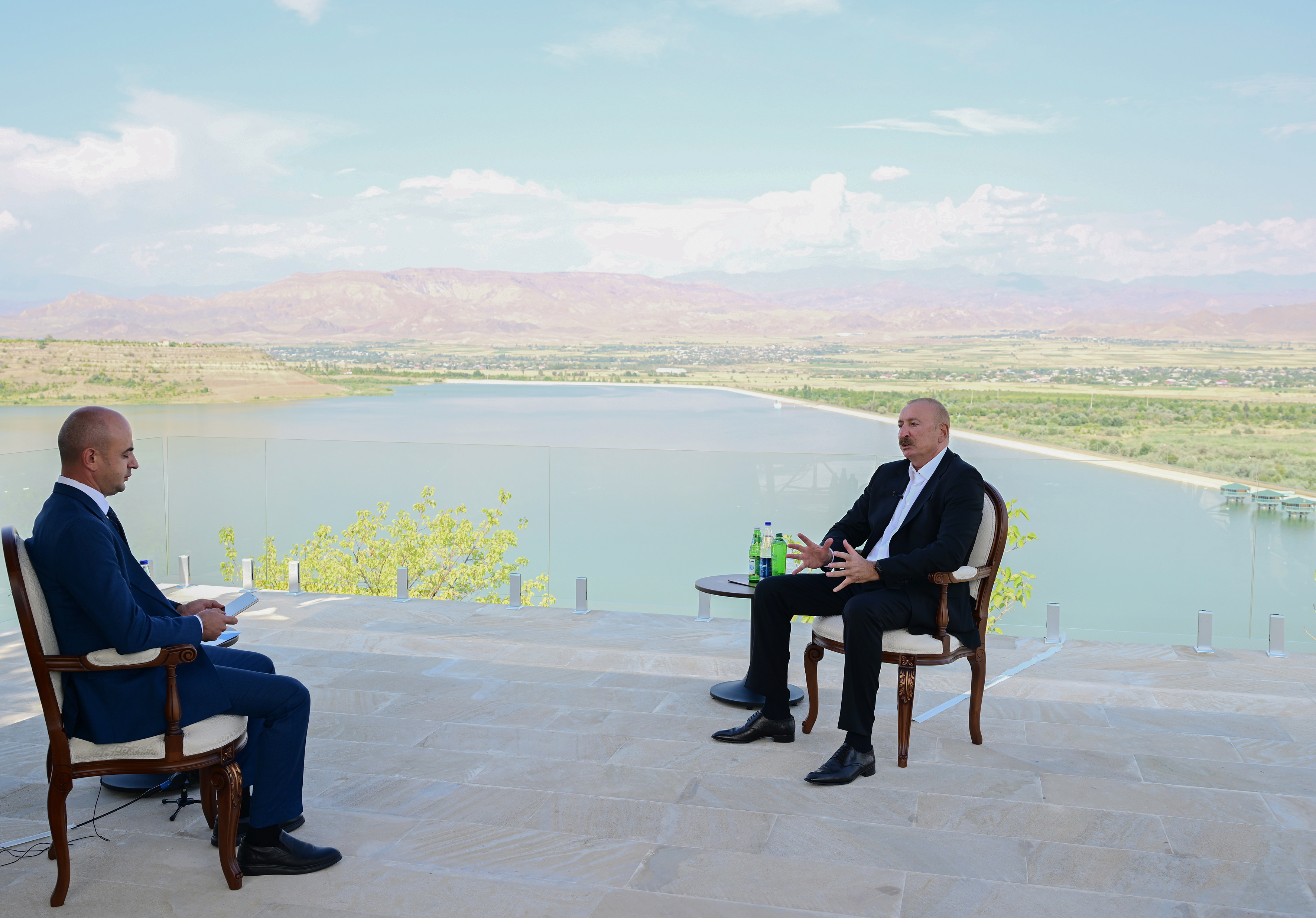
President Ilham Aliyev was interviewed by Azerbaijan Television in Nakhchivan VIDEO


Nakhchivan, August 11, AZERTAC
As part of his visit to the Nakhchivan Autonomous Republic, President of the Republic of Azerbaijan Ilham Aliyev gave an interview to Azerbaijan Television on August 11.
AZERTAC presents the interview.
Journalist: Welcome, Mr. President. First of all, I would like to thank you for taking the time to give this interview despite your busy schedule. With your permission, we would like to proceed with the questions.
President Ilham Aliyev: Please, go ahead.
Journalist: This is your 17th visit to Nakhchivan, and during this visit, we witnessed a number of very important events. Overall, how would you assess the details, outcomes, and results of the visit?
President Ilham Aliyev: In fact, my visit and the events I have attended during it are themselves an indication of this. They once again demonstrate that the Nakhchivan Autonomous Republic is developing comprehensively. As you mentioned, this is my 17th visit to Nakhchivan as President, and each of my visits has been of great significance and produced important results.
Over these years, many important projects have been implemented, ensuring the comprehensive development of Nakhchivan. Today’s events are, in a sense, a continuation of the work accomplished so far, and naturally, the necessary decisions will continue to be made in the future to ensure the rapid socio-economic development of Nakhchivan.
Over these years, strengthening Nakhchivan’s defense capabilities was, of course, one of our foremost priorities. Significant work has also been carried out in this area, and today, at the Battle Flag presentation ceremony, Nakhchivan’s military capabilities were once again demonstrated—both through the provision of modern, particularly state-of-the-art, equipment and through the establishment of new commando units. This is also a trend we have recently observed in the Armed Forces of Azerbaijan.
As you know, the Separate Combined Arms Army was established in Nakhchivan by my Order. This army is, naturally, an integral part of the Armed Forces of Azerbaijan. However, Nakhchivan’s specific circumstances, its geography, and the absence of a land connection with mainland Azerbaijan have led us to pay particular attention to the security of this region, of the Autonomous Republic, and this will always remain the case. This is therefore the primary condition. As I noted today, the Armed Forces of Azerbaijan have a decisive say in the region. In particular, Nakhchivan’s military capabilities are being strengthened day by day and will continue to be strengthened.
As for the other events, I would, of course, particularly highlight the work carried out and planned in the area of job creation. Today, the foundation stone of the Nakhchivan Industrial Park was laid. On my instructions, many industrial parks have been established in Azerbaijan, and in terms of area, the Nakhchivan Industrial Park is second only to the Sumgayit Industrial Park. As I said, its foundation stone has now been laid, and I am confident that practical work at the Industrial Park will begin shortly.
At the same time, as an integral part of this Park, a 300-megawatt thermal power plant will be constructed. I should mention that Nakhchivan’s current generation capacity is approximately 200 megawatts. Thus, the capacity of this single power plant will be one and a half times Nakhchivan’s current generation capacity. Naturally, this plant will serve two purposes: first, to ensure a reliable and sustainable energy supply for the Nakhchivan Autonomous Republic; and second, to facilitate electricity exports.
If there are only a few countries in our region today that do not face problems with electricity supply, Azerbaijan is foremost among them. For one reason or another, an energy crisis is being experienced in our region, and this crisis may deepen due to the ongoing wars in our region, increasing risks, disruptions to transport chains related to the transportation of energy resources, and other factors. It cannot be ruled out that new, unforeseen developments may occur in the future. Therefore, Azerbaijan’s special role in this regard is undeniable. We must ensure that Nakhchivan’s continuous and sustainable energy supply is never disrupted.
For these purposes, at the time, again on my initiative, we signed a gas swap agreement with the Islamic Republic of Iran. Under this agreement, a gas pipeline was constructed from Iran to Azerbaijan, while the transportation of gas from Azerbaijan’s Astara district into Iranian territory was also ensured. In other words, through this swap arrangement, we ensured a 100-percent gas supply to Nakhchivan.
In parallel, we carried out gasification. For approximately 15 years now, perhaps even longer, gasification in Nakhchivan has stood at 100 percent. Overall, the gasification rate across Azerbaijan is 96 percent, which is also a very high figure. However, in Nakhchivan, it has already reached 100 percent. This was also an important step toward ensuring energy security.
Many hydroelectric and solar power plants, as well as a modular power plant, have been constructed here. In other words, energy security is the second most important factor after physical security. As I mentioned today, the foundation stone of the 300-megawatt thermal power plant was laid, and I also inspected the construction of two solar power plants with a combined capacity of 50 megawatts.
Nakhchivan’s solar energy potential is immense. Based on monitoring and detailed analysis, Nakhchivan is the most favorable location in Azerbaijan for solar power generation. Therefore, an area of more than 600 hectares has already been designated, where solar power plants with a total capacity of hundreds of megawatts will be constructed.
It is gratifying that, as a rule, the private sector is taking an active role in the development of renewable energy sources here. The information presented to me today shows that these projects are economically attractive—in other words, profitable—for investors.
Thus, both Azerbaijan’s positive investment climate and state support for the development of renewable energy sources, together with our overall growing potential, including our export capabilities, play an important role here. As I noted, Nakhchivan today has full security of electricity supply.
The 200-megawatt generation capacity I mentioned exceeds Nakhchivan’s current demand. However, we must look to the future. Nakhchivan’s rapid development will continue, including through the implementation of the State Program, which was also adopted by my Order. The export of very large volumes of electricity from Nakhchivan will also be envisaged.
Another important area—which was also reflected in the program of my visit today—is the preservation of Nakhchivan’s historical and cultural monuments. As you know, Nakhchivan has a long and distinguished history and a rich cultural heritage, including a wealth of architectural monuments. Nakhchivan was the capital of the ancient Atabegs state, and many monuments dating from that era and subsequent periods are of world importance.
The restoration works carried out at the Momine Khatun Mausoleum were presented to me today. At the same time, the conservation, protection, and restoration of other historical and cultural sites are also envisaged. A monument was erected in honor of the famous Nakhchivan architect Ajami Nakhchivani, the creator of the Momine Khatun Mausoleum. Located right behind the monument is his immortal creation—the Momine Khatun Mausoleum.
All these issues are of great significance. Because, naturally, socio-economic development and energy security are crucial matters. However, at the core of all the work being accomplished lies our national identity, our national spirit, our culture, our language, our literature, and our history. The Azerbaijani people are a fortunate people. We can truly take pride in our history, our culture, and our outstanding personalities.
At the same time, Nakhchivan has given Azerbaijan many prominent figures. Nakhchivan gave the Azerbaijani people a National Leader of such genius stature as Heydar Aliyev. In other words, the rich history of this region, the courage and dedication of the people living here to their native Motherland, Nakhchivan’s strategic location and potential, as well as the projects implemented and to be implemented here, are today of immense importance not only for Azerbaijan—although first and foremost for Azerbaijan—but also for a much broader geography.
For example, when we speak of transport corridors, we naturally see new transport arteries emerging today, with Nakhchivan serving as an important example. We are creating these. Extensive work has already been carried out, and more will be done to achieve this. Therefore, continuous attention is being paid to these matters and will continue to be paid.
Today, I can also highlight the opening of the DOST Center for social services. Next to it stands the “ASAN Khidmət” Center, which was also established at the time on my instructions to provide better services to the people.
In short, it is enough to look at the components of the program to see that Nakhchivan’s development is a reality. I can also add that Nakhchivan holds a special place and has a special share in the State Program on the Development of Agriculture, which was adopted recently, just a few months ago, and the necessary funds have been allocated. In particular, irrigation projects, which are a crucial factor for agricultural development, are being implemented. Numerous artesian wells will be drilled, and modern irrigation systems will be installed. Water will be supplied to currently unirrigated lands. Thus, the development of the Autonomous Republic will become even faster and more comprehensive.
Journalist: Mr. President, this visit is also taking place amid new realities. The most important of these realities is probably related to the Zangezur Corridor—the corridor you declared, immediately after the war, would definitely be opened, regardless of who wanted it or not. At what stage are the works on the restoration and opening of Nakhchivan’s railway and the Zangezur Corridor now?
President Ilham Aliyev: As you know, the creation of the Zangezur Corridor was our initiative. Connecting the main part of Azerbaijan with Nakhchivan, which is an integral part of it, has been our long-standing dream. We have been taking steps toward this goal, and we have now moved closer to achieving it with confidence and great skill.
Naturally, you remember that following the conclusion of the Second Garabagh War, a trilateral statement was signed by the President of Azerbaijan, the President of Russia, and the Prime Minister of Armenia. In fact, this was an act of capitulation by Armenia, because Armenia surrendered. At that time, the Aghdam, Kalbajar, and Lachin districts, which were still under occupation—we had not yet liberated those territories through military means—were returned to us without a single shot being fired. Naturally, Armenia did not do this voluntarily; we compelled them to do so. If, under wartime conditions, you compel the other side to take such a step, it means that the other side has capitulated.
So, there is no need to look for any humiliating or insulting meaning in this term. This is simply a reality. We must know history as it is, we must not forget it, and we must never allow history to be falsified or any such attempts to be made.
At that time, on November 9, following the liberation of Shusha, trilateral negotiations were taking place through the mediation of the President of Russia. I firmly insisted that the corridor connecting the main part of Azerbaijan with the Nakhchivan Autonomous Republic must be reflected in the statement to be signed. The Armenian side did not want to agree to this. However, they did not have many alternatives.
Had the war continued, we would, of course, have suffered losses, but Armenia would have suffered far greater losses. Their troops were practically encircled, and it was entirely possible to destroy them. Therefore, even though they did not want to, Armenia agreed to it, and that statement is known to everyone—there is a specific clause to this effect in the statement.
However, over the five years that have passed since the Second Garabagh War, no practical steps have been taken toward the opening of the Zangezur Corridor. We repeatedly conveyed to both Russia and Armenia that time was slipping away, that a vital provision of this statement was not being implemented, and that this was an unacceptable situation. We received various responses at different times; I do not wish to elaborate on them too much. The fact remains that Armenia tried to delay the process in every way possible. The Russian side, on the other hand, was either unable to ensure its implementation, or there were other reasons. In short, the fact is that until August of last year, the matter remained in a frozen state.
When the United States of America began to address this issue—as a result of contacts initiated in early spring last year—this process was launched. They naturally sought to contribute to the Armenia–Azerbaijan normalization process and expressed their readiness to do so. Naturally, we had several important conditions, including the Zangezur Corridor.
As a result, this issue found its solution at the historic Washington Summit on August 8, 2025. The implementation of this project, named TRIPP, has already begun. Recently, just three days ago—on August 8—during a conversation with President Trump, this issue was also discussed, and both sides expressed confidence that this important transport project will definitely be implemented swiftly. So, this is the history of the matter.
At the same time, as soon as the Second Garabagh War ended, we immediately began restoring both railways and highways, including the construction of roads leading toward Nakhchivan. Today, the Horadiz–Aghband highway is almost complete. Only a few minor issues remain. The construction of the railway is also progressing rapidly. We can accelerate this project at any time; however, we see no need to do so as long as the Armenian section is not ready, in order to direct investments and resources toward addressing more crucial and urgent matters.
Nevertheless, in any case, the railway will reach the Armenian border next year. As for the construction of the Nakhchivan railway, work is currently underway. On my instructions, the Ministry of Transport is handling this matter. Azerbaijan Railways has commenced construction work in the direction of Ordubad, and the missing sections will be rebuilt.
Two sections were missing, both located close to the Armenian border—one in the Ordubad district and the other in the Sadarak district. The combined length of these two sections is not very long, approximately 3 to 7 kilometers. The remainder of the railway is, in principle, operational and is being used—and can be used—today. However, the throughput capacity of the existing railway is currently 1.5 million tons.
For the initial stage, this is sufficient for the launch of the Zangezur Corridor and this line in general, which serves as a branch of the East–West Corridor. But our goal is to have at least 15 million tons of cargo transit through this transport corridor. For that to happen, the existing railway must be reconstructed and rehabilitated. The information and presentation delivered to me today were very important. My instructions were that no time should be lost; Azerbaijan can and must, using its own funds, bring this railway to a fully operational state with a throughput capacity of 15 million tons.
I should also mention that many international organizations and several countries are expressing interest in this route, particularly in the Nakhchivan section of the railway. One of them is the European Union. Representatives of the European Union were sent to Nakhchivan, where they familiarized themselves with the situation on the ground, and the EU also wishes to participate in this corridor.
In principle, we do not object to this. Our position is that in the territory of mainland Azerbaijan, Azerbaijan Railways is already finalizing the work, and there is no need for any foreign participation in that part. As for the rehabilitation of the Nakhchivan railway, an international consortium could, in principle, be established for this purpose. Naturally, provided that the Azerbaijani state holds the controlling stake, the international consortium could bring together investors, and we are open to this. Even if this does not happen, we will build the railway ourselves. We do not have any financial problems at present. Even if we did, we would always find the necessary funds for this important project. However, we believe that in order to make this route more attractive to international actors and potential shippers, the Nakhchivan railway project could be implemented, as I said, precisely by a consortium consisting of several companies.
We have received messages from several countries on this matter. I do not wish to speak about that just yet. Simply put, in principle, it is possible. However, as I told the Minister of Transport and the head of the Railway Department today, we are certainly open to this, but we do not want to lose any time. During my recent conversation with President Trump, it became clear that the construction of the railway on Armenian territory must begin this year—it is only 42 kilometers of railway there.
In Nakhchivan, however, according to the new feasibility study—because an entirely new feasibility study has been prepared—the length of the railway will be 194 kilometers. Previously, it was shorter. Why is it longer? Because previously the curves were tighter, and if we were to follow that alignment—if we restored it exactly as it was—it would not be able to handle 15 million tons of cargo.
Therefore, the railway will be longer—194 kilometers. We cannot afford to lose time. We also have the necessary funds available for this year and next year. So, my words will presumably reach the relevant parties. If anyone wishes to participate in this project, they should not waste time and should reach an agreement with us as soon as possible. Because certain bureaucratic obstacles and delays are not our way of doing things in Azerbaijan. We define the issues, make decisions, and immediately begin implementation.
As I mentioned, the significance of this route will extend not only to Azerbaijan, but also to a broader geography. As I noted, this will be a branch of the East–West Transport Corridor. At the same time, it will also serve as a branch of the North–South Transport Corridor. Because today, when we talk about the North–South Transport Corridor, we usually mean the Russia–Azerbaijan–Iran route—that is, the border crossing at Astara and the Astara–Rasht project on Iranian territory.
As far as I know, work on that project has either begun or is about to begin. In any case, this project is ready on the Azerbaijani side. However, after the opening of the Zangezur Corridor, a second railway connection between Azerbaijan and Iran will become operational. Upon entering Nakhchivan through the Zangezur Corridor, there is a railway connection to Iran from the Julfa railway hub. So, this project could be realized even sooner. The North–South Transport Corridor extends toward the Persian Gulf. From there, it can extend to regions further afield, for instance, Pakistan. In short, this will be a crucial transport project, and Nakhchivan will stand at its center.
Therefore, from a strategic point of view, in addition to the factors I mentioned earlier, this factor also plays a vital role. Of course, the transit of, say, 15 million tons or perhaps more of cargo through here will generate much greater activity. More jobs will be created, economic activity will increase, and I can say that Nakhchivan will become an indispensable transport hub. This is entirely possible.
We all know very well—we have spoken about this many times—that our country has no direct access to the open seas or oceans. Yet today, when the development of Eurasian transport corridors is discussed, it is impossible to bypass or circumvent us. Nakhchivan will have a similar future, and of course, this will bring us economic and other benefits.
Journalist: Mr. President, you have already touched upon this issue to some extent. A series of measures are being implemented to strengthen Nakhchivan’s energy supply and energy security. We can particularly highlight the commissioning of the Iğdır–Nakhchivan gas pipeline last year, as well as the steps taken to realize Nakhchivan’s green energy potential. Overall, how would you evaluate the current situation and prospects? Can we also expect foreign investments in Nakhchivan in this area?
President Ilham Aliyev: Yes, absolutely, this will happen. We are already receiving such proposals from many sides. Concrete projects have already been launched in mainland Azerbaijan, in the Caspian Sea, and, as you know, in the liberated territories. Some have already been commissioned, while others are currently under implementation. Given the solar potential and particularly its hydropower potential of the Nakhchivan Autonomous Republic, even more extensive work will be carried out here. For instance, one of the issues on the agenda is the project to construct a hydroelectric power plant with a capacity of slightly over 15 megawatts in the village of Tivi in the Ordubad district. We will also allocate funds for continued work on this power plant. Local investors, as I mentioned, are constructing 50-megawatt solar power plants. Foreign investors are also showing interest.
I believe that Nakhchivan’s solar power generation capacity alone could reach at least 500 megawatts—at the very least. It could even reach 1,000 megawatts. The main issue here is the export potential. For this, negotiations must, of course, be conducted with the relevant agencies in the respective countries, and they are underway. At the same time, we need to expand the capacity of the transmission lines. Naturally, there are currently power lines connecting Nakhchivan with both Iran and Türkiye, but their capacity is somewhat limited. That is to say, to export 500 megawatts or even 1,000 megawatts of electricity, there are currently two directions for exports: one to Türkiye and one to Iran. In the future, Europe could also become a destination.
Therefore, supporting the Zangezur Corridor with concrete projects carries a broader significance. Naturally, when we put forward the idea and initiative for the Zangezur Corridor, first and foremost, we had the transport component in mind. But today, we view it in a broader context. For instance, our project to construct power transmission lines from the main part of Azerbaijan to Nakhchivan through the territory of Armenia is ready. A very large substation was constructed in the liberated Jabrayil district. The main function of that substation is power transmission; in other words, it is what is known as a converter substation. It was not built for domestic supply, but to transmit large volumes of energy. It is ready and was constructed specifically for the Zangezur energy corridor.
As a result of the analysis conducted by our specialists in Armenia, the exact locations have even been identified for the installation of power transmission towers. I hope the Armenian side will not delay this matter either. Because, first of all, they themselves may need it. Their primary source of energy today is a nuclear power plant, which is not under their control. That is the first point. Secondly, this plant is outdated and poses a threat to the entire region. Azerbaijan and Türkiye have repeatedly expressed their concerns regarding this issue on various international platforms. The lifespan of that plant cannot be extended indefinitely; it will have to be shut down sooner or later. Naturally, if it is shut down, Armenia will plunge entirely into an energy crisis. Therefore, as they say, having an additional source of energy can only be beneficial.
For example, today our power grid is interconnected with Russia, Iran, Georgia, and with Türkiye through Georgia. Thus, the energy corridor running through Armenia to Nakhchivan, and from there onward to Türkiye and Europe, would also help ensure the stability of Armenia’s energy system in the event of a crisis. Therefore, the sooner we implement this, the better. Naturally, as you know very well, over the past five years we have erected transmission towers amid the snow in the Kalbajar mountains at altitudes of 3,500 meters. In other words, if we undertake this project, it would take no more than six months.
However, Armenia must, of course, do this itself. Therefore, I believe this issue should be clarified shortly. This will be an integral part of the Zangezur Corridor, of TRIPP. Because this project is not merely a railway or highway. Fiber-optic cables, power lines, and in the future, if needed, oil and gas pipelines can also pass through here.
Because the more alternatives there are, the better it is for everyone. Therefore, in answering the question about Nakhchivan's energy security, I also wish to return to my earlier words that a fully sustainable and secure energy system is being created here—in fact, it has already been created, but we are improving it further. We must, of course, expand our export capabilities, including through the territory of Nakhchivan.
I repeat, in our region, there is no other country that is as comprehensively supplied with energy as Azerbaijan, whether in terms of oil and gas or electricity. By expanding our export capabilities to neighboring countries, we will at the same time gain access to the European market. Because we have already reached Europe with our oil and gas, but we also wish to reach the European market with electricity.
Today, the only existing route is through Georgia and Türkiye, and from there onward to Europe. We must expand these capabilities. In particular, the feasibility study for the Black Sea energy cable project is ready. However, having a second transmission line will only strengthen our capacity. Moreover, as you likely recall, in November 2024, during COP29, the Presidents of Kazakhstan and Uzbekistan and I agreed to lay an underwater electricity cable across the Caspian Sea and signed an agreement. That is to say, we must be prepared for that as well.
Azerbaijan will establish itself as a country that generates, receives, transmits, and exports electricity. In short, these are our strategic vision and plans. I repeat, these plans serve the interests of all the countries in our vicinity. Simply put, coordination here must be carried out at the proper and necessary level, and negotiations must be accelerated. I can say that negotiations in this regard are currently being conducted with both Türkiye and Iran. It is still too early to say anything definitive. As for Armenia, I would like to reiterate that the sooner the energy corridor is established in Armenia, the better it will be for TRIPP and the entire region.
Journalist: Mr. President, you touched upon the work that has been done and the work that remains to be done in various areas. Overall, we would like to know what the approach, strategic vision, and plans are for the development of Nakhchivan—an answer that is undoubtedly awaited with great interest in Nakhchivan as well.
President Ilham Aliyev: As I noted, the primary issues were security matters, and these have been resolved. Then there was energy security, and for the Nakhchivan Autonomous Republic, this issue has also been resolved. Now, the focus is on Nakhchivan becoming an energy exporter.
Measures are also being taken to address unemployment. In particular, as I mentioned, the creation of the Nakhchivan Industrial Park will give a major impetus to this effort. The creation of modern industrial complexes in Nakhchivan is envisaged. The creation and restoration of social infrastructure are also planned. According to the information provided to me, there is a need to construct and repair kindergartens, and we will undertake this work.
The transport problems of Nakhchivan city have been resolved. Today, new electric buses were presented, and they will likely be put into service as of tomorrow. We frequently see these green buses on the streets of Baku. The old buses have been completely decommissioned. We will see them even more, as their share relative to diesel buses continues to increase. For Nakhchivan city, this issue has been resolved.
I know there is still a problem with intercity and interdistrict transport. Instructions have been given to procure 217 modern interdistrict buses to be put into service on the routes this year and next year.
Substantial funds were also invested in the road infrastructure of the Nakhchivan Autonomous Republic in previous years. You also saw the condition of the roads; they are in good condition. However, there are village roads and roads that are still in poor condition, and the necessary assessments have been carried out: the construction and major rehabilitation of roads in various categories with a total length of approximately 420 kilometers are planned. The population of these 26 communities is approximately 160,000 people. This issue will be resolved.
The construction of a hydropower plant in the Ordubad district is planned. As you know, the State Program for the comprehensive development of Nakhchivan was adopted recently, followed by the preparation of an action plan for irrigation. I dispatched a large delegation here; all issues were thoroughly analyzed, and work commenced.
In the State Program for the Development of Agriculture adopted in May this year, it contains a dedicated section on Nakhchivan, and the relevant instructions have been given. In addition, I will sign a new Order tomorrow on additional measures. This will be an Order with substantial financial resources, specifying concrete projects. Naturally, the necessary oversight will also be ensured to ensure that work here progresses even faster.
Overall, I have already said this, and we have structured our approach so that Nakhchivan, along with the liberated territories—East Zangezur and Garabagh—are developed according to a unified concept. For instance, Master Plans for cities across all the liberated territories have been approved. I instructed that a Master Plan for Nakhchivan city also be developed—it was presented to me today—and that additional measures be taken to ensure the city's development and the creation of modern infrastructure.
Nakhchivan's tourism potential is immense, with its historical monuments, beautiful nature, clean air, and picturesque landscapes. Unfortunately, however, the shortage of hotels, as well as the limited number of high-standard hotels, hinders the development of tourism. Today, the foundation stone of a new five-star hotel was laid in the city centre, which is expected to be completed around 2028.
In short, everything required from the state for the development of the Nakhchivan Autonomous Republic has been done to date and will continue to be done in the future. Over the past 20 years, all construction projects in Nakhchivan have been financed from the state budget. Every year, hundreds of millions of manats are allocated from the Azerbaijani state budget to the state budget of the Nakhchivan Autonomous Republic. Without this, naturally, we would not be able to see the developing and prosperous Nakhchivan we see today.
However, we always wish for things to be better, we want things to be better. Given that Garabagh and East Zangezur are being built virtually from scratch, and the distance between Zangilan district and Ordubad district is only 42 kilometers, this is, in fact, a single geographical space, as it has been historically. Zangezur, Nakhchivan, and Garabagh formed a single space, and people moved across this space for centuries. Therefore, there are many relatives across this vast geography. Consequently, we envision this as a unified, exemplary region of development.
Garabagh and East Zangezur have been declared green energy zones, and Nakhchivan is also a green energy zone. Most of the energy generated here today comes from renewable sources. We have already established two 250-megawatt battery energy storage systems. I issued instructions to install a battery energy storage system of at least 100 megawatts in Nakhchivan as well during the first stage. Because renewable energy is also generated here, through solar and hydropower plants. Therefore, to store this energy, we must make use of these modern technologies.
All this work is already progressing in a systematic manner. If we look at the geographical location of our country, we will see that there is a specific development plan for every region. Every single one of our economic regions is developing successfully, and this ensures the country’s overall development.
Therefore, the plans are ambitious, and I have no doubt about the implementation of these plans. Because there is strong political will, we also have the necessary financial resources, and we are not dependent on anyone. By establishing a governance system in Nakhchivan similar to those in Garabagh and East Zangezur, we are effectively bringing these three regions into a more unified administrative framework as well. Naturally, while preserving the status of the Nakhchivan Autonomous Republic as an autonomous republic, governance arrangements must be improved.
We have seen the advantages of the new governance system in Garabagh and East Zangezur. I am confident that the more than 90,000 people already living there can also see this. The same governance system—the Special Representation of the President—was applied in Nakhchivan as well. Thus, alongside personnel reforms, these structural reforms are, naturally, aimed at the main objective: to ensure that this region, this ancient land, develops continuously, and that people live here in comfort, security, and prosperity.
Journalist: Thank you very much for taking the time.
President Ilham Aliyev: Thank you.
Other news in this section


VIDEO