Archaeologists discover monumental building in Bulgarian medieval town of Rusokastro
Baku, October 29, AZERTAC
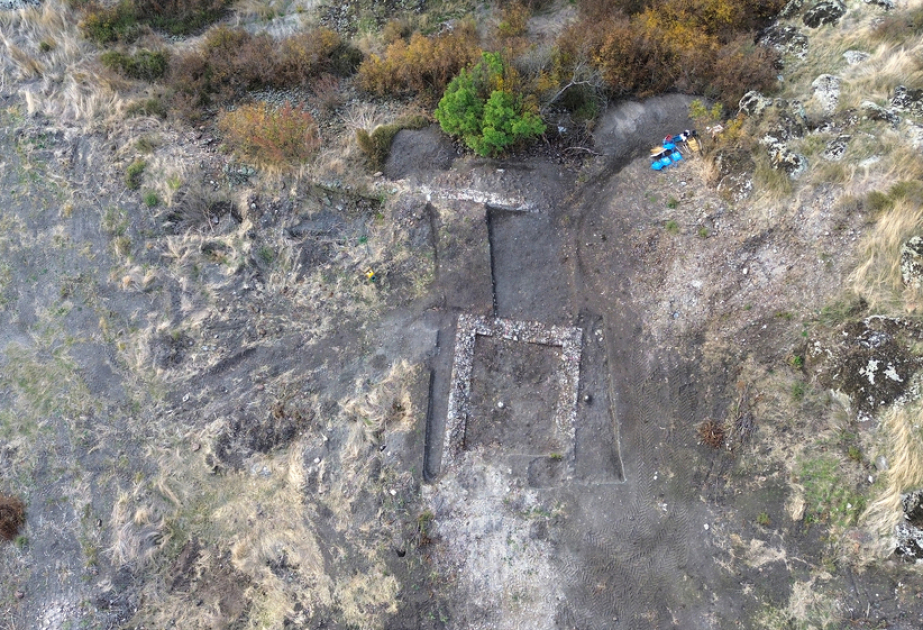
A monumental building measuring 7.60 metres in width and with undetermined length has been discovered at the medieval town of Rusokastro at the very end of this year’s archaeological excavations, the Bulgarian News Agency (BTA) reported citing the Regional History Museum in Burgas.
The building is located near the inner southern fortress wall. Its walls are 1.1 metres thick and are constructed of stone bonded with abundant mortar. The interior surfaces of the walls are covered with a thick layer of pink hydrophobic (waterproof) mortar. This suggests that the building was used either as a water reservoir or as a storage facility for food supplies.
Archeologists believe this was the ground floor of a building situated in the central quarter of the city, and a second, residential floor existed above it.
A vast number of archaeological artefacts have been uncovered, including silver coins issued during the reign of the Bulgarian Tsar Ivan Alexander, Venetian silver grosso coins known as matapans, copper coins, and many other objects. These finds are already undergoing cleaning and conservation at the restoration laboratory of the Burgas Museum.
The archaeological excavations of the medieval town of Rusokastro are funded by the Council of Ministers of the Republic of Bulgaria and Kameno Municipality. The excavations are carried out by the Regional History Museum of Burgas.
For the first time the name Rusokastro was used by the Arab geographer El Idrisi in his work “Geography of the world”. He described the settlement of Rusokastro as a large and crowded town. With this name the town was included in the descriptions of Byzantine chroniclers, mostly related to historical events in the 14th century.
On July 18, 1332 Rusokastro became scene of a spectacular battle ended with the victory of the Bulgarian Tsar Ivan Alexander over the Byzantine army led by Emperor Andronicus.
The castle/fortress was destroyed during the Ottoman campaigns in 1443 and is one of the largest forts in South Bulgaria, which guarded the Bulgarian border ridge Erkesiya during 10th-11th century.
Rusokastro is included in the list of priority archaeological sites receiving state funding to support the development of cultural tourism in Bulgaria.
Other news in this section


