Article by AMADA officials on artificial intelligence published in prestigious journal

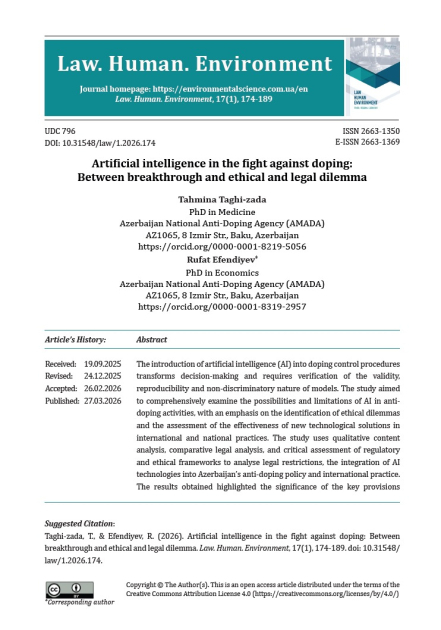

Baku, April 9, AZERTAC
A scientific article dedicated to artificial intelligence in the field of anti-doping has been published in the Law. Human. Environment journal, which is included in the international indexing system Scopus.
According to information provided to AZERTAC by the Azerbaijan National Anti-Doping Agency (AMADA), the article titled “Artificial Intelligence in the Fight Against Doping: Between Breakthrough and Ethical and Legal Dilemma” was co-authored by AMADA Executive Director Tahmina Taghi-zada and Deputy Executive Director Rufat Efendiyev.
The new peer-reviewed scientific article emphasizes the need for technological progress in anti-doping to be accompanied by strong mechanisms that ensure transparency, protect athletes’ rights, and guarantee procedural justice.
The article examines the growing role of artificial intelligence in anti-doping systems and highlights its potential to improve the detection of anomalies, strengthen risk-based monitoring, support more targeted testing, and advance the analysis of biological and performance-related data.
The main thesis of the article is that if artificial intelligence is to play a legitimate role in anti-doping, its application must be firmly based on the principles of transparency, accountability, explainability, non-discrimination, data protection, and procedural justice.
The legal and regulatory dimensions of this issue are analyzed in the context of the “Artificial Intelligence Strategy of the Republic of Azerbaijan for 2025–2028,” approved by Presidential Decree No. 530 dated March 19, 2025, the World Anti-Doping Code and related International Standards, as well as the Council of Europe’s Framework Convention on Artificial Intelligence and Human Rights, Democracy and the Rule of Law (CETS No. 225), adopted in 2024.
According to the authors, one of the main governance challenges in the coming years will be ensuring that increasingly powerful analytical tools do not outpace the necessary safeguards for protecting athletes’ rights.
The article also outlines several priority directions for the responsible use of artificial intelligence in anti-doping. These include human-centered and hybrid decision-making models, multilateral governance and ethical audits, as well as stronger guarantees for standardization and data integrity. All of these are intended to strengthen, rather than weaken, the legitimacy of innovation.
At the same time, the authors emphasize that a number of significant risks remain unresolved. These include algorithmic bias, limited explainability, the lack of sufficient mechanisms to challenge AI-supported decisions, concerns regarding the privacy of sensitive athlete data, and the deepening of inequalities in access to advanced technologies.
Sharing her views on the article, Tahmina Taghi-zada stated that artificial intelligence creates important new opportunities for strengthening anti-doping activities, particularly in terms of enhancing analytical capabilities, improving risk assessment, and providing more evidence-based monitoring. “However, its legitimacy will depend on whether it is fully based on ethical principles, legal guarantees, and full respect for athletes’ rights.”
Rufat Efendiyev noted that it is becoming increasingly clear that artificial intelligence will be an integral part of the future development of the anti-doping system: “As the global anti-doping system pays greater strategic attention to data and artificial intelligence, it becomes even more important to ensure that this transition is managed responsibly. Otherwise, the system’s capabilities may develop faster than the trust and legitimacy necessary to support it.”
Other news in this section


