Bulgaria has fourth-highest Q1 GDP growth in EU
Baku, June 5, AZERTAC
Bulgaria’s GDP grew by 3.1% year-on-year in Q1, the fourth-highest rate among EU countries with available data, final seasonally adjusted Eurostat figures showed on Friday, the Bulgarian News Agency (BTA) reported.
Bulgaria’s economy grew 2.9% year-on-year in the fourth quarter of 2025, slowing from 3.1% in the third quarter.
Earlier on Friday, the National Statistical Institute released estimates for Bulgaria’s economy in line with Eurostat data.
The strongest year-on-year growth was recorded in Denmark, at 5.9%, followed by Malta at 4.3% and Poland at 3.5%. Bulgaria and Slovenia followed, both at 3.1%. Year-on-year declines were reported only in Ireland, at 16.8%, and Romania, at 1.1%.
On a quarterly basis, Bulgaria’s GDP grew 0.7% in the first quarter of 2026 from October to December 2025, placing the country sixth among EU member states, alongside Slovenia. Denmark led with 1.9%, followed by Estonia and Malta at 1.1% each, Finland at 0.9% and Hungary at 0.8%.
In the fourth quarter of 2025, Bulgaria’s GDP rose 0.8% from the previous three months.
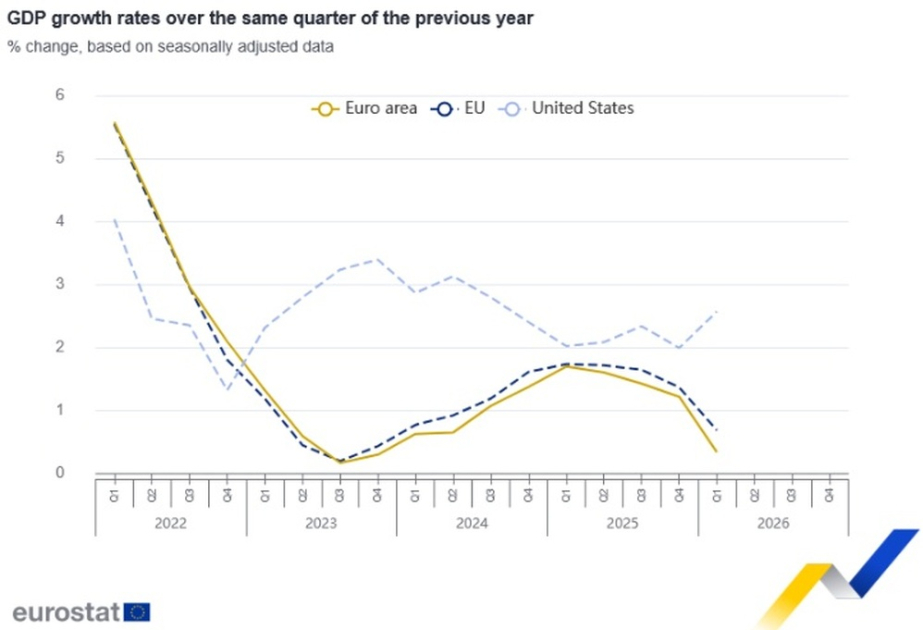
The euro area economy contracted in the first quarter of 2026 after a sharp downturn in Ireland prompted a substantial revision to preliminary growth figures. Eurostat data showed euro area GDP fell 0.2% in January to March from the previous quarter. The earlier estimate had pointed to growth of 0.1%.
The revision was driven mainly by Ireland, where GDP slumped 12.1% in the first quarter instead of the initially reported 2%. Data from Ireland’s Central Statistics Office showed the decline was largely due to a sharp contraction in the multinational sector, particularly pharmaceuticals. The large presence of multinationals in Ireland often skews euro area statistics, but the scale of the latest drop has further complicated assessments of the region’s underlying economic health, Bloomberg reported.
Earlier this week, the Organisation for Economic Co-operation and Development cut its 2026 euro area growth forecast to 0.8% and warned that recent indicators point to deteriorating economic sentiment.
In recent days, beyond the Irish data, figures for other major euro area economies have also been revised. France’s GDP was revised down, while Italy’s came in stronger than preliminary estimates.
Other news in this section


