Frontex and European Space Agency sign joint letter on Earth observation
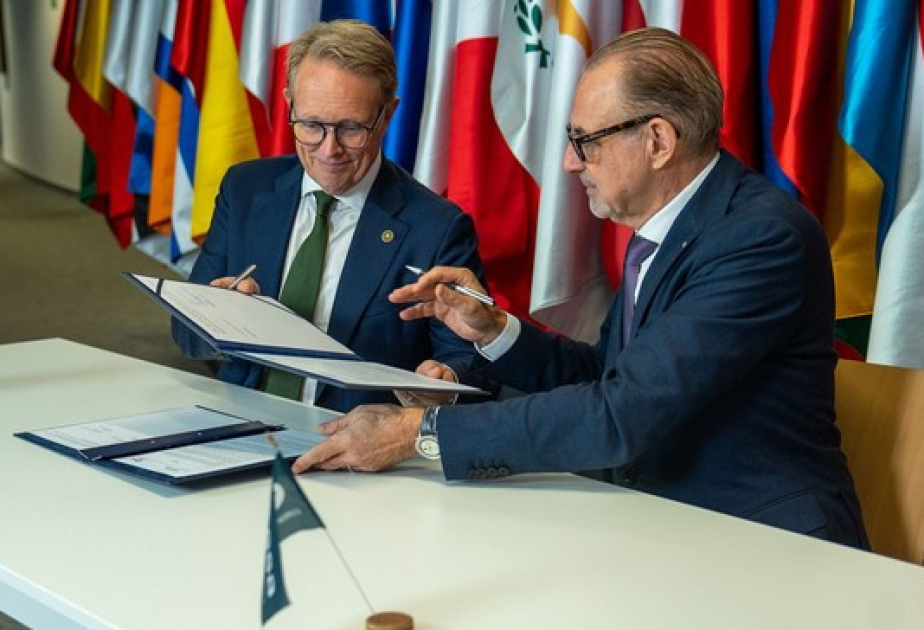
Baku, October 13, AZERTAC
Hans Leijtens, Executive Director of the European Border and Coast Guard Agency (Frontex), and Josef Aschbacher, Director General of the European Space Agency (ESA), signed a joint letter in Warsaw today, confirming how closely the two agencies already work on Earth observation and asking their teams to explore the scope for closer cooperation, according to Frontex.
The letter records that the agencies’ technical teams now work together in a focused and effective way, ESA’s technical expertise complementing Frontex’s operational experience, on work that ranges from satellite support for border surveillance to Europe’s wider security and resilience. On the strength of that record, the two agency heads propose that their services continue the technical dialogue and explore what closer cooperation could look like.
The relationship goes back to 2015, when ESA began providing access to satellite data, on behalf of the European Commission, for the border surveillance service Frontex operates. The service is part of Copernicus, the European Union’s Earth observation programme. More recently, under their respective contribution agreements with the Commission’s Directorate-General for Defence Industry and Space (DG DEFIS), the two agencies have supported the evolution of Copernicus by testing new solutions from emerging EU space companies against the needs of the European Border and Coast Guard.
The letter also underlines the strategic importance of ESA’s planned centre in Warsaw, which will focus on security and resilience and whose presence in the EU Member State hosting Frontex opens the way to more frequent technical exchanges. The two teams have identified promising areas for further work within the European Resilience from Space initiative, in close coordination with DG DEFIS, which leads the Commission’s work on the emerging Earth Observation for Governmental Services (EOGS). These discussions remain exploratory and within each agency’s mandate.
The visit followed Digital Twin Frontiers, the event Frontex hosted in September on digital twin technology for border management, to which Aschbacher contributed a video message. The programme concluded with a visit to the Frontex Operations Centre, which monitors the situation at the EU’s external borders around the clock and where Copernicus imagery is one of the sources feeding the picture shared with Member States.
Frontex, the European Border and Coast Guard Agency, has been entrusted with the border surveillance component of the Copernicus Security Service since 2015 and delivers satellite-based products to national border authorities through its EUROSUR Fusion Services.
Other news in this section


