Guivami Rahimli: A Swedish storyteller in love with Azerbaijan
Baku, December 8, AZERTAC
The Swedish photographer and filmmaker Mikael Silkeberg is precisely such a person who made an invaluable contribution to conveying an accurate information about Karabakh conflict to the international audience being the true voice of Azerbaijan.
Guivami Rahimli, PhD, Professor at Baku State University, who also served as president of the Azerbaijan-Norway Friendship Society, shared with AZERTAC his reflections in promoting Azerbaijan’s cultural heritage to international audiences.
Mikael Silkeberg’s most recent visit to Baku once again showed how deeply he feels attached to our land, our music and our cultural heritage.
Mikael’s programme started on 3 December with a meeting with Saadat Yusifova, Deputy Minister of Culture of the Republic of Azerbaijan.
In a conversation, held in a warm and open atmosphere, Mikael spoke about his long journey with Azerbaijan: from his first steps in Shusha in 2021 to filming in Nakhchivan and Baku, and now to taking part in conferences on Western Azerbaijan.
The Deputy Minister, in turn, welcomed the fact that a filmmaker from Sweden is devoting so much of his creative energy to telling the world about Azerbaijan.
They also discussed future cooperation between our cultural institutions and Nordic partners, and new projects focusing on intangible heritage.
The next day, 4 December, Baku saw Mikael in his most natural element: in front of the camera, but this time as a guest, not as a director.
He was hosted by Dilek Tuna in the studios of ANewZ TV. In a wide-ranging interview, he focused more closely on his films, his visual style and his experience of working in Karabakh and Nakhchivan. For our media landscape, it is significant that a foreign filmmaker can speak about Azerbaijan not through clichés, but through carefully researched stories and personal encounters.
The highlight of the evening on 4 December was the screening of Mikael’s latest film, “A Story About Folkjazz From West to East”, organised by the Ministry of Culture at the Nizami Cinema Center.
The story of folk jazz from West to East is a narrative of continuous cultural exchange, beginning with jazz's own origins as a fusion, and evolving into a global phenomenon where musicians worldwide weave their local folk traditions into the improvisational spirit of jazz.
This documentary explores an unexpected yet deeply musical dialogue: between Swedish pianist Jan Johansson, whose legendary album “Jazz på svenska” fused Swedish folk tunes with jazz in the 1960s, and Azerbaijani genius Vagif Mustafazadeh, who around the same time was creating his revolutionary jazz-mugham, blending our mugham tradition with modern jazz harmonies. The film also featured interviews with the children of great jazzmen who have continued their fathers’ paths — Anders and Jens Johansson, as well as Aziza Mustafazade.
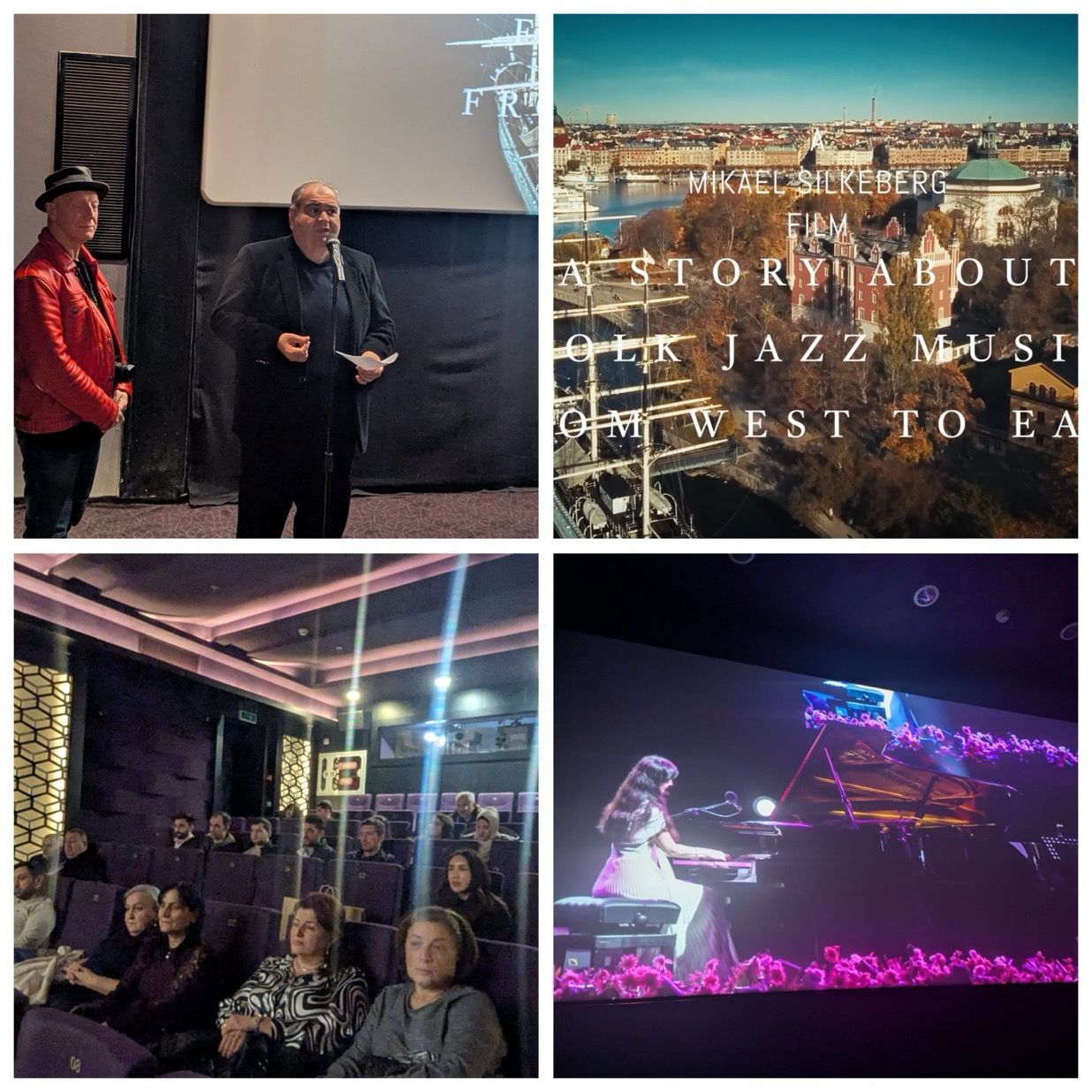
This evening confirmed once again that jazz-mugham is not only part of our national identity, but also a key element of Azerbaijan’s cultural dialogue with the world.
If the Nizami screening showed the musical side of Mikael’s work, 5 December revealed its historical dimension.
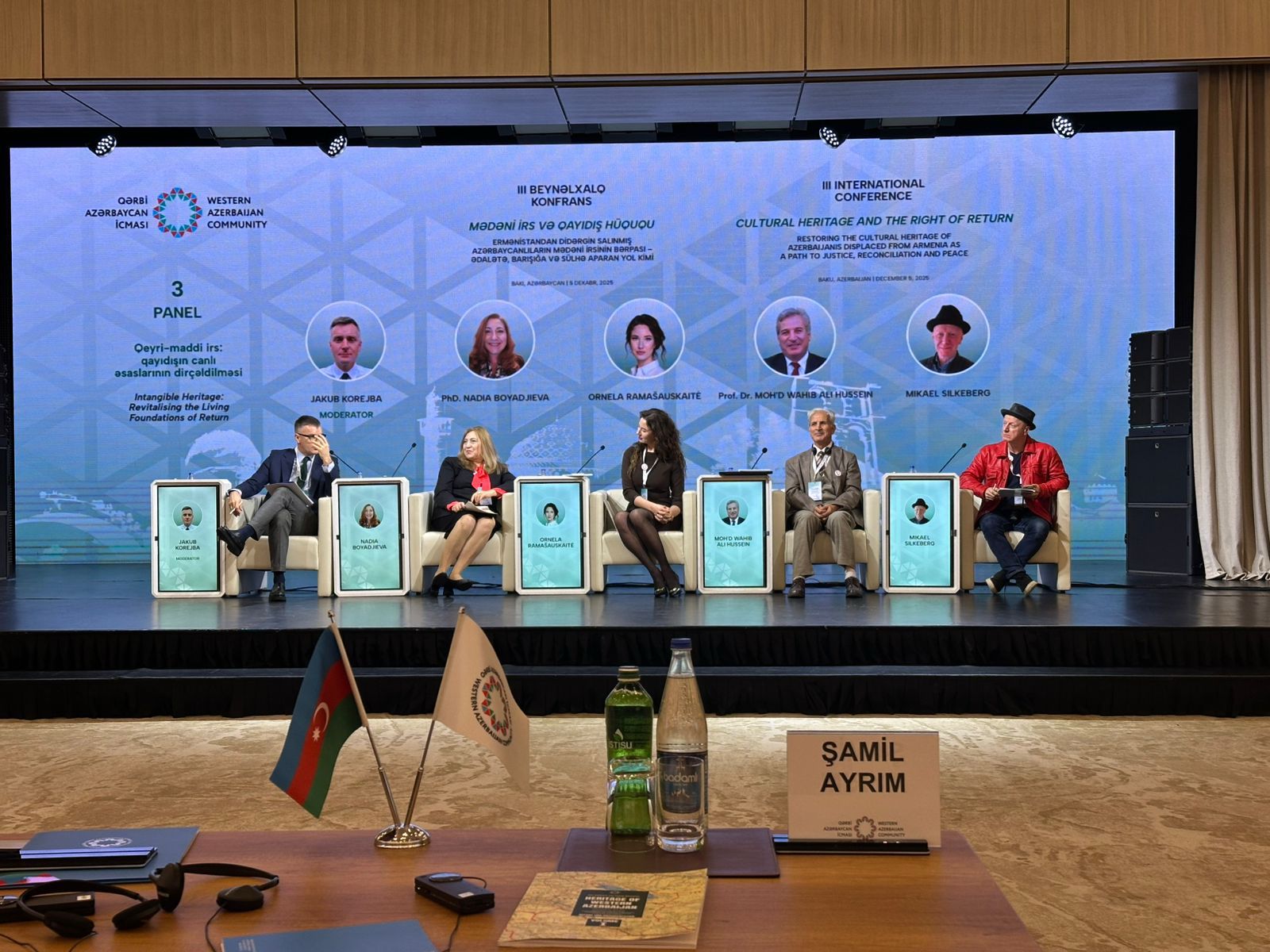
Throughout the day he participated in the III International Conference on “Cultural Heritage and the Right of Return: Restoring the Cultural Heritage of Azerbaijanis Displaced from Armenia as a Path to Justice, Reconciliation and Peace”, organised in Baku by the Western Azerbaijan Community.
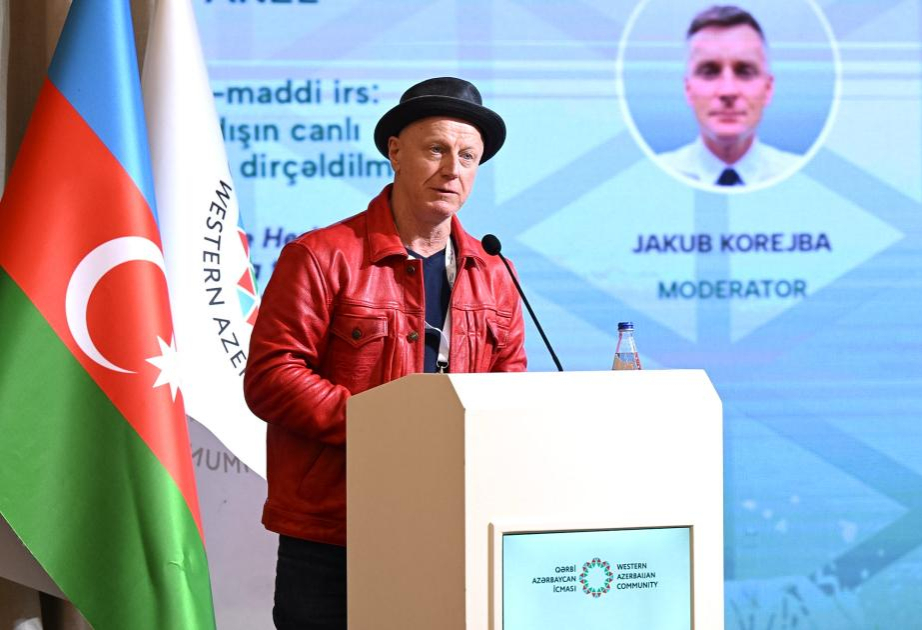
Mikael spoke in Panel III – “Intangible Heritage: Revitalising the Living Foundations of Return”. Addressing an audience of scholars, community representatives and international experts, he began by underlining that he was probably the only participant from the Nordic region – and that he stood there “as a Swede, but also as a friend of Azerbaijan”.
In his speech, he recalled his earlier visits to our liberated territories. He described his first journey to Shusha in November 2021, when the city still bore the deep scars of war. Amidst the ruins, near the statue of Uzeyir Hajibeyli, he noticed a small purple crocus. Later he learned about the Khari Bulbul – the flower that has become a symbol of Karabakh’s resilience and Azerbaijan’s victory. This simple, fragile flower inspired him to make his first film about Azerbaijan.
“The Legend of Khari Bulbul” – a documentary about Shusha as the cradle of Azerbaijani music, its close links with literature and mugham, and its spiritual strength in the face of destruction. The film presents Shusha not only as a national treasure, but as a part of the world’s cultural heritage.
Then followed other films that Mikael produced to show Azerbaijan's cultural and historical richness to the world.
“The Odin Code” – a bold exploration of historical and mythological connections between Scandinavia and Azerbaijan. Inspired by the famous Norwegian ethnographer Thor Heyerdahl, Mikael follows possible links between the petroglyphs of Gobustan, Scandinavian rock carvings and Viking rune stones commemorating the Ingvar expedition towards the Caspian Sea.
“Footsteps of Noah” – filmed in Nakhchivan and dedicated to the 100th anniversary of the Nakhchivan Autonomous Republic of Azerbaijan. The documentary, presented in Stockholm, Baku and Nakhchivan, portrays this land as one of the cradles of human civilisation, where different layers of history, religion and culture meet.
At the conference Mikael linked his films to the right of protection of cultural heritage. But for him as an artist, it is also about something very human: the right of people to tell their own story on their ancestral land.
He did not hide his sadness at the large-scale destruction and appropriation of Azerbaijani cultural monuments in today’s Armenia – mosques, cemeteries, neighbourhoods and place names.
“Monuments can be rebuilt,” he remarked, “but trust must also be rebuilt. Both processes are necessary if peace in the South Caucasus is to be just and lasting.”
Mikael also spoke about the documentary “İZ” on Western Azerbaijan, which he helped screen in Stockholm. The film, combining historical research with personal testimonies, moved him deeply and strengthened his desire to document not only landscapes and buildings, but also the memories of those who were forced to leave their homes.
He concluded by expressing the hope that one day he would be able to film not only ruined villages, but living streets, reopened mosques and schools, and families who have finally returned to their native land.
For me, as someone who has devoted much of my life to preserving and promoting Azerbaijan’s cultural heritage, it is deeply encouraging to see how profoundly a Swedish filmmaker understands our history and our pain, our music and our dreams. He looks at Azerbaijan not as a distant “exotic” country, but as a partner in a long and fascinating conversation between East and West.
Other news in this section


