Mayon logs largest pyroclastic flow so far, Alert Level 3 stays
Baku, February 10, AZERTAC
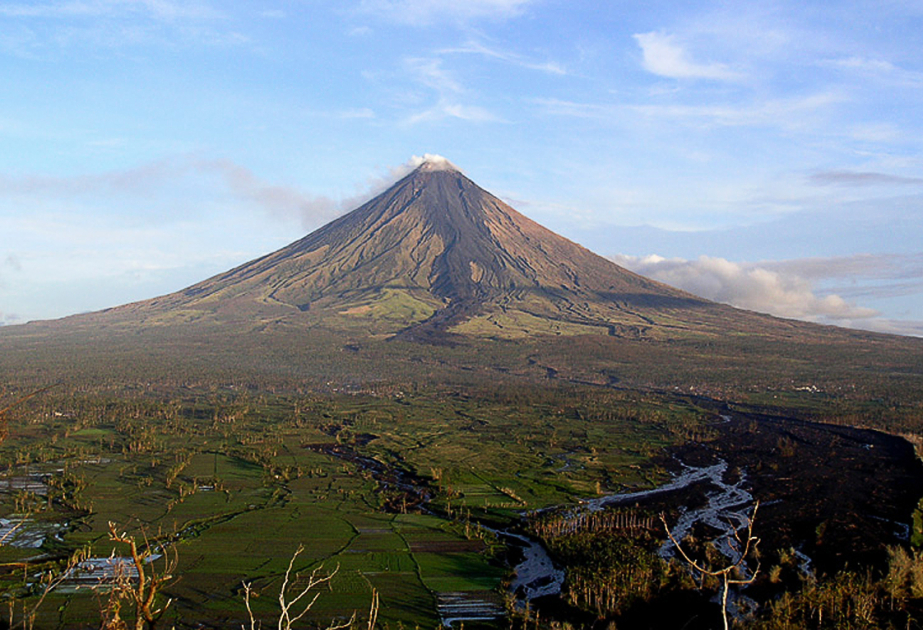
The Department of Science and Technology – Philippine Institute of Volcanology and Seismology (DOST-Phivolcs) has recorded the largest pyroclastic density current (PDC) since January, causing heavy ashfall that has affected 32 barangays in Camalig and Guinobatan, Albay, according to the Philippine News Agency (PNA).
In a Bagong Pilipinas Ngayon interview on Tuesday, Paul Alanis, Phivolcs Supervising Science Research Specialist at the Mayon Observatory, however, said there is no observed indication to warrant a higher alert level, adding that Alert Level 3 remains over the volcano.
“May mga possibilities po tayong tinitingnan, mga parametro (We are looking at some possibilities, some parameters),” he said.
Phivolcs said parameters that would suggest a higher level of unrest include sustained increases in the levels of volcanic earthquakes, occurrence of low-frequency earthquakes, volcanic tremor, rumbling sounds, forceful and voluminous steam/ash ejections, sustained increases in sulfur dioxide (SO2) emission rates, and ground deformation or swelling of the edifice.
The third parameter, Alanis said, is the possibility that the lava flow would exceed or reach the 6-km. permanent danger zone, pushing the ash clouds or pyroclastic density currents, to exceed it.
“Pero sa ngayon po lilinawin ko po na yung mga ganitong kondisyon sa ngayon ay wala naman po kami nakikitang indikasyon na aabutin siya (But as of now, I would like to clarify that we do not see any indications that it will reach a higher alert level)," he said.
Alanis, meanwhile, noted that when they said that this is the largest ash or pyroclastic density current recorded, this is the largest so far only for this year, as more severe or larger pyroclastic flows occurred last year.
“Since Mayon Volcano entered a period of magmatic eruption on 6 Jan. 2026, its activity has been characterized by effusion or non-explosive eruption of lava from the summit crater, generating lava flows and collapse-fed rockfall and pyroclastic density currents or ‘uson,’ hazardous mixtures of hot volcanic gas, ash, and fragmented rock,” the summary of surface observations issued by Phivolcs on Tuesday read.
These volcanic hazards have continually affected three major drainage systems on the southern to eastern slopes – the Mi-isi, Bonga, and Basud Gullies, including minor drainages in between, that are within the 6-km. radius PDZ.
As of Feb. 8, it said, lava flows have advanced to radial distances of 1.3 km., 1.6 km., and 3.8 km. on the Mi-isi, Bonga, and Basud Gullies, respectively, while rockfall and PDC runouts remained within the 3-km. radial distance from the summit crater.
The total volume of magma erupted based on these deposits was estimated to be 22 million cubic meters.
On Feb. 9, Phivolcs reported the largest PDC that occurred at 10:59 a.m., lasting seven minutes based on seismic record, and generating ash clouds more than 2 km. high that were carried westward by 40 kph winds.
The flow traveled 4 km. from the crater along the Mi-isi Gully, the farthest runout recorded in this eruption so far this year.
From Jan. 1 to Feb. 9, Phivolcs recorded 1,690 PDCs, 9,941 rockfalls, and 1,346 volcanic earthquakes, with sulfur dioxide emissions peaking at 6,569 tonnes per day on Feb. 4, indicating rising magma beneath the volcano.
Other news in this section


