Azerbaijan's experience highlighted at online meeting of WEF’s Centres for Fourth Industrial Revolution Network
Baku, August 13, AZERTAC
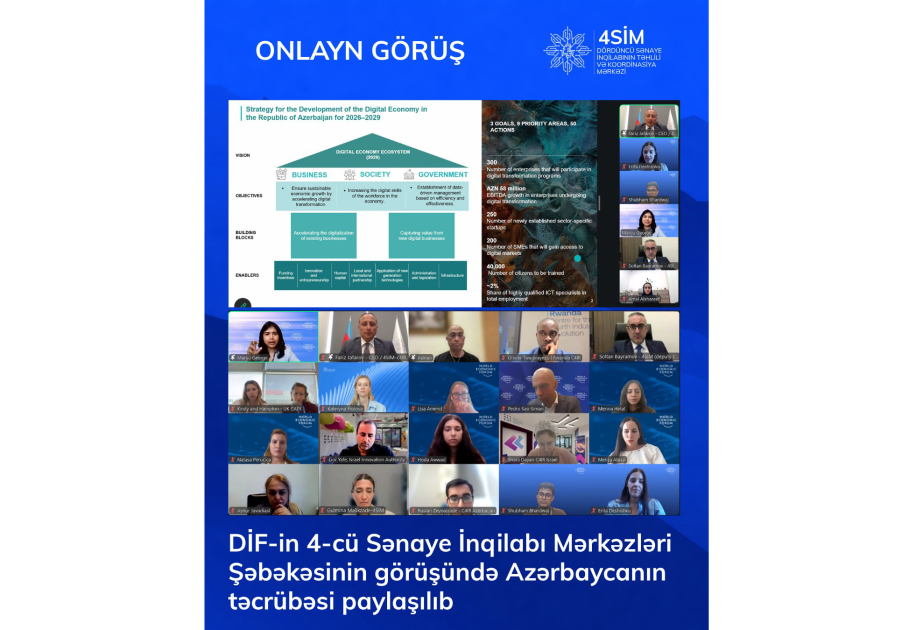
Fariz Jafarov, Executive Director of the Center for Analysis and Coordination of the Fourth Industrial Revolution (4SIM) under the Ministry of Economy, participated in an online meeting dedicated to the formation of national agendas within the framework of the World Economic Forum’s (WEF) Centres for the Fourth Industrial Revolution Network.
The meeting featured discussions on the contribution of centers within the network to the formation of strategic initiatives at the national level, as well as successful experiences in this area.
Fariz Jafarov provided an overview of the “Strategy for the Development of the Digital Economy in the Republic of Azerbaijan for 2026–2029.”
He noted that the strategy aims to accelerate digital transformation in business, society, and the public sector, develop digital skills, and strengthen data-driven governance. The strategy covers nine priority areas and includes 50 initiatives.
The 4SIM Executive Director also gave a presentation on Azerbaijan’s Industry 4.0 ecosystem, support for the technological and green transformation of enterprises, human capital development, and initiatives aimed at promoting the application of new technologies.
According to him, the center aims to involve 300 enterprises in digital transformation programs by 2029, create 250 new sectoral startups, ensure access to digital markets for 200 small and medium-sized enterprises (SMEs), and engage 40,000 citizens in specialized training under the strategy.
The meeting was attended by the heads of 24 centers and Manju George, Head of Strategic Impact at the World Economic Forum’s Center for the Frontier Technologies and Innovation. Alongside Azerbaijan, representatives of the 4IR centers of Rwanda and Malaysia also shared their experiences.
The meeting also featured an exchange of views on effective contributions to shaping national agendas, stakeholder engagement, successful approaches, and current challenges.
Other news in this section


