2nd Global Shared Societies Forum continues in Baku with several sessions
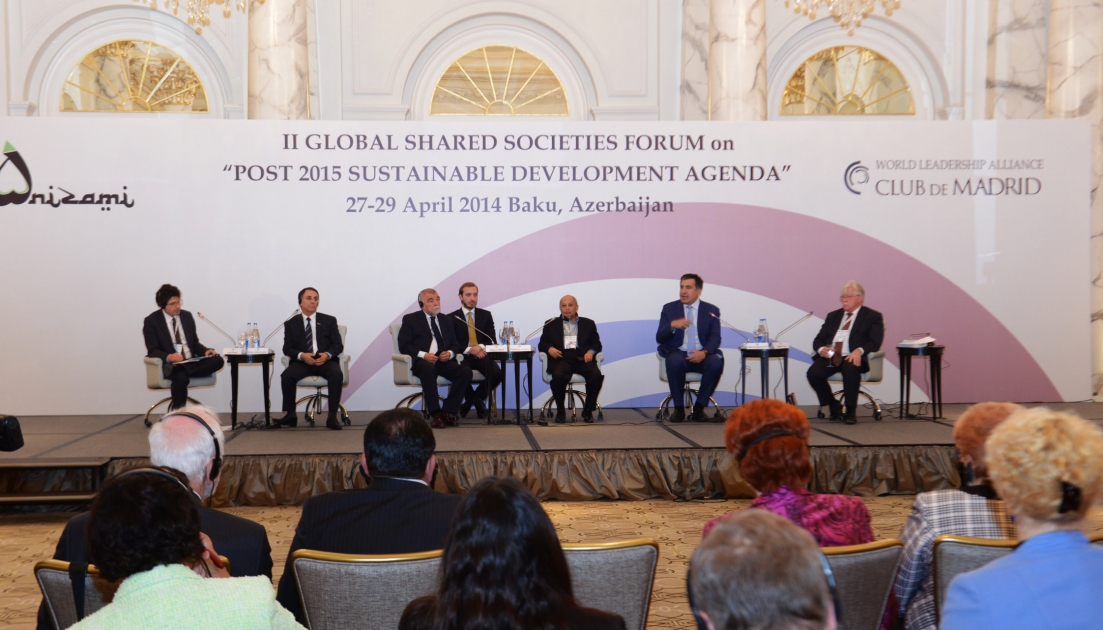
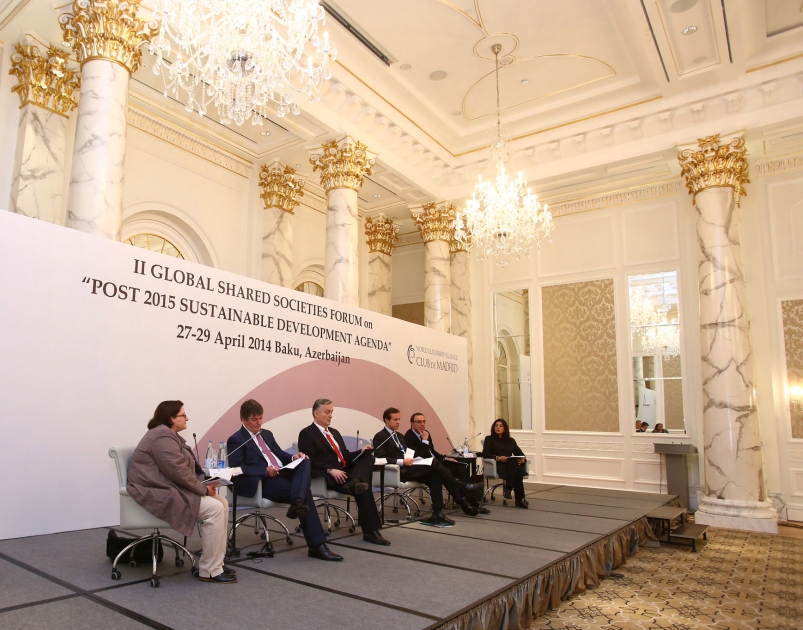
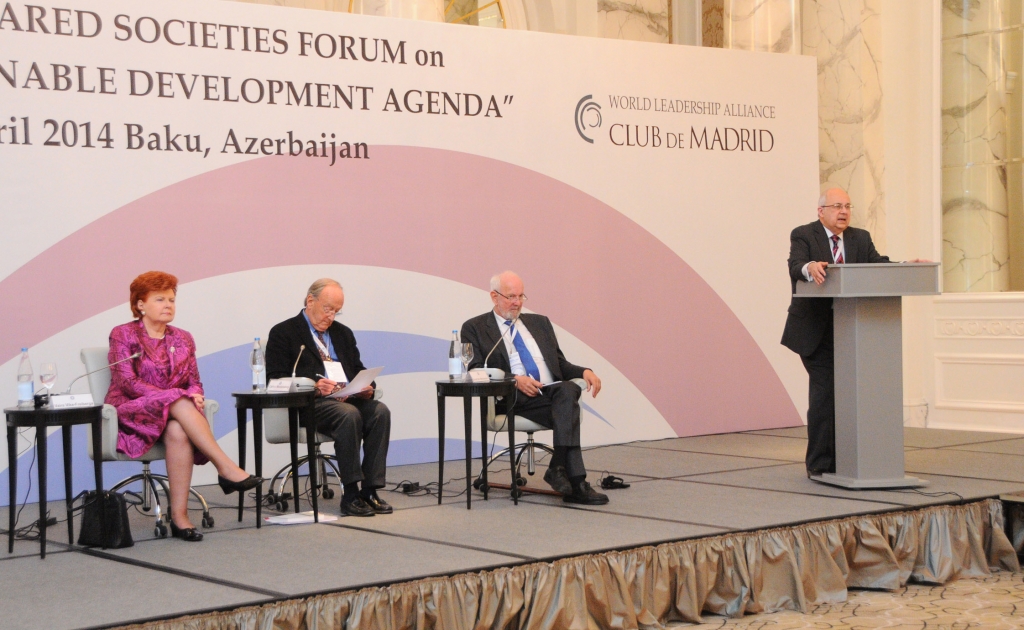
Baku, April 29 (AZERTAC). The 2nd Global Shared Societies Forum has featured several sessions as it entered its second day in the Azerbaijani capital of Baku.
The forum is co-organized by the Nizami Ganjavi International Center and the Club de Madrid in partnership wit the Azerbaijani State Committee for Work with Diaspora.
Called “Multi-level governance and the institutional framework needed to enable a sustainable development process”, the first session of the day saw discussions on the issues of protection of shared societies within political framework.
The session basically focused on the importance of political will and leadership to move forward implementing new set of sustainable development goals at the international, national and local levels.
Novruz Mammadov, Deputy Head of Azerbaijan`s Presidential Administration, said the country was located in one of the most volatile regions of the world. “Azerbaijan’s path of development answers most of the questions raised here today. Azerbaijan has been one of the countries successfully pursing its internal and foreign policy after the collapse of the bipolar system in the world. Azerbaijan is still continuing to move forward and develop.”
He also noted that Azerbaijan was closely cooperating with the European Union in a variety of fields, including energy sector.
Mr. Mammadov, however, expressed regret over the fact that neither the European Union, nor the OSCE Minsk group has proposed ways of ensuring just settlement of the Karabakh dispute. He said that being a young country, Azerbaijan chose democratic path of development following the example of the European countries.
Mikheil Saakashvili, former President of Georgia, highlighted Azerbaijan’s and Georgia’s key role in the region: “Steps that we have made jointly with Azerbaijan encouraged us to great changes. When Georgia was experiencing an energy crisis Azerbaijan provided us with energy. Exclusively such neighborhood can give impetus to development both within the country, and among countries.”
Abdul-kareem Al-Eryani, former Prime Minister of Yemen, highlighted the ongoing processes in Yemen. He underlined the importance of the national dialogue in terms of sustainable development.
The former Premier noted the development was possible only in through ensuring security. “Societies need justice. Communication with people must be a useful model of ensuring their welfare. The rule of law must be ensured so that institutions operate normally.”
Stjepan Mesic, former President of Croatia, noted that democracy was possible only if stability is ensured in societies.
He expressed regret that in a number of places of the world people suffer from conflicts. He also highlighted the importance of building shared societies.
The Former Croatian President said that every country had its unique model of development, adding that it depends on how local institutions were set up.
Called “Measuring sustainable development and social inclusion. The challenge of disaggregated data in tracking the New Sustainable Development Goals”, the second session was moderated by Project Manager at the Bertelsmann Stiftung Sabine Donner.
Jorge Quiroga, former President of Bolivia, spoke of ongoing processes in Latin America, saying that social policy principles had been implemented in several countries of the region. He highlighted the role of religion in relations among the communities, sharing Bolivia`s experience in this field.
The former President said free conditions were created for all religions in his country.
Touching on the UN’s report on human rights, the former Bolivian leader praised the expanding foreign policy of the country. He also said Bolivia`s trade notably grew up thanks to cooperation with China.
Maitreyi Das, Team Leader for Social Inclusion at Social Development Department of World Bank, hailed solidarity as important in terms of achieving the goals set.
Das pointed to the possibility of preventing corruption through transparency.
Zlatko Lagumdzija, former Prime Minister of Bosnia and Herzegovina, pointed out that justice was one of the important parameters of societies that faced conflicts. He said that equal conditions were created Bosnia and Herzegovina for representatives of all religions as in Azerbaijan.
Calling the Khojaly and Srebrenica events “terrible” tragedies of the two countries, Zlatko Lagumdzija noted the possibility of preventing such tragedies in the shared societies.
Petar Stoyanov, former President of Bulgaria, thanked the organizers of the Forum, noting that the event opened up excellent opportunities for discussing numerous important issues.
Bamir Topi, former President of Albania, noted diversity existing in his country. The former Albanian leader pointed to the impossibility of ensuring stability, peace as well as economic development without democracy.
Called “Moving forward. Proposals and recommendations for the UN to mainstream Social Inclusion in the Post-2015 Process and their implementation at the national level”, the third session was moderated by Ismail Serageldin, Director of Library of Alexandria and Co-Chair of the Nizami Ganjavi International Center.
It discussed how the conclusions and suggestions of the previous panels could be most effectively presented to the consideration of the Post 2015
Sustainable Development Agenda decision makers.
Ernst von Weizsaecker, Co-President of Club of Rome, expressed regret over the fact that people suffer from conflicts around the world.
He highlighted the necessity of protecting environment for building a perfect society.
Carlos Westendorp, Secretary-General of Club de Madrid, highlighted the organization`s cooperation with the Nizami Ganjavi International Center. He noted a number of important projects had been successfully implemented jointly.
Vaira Vike-Freiberga, former President of Latvia, President of the Club de Madrid and Co-chair of the Nizami Ganjavi International Center, also hailed the cooperation of the Club de Madrid and the Nizami Ganjavi International Center in organizing the Forum.
The former Latvian President thanked President of Azerbaijan Ilham Aliyev for conditions created for holding such events in the country.
Other news in this section


