Azerbaijani Deputy Prime Minster meets editor of Spanish news agency EFE
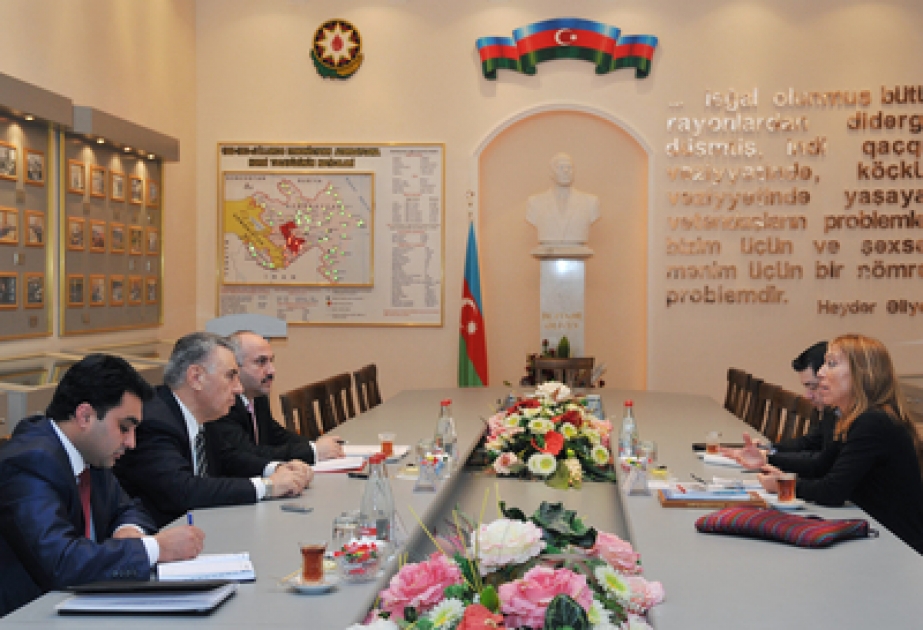
Baku, December 17 (AZERTAC). Azerbaijani Deputy Prime Minister, Chairman of the State Committee for Affairs of Refugees and Internally Displaced Persons (IDPs) Ali Hasanov has met with editor of Spanish news agency EFE, popular journalist Carmen Clara Rodríguez Alonso.
Briefing the journalist on the Armenia-Azerbaijan Nagorno-Karabakh conflict, its consequences, Hasanov said during last 200 years, as a result of complicated political processes happened in the South Caucasus, Azerbaijanis had been subjected to forcibly deportation from their native homelands and ethnic cleansing. He said because of the systematic policy of the Czarist Russia, which invaded the Caucasus beginning from early 19th century, the Armenians were massively removed from the territories of neighboring countries to Azerbaijan, including to the territory of the Nagorno-Karabakh. The Deputy Prime Minister said Armenians realized their plans - groundless territorial claims against Azerbaijan - stage by stage. He stressed that in 1905-1907s and 1918-1920s, thousands of Azerbaijanis were brutally and massively killed, their villages were destroyed and the peaceful people became refugees and IDPs.
Declaring its independence on 28 May, 1918, Azerbaijan faced again territorial claims of Armenian nationalists. An idea of establishing Armenian state in the territory of the Iravan khanate of Azerbaijan has emerged. As a result, a small Armenian state was set up in 1918 in the territory of the Iravan khanate. In the course of systematic ethnic cleansings during many years and migrations of Armenians from Persia and Ottoman Empire, the capital of present day Armenia became the city with monoethnic population.
Hasanov said this insidious policy was continued during the period of the Soviet regime too. In 1923, Nagorno-Karabakh Autonomous Oblast was established in Azerbaijan`s territory. Later, during Stalin`s power, the deportation of Azerbaijanis from Armenia took place as an act of forced resettlement and ethnic cleansing throughout the 20th century.
Hasanov said Armenians, who used sympathy of leader of the Soviet Union Mikhail Garbachov, had further activated their claims to create “Great Armenia”.
The last wave of Azerbaijanis` deportation from Armenia - the last ethnic cleansing policy took part in 1988-1992 and this process was carried out very brutally and cruelly, as a result of which 250 Azerbaijanis were driven out from their home lands.
The Armenian armed forces have occupied 20 percent of Azerbaijan since 1992, including the Nagorno-Karabakh region and seven surrounding districts. Over one million people have become refugees and IDPs.
Armenia constantly violates the ceasefire agreement signed with Azerbaijan in 1994 and ignores the U.N. Security Council`s four resolutions on the liberation of the Nagorno-Karabakh and the surrounding regions. Azerbaijan`s material and cultural riches have been plundered, the all infrastructure have been destroyed.
The Chairman of the State Committee also gave information about the Khojaly genocide - one of the most horrible tragedies, which Azerbaijan experienced in the 20th century. It is like the genocides committed in Khatyn, Lidisia, Oradur reflected in the history of mankind.
In the early hours of February 26, the armed forces of Armenia, the Armenian militants of the Nagorno-Karabakh, and Motorized-Infantry Regiment 366 of the former Soviet Union dislocated between Askaran and Khankendi (Stepanakert) occupied the town and committed genocide against Azerbaijanis.
On that night, when Armenians committed genocide in Khojaly, 613 peaceful residents were murdered with a special cruelty, tortured, beheaded and blinded. Pregnant women were bayoneted; among them were 63 children, 106 women and 70 elderly people.
The Azerbaijani Deputy Prime Minister said that the damage inflicted on Azerbaijan by the Armenian aggression is estimated at $300 billion. The figure excludes items of inestimable heritage, and it is impossible to determine the immense moral value of the ancient and irreplaceable cultural monuments of Azerbaijani nation that have been destroyed.
Hasanov said many international and regional organizations, including the United Nations Security Council, the Council of Europe, Organization of Islamic Cooperation and the European Parliament had adopted resolutions condemning Armenia`s aggression and invasion policy, demanding withdrawal from Azerbaijan`s occupied lands and returning of refugees and IDPs to their homes. However, all these resolutions remain unfulfilled. He added that the resolution of the conflict must be based on international legal principles and the Helsinki Final Act.
Hasanov said peace talks over the settlement of the conflict brokered by mediation mission of the OSCE Minsk Group had produced no results so far. He pointed out that a powerful Armenian lobby`s activities in those countries which are Minsk Group co-chairs caused Azerbaijan fair discontent.
Hasanov also highlighted 31 March-day of genocide of Azerbaijanis. The massacre of Azerbaijanis and repressions committed against them should be considered as the bloodiest page of the world history of the 20th century. On March 31, 1918 the Baku Commune and the Armenian nationalists committed unprecedented violence in the history of mankind by perpetrating massacres and executions.
Members of the Armenian Dashnak party in concert with Soviet Bolsheviks massacred about 20,000 innocent Azerbaijani people, including the elderly, women and children, starting on the night of March 30, 1918.
During March-April 1918, hundreds of Azerbaijanis were executed by Armenians in Baku, Shamakhy, Guba, Mughan and tens of thousands of people were ousted from their lands.
Armenian Bolshevik troops led by Stepan Shaumyan massacred thousands of people, burnt Islamic shrines and confiscated the 400-million-manat estate of Baku residents. Tezepir Mosque was bombed, and one of the magnificent architectural buildings, Ismailiyye, was burnt down.
The genocide policy pursued against Azerbaijanis was not limited to Baku. Armenian dashnaks killed 8,027 Azerbaijanis, including 2,560 women and 1,277 children, in 53 villages of Shamakhy, 110 km west of Baku, on March 31. Also, 16,000 Azerbaijanis were murdered in 122 villages of Guba, northern Azerbaijan.
The evidence of the Armenian vandalism in Guba is the burial of remains of the genocide victims. The burial was discovered during the construction of a stadium in Guba in 2007.
It was proven that people, whose remains were found in a mass grave in Guba region, were killed by Armenians in 1918.
The deputy Premier said President Heydar Aliyev issued a decree on March 26, 1998 to commemorate March 31 as the Day of Azerbaijanis' Genocide.
Hasanov also briefed on the Black January. He said late at night on January 19, 1990, 26,000 Soviet troops stormed Baku. They began to open fire on protesters at will, crushed many with tanks, and arrested hundreds more for imprisonment and torture. Though the final death toll is still contested to this day, at least 130 people died from wounds received that night and during subsequent violent confrontations. A vast majority of the casualties were civilians, with over 700 wounded.
The Spanish journalist thanked for detailed information. Carmen Clara Rodríguez Alonso said the aim of his visit to Baku was to raise awareness of the Spanish people about tragedies that Azerbaijanis faced in different times. The journalist said what he learned at the meeting with the Deputy Prime Minister would help him in this regard.
The editor of the EFE agency praised the rapid development of Azerbaijan, saying Baku was a city where modernism and antiquity unite.
Other news in this section


