MINISTERIAL CONFERENCE ON GENDER EQUALITY KICKS OFF IN BAKU
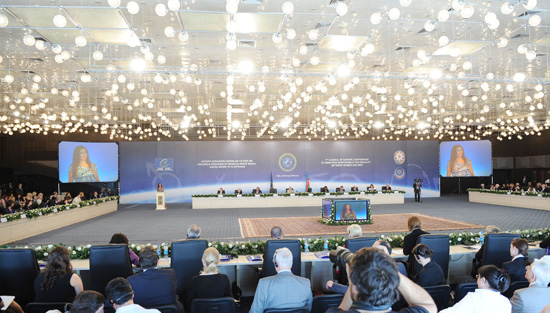
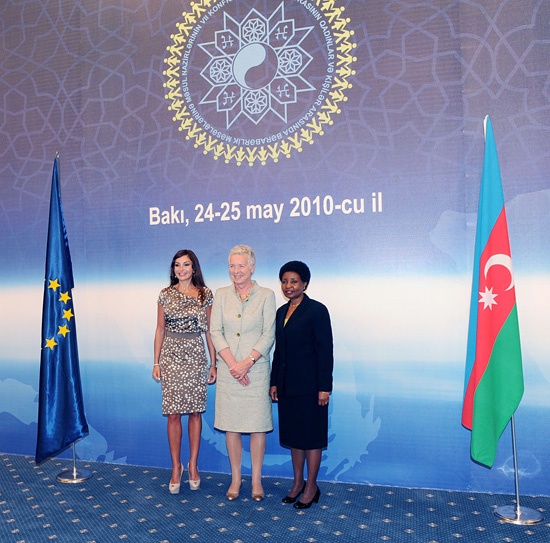
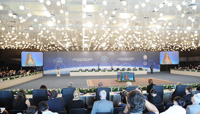 Baku, May 24 (AZERTAC). The 7th Council of Europe Conference of Ministers responsible for Equality between Women and Men, under the theme “Gender equality: bridging the gap between de jure and de facto gender equality” has today started in Azerbaijan`s capital.
 Head of the President Administration`s department for Humanitarian Policy Fatma Abdullazade read out President Ilham Aliyev`s congratulatory letter to the conference participants.
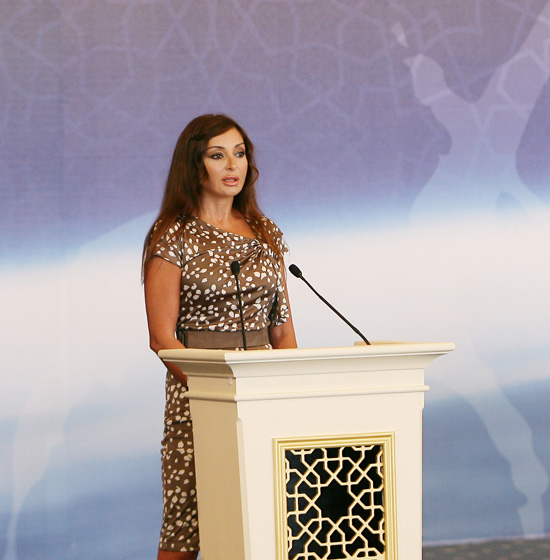
First Lady of Azerbaijan, President of the Heydar Aliyev Foundation, UNESCO and ISESCO goodwill ambassador, MP Mehriban Aliyeva made opening remarks:
“Ladies and gentlemen,
Dear quests
I would like to begin by welcoming all participants and quests of this forum. I am very pleased that Baku has become home to many international meetings and conferences on important problems and challenges in the modern world. These events create the possibility for constructive dialogue and joint solutions, as well as being valuable opportunity to benefit from global experience. I would like to thank the Council of Europe for its decision to hold this conference in Baku and I believe that active position and concrete strategy of the Azerbaijani state on the issue of the gender equality are the main reasons why this conference is being held in Baku.
The topic of today`s conference is of paramount public importance. Gender equality and equality of rights are the most important basis of any democratic society. One of the main achievements of 20th century is that we have managed to change the values and ethical guidelines of society. In various countries the seriousness of gender problem has been fully realized and the process of eliminating false stereotypes has started. In the1960-70s some significant worldwide changes took place in people`s attitudes to women.
Since 1975 four global conferences in Mexico, Copenhagen, Nairobi and Beijing dedicated to the status of women have been organized under the umbrella of the United Nations. These conferences were a great success and enabled the international community to focus on the problem of inequality between sexes.
In European countries there is a rich experience of creating successful national policy and eliminating the gender discrimination and moving towards the real social equality between men and women. Today women in modern European society can be found in almost all public spheres, including the most inaccessible, traditionally male professions. They take an active part in the world business, the financial world and the military sphere. Women have also broken in the politics, where they bring great emphasis to problem resolution.
Despite all these positive changes, we still have a long way to go. A lot of recommendations and resolutions have still not been implemented. So from one point of view, gender equality is high priority in the modern European society, but on the other hand, progress could be greater.
Azerbaijan has also achieved a lot of success in protecting women`s rights. The 20th century can be regarded as a start of a new epoch in the life of Azerbaijani woman. In 1918 Azerbaijan became the first Democratic Republic in the Muslim East, where women got the right to vote and to be elected. This happened several years earlier than in many western countries. At the end of the 20th century, after our country restored its independence, women got new opportunities. There is no sphere in modern Azerbaijan where women cannot participate. They are represented in management system, law enforcement bodies and judicial system. They lead business activities and participate in public and political processes.
There has been a remarkable increase in the public and political activities. The percentage of women working in municipalities in 2009 has increased seven fold since the municipal election of 2004. Currently women make up almost half of all public servants and scientific employees. The majority of doctors and school teachers are women. Every five years a forum is held in our country for Azerbaijani women to discuss their position and role in the society. All of these achievements are an indication of positive and optimistic future.
At the same time there are serious problems in Azerbaijan in the field of gender relations and the status of women in family and society. All of these are a matter of concern for public and non governmental institutions. As it is widely known, Azerbaijan has faced aggression from neighboring Armenia since the first years of the restoration of its independence. The occupation of 20 percent of the Azerbaijani territories has brutally violated the fundamental rights of citizen of our country, including women. Women make up almost half of the number of refugees and internally displaced persons as a result of Armenian Azerbaijani Nagorno-Karabakh conflict. Issues such as ensuring access to education for refugees, access to medical assistance and the creation of normal living conditions should constantly be on the agenda not only on the state level, but also on the level of international organizations.
Another problem which concerns us is the problem of violence inside the family. Women in any and even the most developed society can be subjected to different forms of violence and Azerbaijan is no exception. As in other countries, it is also very difficult in our country to get a clear picture about violence inside the family. However, violence against women, against children is unacceptable in any form, even in one single case.
I would like to underline that it is very immoral to use our tradition, our mentality to support this behavior. Like tradition, Azerbaijani people respect and care about women. Family values have been and are the most important values in our society. The image of a mother is sacred one for Azerbaijanis.
A draft law against family violence has already passed the leading stage in parliament and I am sure it will be adopted in the near future. On a legislative base, I would like to underline that sometimes adopted laws aimed at ensuring equal opportunities for the citizens of a country do not guarantee equalization for men and women. This means that to obtain civil rights is just a part of these tasks. The other difficult part is to learn how to implement them. This is another field which we have to work on.
We can have various suggestions and thoughts about how harmonious gender equality may and should look. It would be nice to hope that because of any platform or action plan it will be possible to erase all differences between men and women in society. All researchers have the same opinion that starting from the development of civilization women have been depended on men in practically all societies, regardless to their religious background or political regime. Now the world approaches such a stage in its development, where there are finally objective conditions to change this situation. The success of these changes depends on many factors, such as political, public, social, religious and moral ones. But at the end of the day everything depends on all of us, on men and women living on this planet.
In middle of the 20 century, Simon de Beauvoir wrote: “As stronger is the individualization of man, as greater is his need for it, as faster he will recognize the right to be individual and free for his woman.” For a man to be truly independent a woman must have the same freedom, same independent and same opportunity.
If the state and destiny of woman in current society are defined mainly by the man around them, then all these men are brought up and educated by women. This means that the women, a carrier of moral values using her creative potential, will offer a new model of gender equality to all of mankind.
In conclusion, I would like to thank all of you for active position and contribution to this issue. I wish you success and I hope you enjoy your stay in our beautiful city.
Thank you for your attention.”
The event will be an opportunity to take stock of the progress accomplished and to examine delays and even regression in this field.
European ministers responsible for gender equality will examine what is blocking progress and debate ways to improve the effects of positive action - such as the setting of quotas in decision making bodies or specific funding for firms created by women - and gender mainstreaming, the incorporation of a gender equality dimension in all public policies. They will also discuss how education and the media can combat gender stereotypes.
The ministers will examine and adopt a resolution and an action plan that maps out the future work of the Council of Europe in this field.
The organizers of the event are Azerbaijan government and the Council of Europe.
######
 |
 |
 |
Other news in this section


