RUSI highlights British-Azerbaijani roundtable
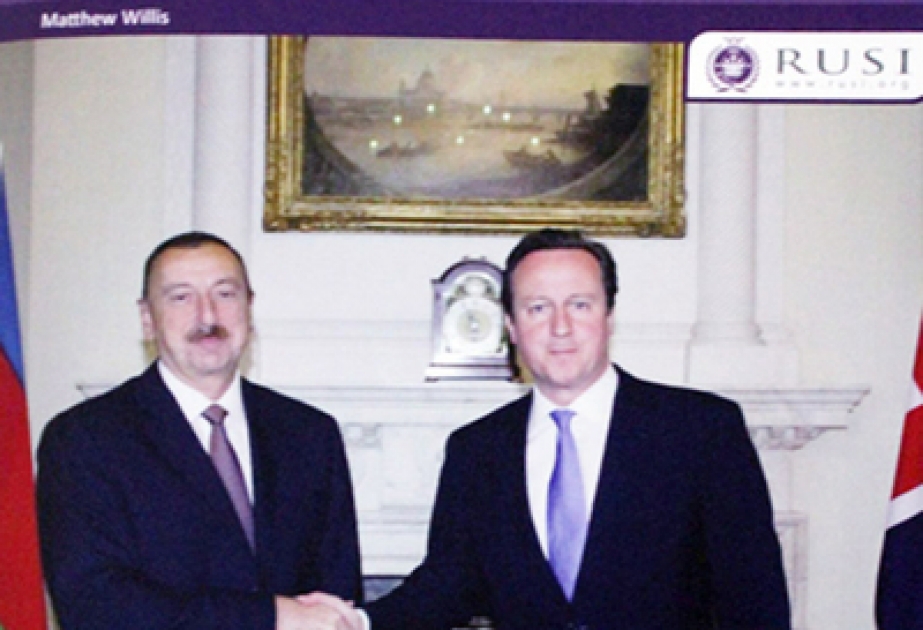
London, May 19 (AZERTAC). British think tank Royal United Services Institute (RUSI) has published a magazine consisting of the materials of “Shaping the Policy Agenda: British-Azerbaijani relations in the context of Europe” roundtable which was held in London in July, 2013.
The magazine stressed the importance of the issues on the agenda of the event. It says the opening ceremony of the roundtable was addressed by British Minister of State for Europe David Lidington and Deputy Head of Azerbaijan`s Presidential Administration, head of the foreign relations department Novruz Mammadov.
“Shaping the Policy Agenda: British-Azerbaijani relations in the context of Europe was a one-day roundtable, held at RUSI in July 2013, designed to provide a platform for assessing the strength, weaknesses and prospects of the countries’ bilateral relationship,” the magazine says.
“Divided into discussions of the relationship’s strategic and commercial dimensions and the UK’s role in resolving the Nagorno-Karabakh conflict, the roundtable brought together high-level government representatives from both countries, members of the think tank and academic communities, and participants from the private sector. In view of the numerous international institutions through which aspects of the bilateral relationship are mediated - notably NATO and the EU - representatives from both organizations were also present. What follows is not a verbatim transcript of the discussion, but rather a synthesis of its highlights and the perspectives expressed most forcefully over the course of the sessions. As the seminar was held off the record, the majority of the comments and arguments reported here are unattributed.”
“Azerbaijan’s importance to the UK as an export market and target for British foreign investment was a recurring theme for British participants. British Petroleum’s (BP) activities were, unsurprisingly, acknowledged and discussed on several occasions, not least on account of the announcement in June 2013 that the Trans Adriatic Pipeline had won out over the Nabucco pipeline as the project of choice for carrying Shah Deniz-2 oil to Europe. Noticeable, however, were British contributors’ efforts to show that the UK’s relations with Azerbaijan rest on more than oil and gas.”
“David Lidington, the UK minister of state for Europe, spoke of the ‘multifaceted’ character of the relationship, and emphasized the UK’s pole position among Azerbaijan’s foreign investors (accounting for over 50 per cent of the country’s foreign direct investment) and the presence in Azerbaijan of 300 British companies. Echoing the minister’s comments, the UK’s trade envoy to Azerbaijan, Charles Hendry MP, spoke of the UK’s desire to expand the countries’ trade ties into areas including financial services, retail, agriculture and architecture. His goal, he stated, was for the UK’s companies to become ‘natural partners of choice’ for Azerbaijan, and both he and Lidington made a point of observing that the UK’s trade and investment interests in Azerbaijan went well beyond the oil-and-gas sector,” the magazine says.
Other news in this section


