Azerbaijan’s next frontier - building a regional hub for space, AI, and innovation - INTERVIEW
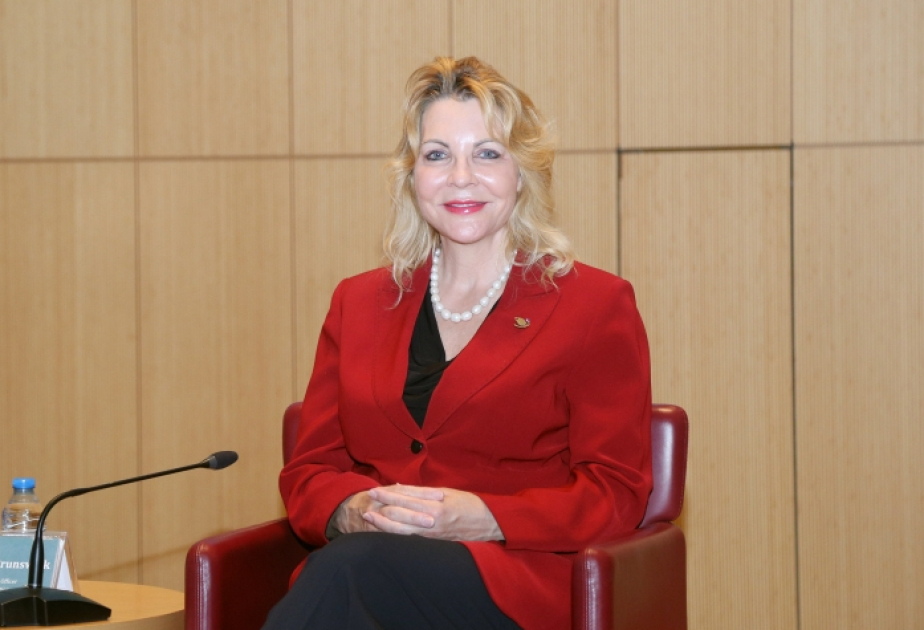
Baku, August 13, AZERTAC
Azerbaijan stands at an important moment in its economic and technological development. By hosting the International Astronautical Congress in 2023 and COP29 in 2024, the country reinforced its growing role as a global convener around two defining priorities: expanding the benefits of space and building a more resilient, sustainable future. The opportunity now is to translate the visibility and relationships created by these events into lasting innovation, investment, and societal progress.
Shelli Brunswick’s insights are informed by her time in Baku during IAC 2023 and by her broader work across the international space and innovation communities. In this interview with AZERTAC, she explores how Azerbaijan can strengthen its space economy, unite artificial intelligence with Earth-observation capabilities, cultivate globally connected talent, and transform national challenges into solutions with regional and international relevance.
Her central message is clear: enduring leadership will be determined not only by the events Azerbaijan hosts, but by the markets, talent, partnerships, and possibilities it builds from their momentum.
- Azerbaijan has successfully hosted the 74th International Astronautical Congress (IAC 2023), bringing together leading figures from the global space community. How do you assess the long-term impact of hosting such an event on the country’s innovation ecosystem, international partnerships, and the development of its space sector?
- Having participated in the 74th International Astronautical Congress in Baku—including contributing to the United Nations/International Astronautical Federation Workshop and presenting on the future of female entrepreneurship for the Global Women Leaders Committee of the World Business Angels Investment Forum—I witnessed firsthand Azerbaijan’s ability to convene diverse voices from across the global space community.
The long-term value of hosting IAC 2023 extends far beyond the congress itself. An event of this magnitude creates international visibility, but its greatest impact comes from converting that visibility into enduring relationships, investment, knowledge exchange, and pathways for national talent.
For Azerbaijan’s innovation landscape, IAC 2023 connected students, researchers, entrepreneurs, and businesses with new ideas, global expertise, and potential collaborators. It also demonstrated that the space economy is not limited to rockets and satellites. It encompasses communications, agriculture, climate monitoring, transportation, energy, artificial intelligence, and many other sectors that contribute to economic diversification.
The congress also strengthened Azerbaijan’s position as a bridge between regions and a platform for global dialogue. The next challenge is to convert that convening power into lasting ecosystem-building power through joint research, commercial partnerships, startup initiatives, educational exchanges, and sustained cooperation.
Ultimately, the legacy of IAC 2023 will be measured not only by who attended, but also by what Azerbaijan continues to build. By investing in talent, encouraging entrepreneurship, expanding cross-border collaboration, and connecting space capabilities to national priorities, Azerbaijan can turn the congress’s momentum into lasting economic and societal value.
- Following COP29, Azerbaijan has placed increased emphasis on climate innovation, clean technologies, and sustainable development. In your view, how can artificial intelligence and space technologies contribute to achieving climate goals and supporting sustainable economic growth in countries like Azerbaijan?
- Artificial intelligence and space technologies are most powerful when combined. Satellites provide continuous, large-scale information about the Earth, while AI transforms enormous volumes of data into timely insights that governments, businesses, farmers, and communities can use. The real value lies in creating a chain from observation to understanding, from understanding to decision, and from decision to action.
For Azerbaijan, this combination could strengthen climate action in several practical ways. Earth-observation data can monitor changes in land use, water availability, soil conditions, coastal areas, and ecosystems. When paired with AI, it can help forecast droughts and floods, identify environmental risks, improve agricultural productivity, and guide more efficient use of water and other natural resources. Space-based information can also support renewable energy planning by identifying suitable locations for solar and wind projects and by monitoring the performance and resilience of critical infrastructure.
The economic potential is equally important. Climate data should not remain confined to government reports or research institutions. It can become the foundation for new products, services, startups, and skilled jobs in agriculture, insurance, logistics, urban planning, energy, and disaster management. In this way, climate investment can advance environmental resilience and economic diversification simultaneously.
However, data and technology alone are not the solution. Azerbaijan will also need trusted data systems, skilled professionals, responsible AI governance, international cooperation, and pathways that enable entrepreneurs to transform information into scalable applications.
COP29 focused global attention on the relationship between climate action, finance, and innovation. Azerbaijan can build on that momentum by becoming a regional testbed for AI-enabled space applications—demonstrating how advanced capabilities can translate climate commitments into measurable improvements for economies, communities, and the environment.
- Azerbaijan is actively investing in digital transformation, startup development, and innovation-driven economic diversification. Based on your global experience, what strategic priorities would you recommend for Azerbaijan to strengthen its position as a regional hub for innovation and the space economy?
- Azerbaijan has already established important foundations through digital transformation, support for startups, and investment in its national space capabilities. The next strategic priority is to connect these efforts into one coherent innovation system. I would approach that effort through the Space Mindset—a strategic framework centered on three interconnected priorities: Build Markets, Build Talent, and Build Scale.
First, build markets by focusing space and digital innovation on clearly defined national and regional needs. Agriculture, water management, energy, transportation, telecommunications, urban development, and disaster resilience can become proving grounds for new solutions. Government can accelerate demand by making relevant datasets accessible, establishing innovation-friendly procurement pathways, and providing startups with opportunities to showcase their capabilities in real-world settings.
Second, build talent. Azerbaijan will need not only engineers and scientists, but also entrepreneurs, investors, policymakers, legal experts, communicators, and business leaders who understand how to translate technology into value.
Stronger connections among universities, industry, government, and international partners can create pathways for internships, applied research, mentorship, and commercialization. Particular attention should be given to engaging women, young people, and Azerbaijanis working internationally.
Third, build scale by improving access to capital, protecting intellectual property, supporting regulatory experimentation, and helping companies reach markets beyond Azerbaijan.
Regional leadership will come from becoming a place where international companies can partner with local innovators, test solutions, and expand across neighboring markets.
A successful innovation hub is not defined by the number of programs it launches, but by the solutions, companies, talent, and partnerships that endure.
Azerbaijan’s advantage lies in connecting its geography, digital ambitions, space capabilities, and convening power into an environment built not only for regional leadership, but for global relevance.
Shelli Brunswick advances global leadership at the intersection of space, technology, entrepreneurship, and international collaboration. Her work expands access to the space economy, strengthens innovation ecosystems, and inspires leaders to transform emerging technologies into meaningful economic opportunity and real-world impact.
She is the creator of the Space Mindset, a strategic framework centered on three interconnected priorities: Build Markets, Build Talent, and Build Scale. Through this approach, she encourages governments, organizations, and entrepreneurs to view space not as a distant destination, but as essential infrastructure for innovation, resilience, and opportunity on Earth.
Shelli is CEO and Founder of SB Global LLC, Secretary General of the World Business Angels Investment Forum Global Women Leaders Committee, a Visiting Scholar with Blue Marble Space, and a contributor to the Forbes Technology Council. She has delivered keynotes and shared her insights on six continents.
Author – Parvana Gafarova
Other news in this section


