EU-Azerbaijan Cooperation Council holds regular meeting
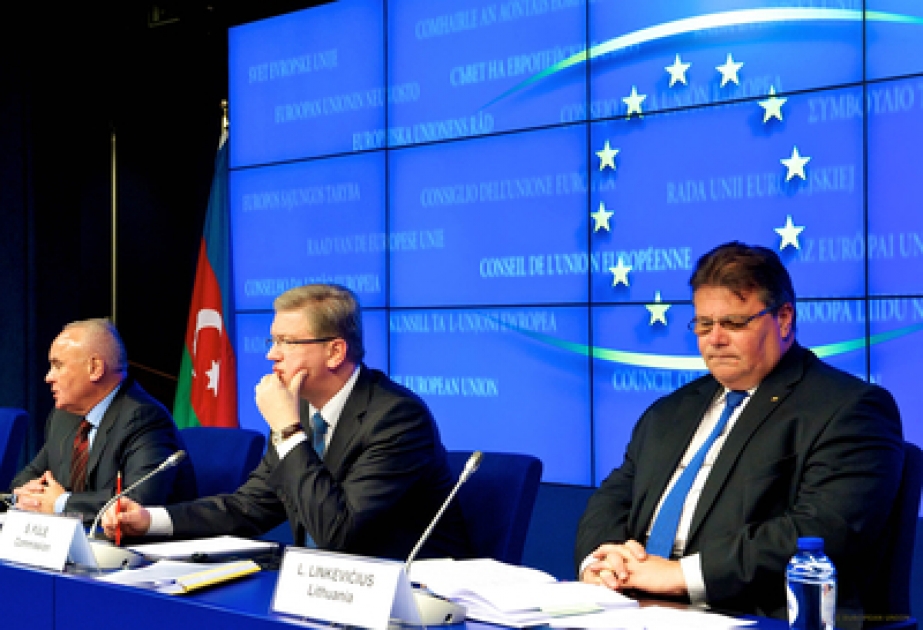
Brussels, December 10 (AZERTAC). The 14th meeting of EU-Azerbaijan Cooperation Council was held in Brussels to discuss the current level and prospects of cooperation.
Azerbaijan was represented by a delegation led by the deputy foreign minister Mahmud Mammadguliyev.
The European Union was represented by Linas Linkevicius, the Foreign Minister of Lithuania, which is currently chairing the EU and EU Commissioner for Enlargement and European Neighborhood Policy Štefan Füle.
At the meeting, Azerbaijan holds rotating presidency.
At the press conference on the outcomes of the meeting, Linas Linkevicius said that the relations between the EU and Azerbaijan are developing dynamically: “We are pleased to see the EU and Azerbaijan coming closer.”
Linas Linkevicius welcomed the recent meeting of Azerbaijani and Armenian presidents and noted that the resolution of the Nagorno Karabakh conflict is one of the foreign priorities of the EU and Brussels is willing to do more to support the OSCE Minsk Group. He said that the EU-Azerbaijan energy cooperation is developing dynamically. In this regard, the EU looks forward to the final investment decision on Shah Deniz consortium on December 17. The parties also agreed to continue discussions on the Trans-Caspian gas pipeline.
EU Commissioner for Enlargement and European Neighborhood Policy Štefan Füle noted the importance of visa facilitation agreement signed with Azerbaijan at the Vilnius summit: “People-to-people contacts and the facilitation of visa regime are important points of our cooperation.”
He also added that a readmission agreement will be likely signed next year.
Štefan Füle called on Azerbaijan to intensify steps towards the country’s accession to the WTO, to comply with international obligations regarding the observance of fundamental freedoms in the country. According to the commissioner, in all issues, Azerbaijan can count on the support of the EU.
Head of the Azerbaijani delegation Mahmud Mammadguliyev said cooperation with the EU is one of the top priorities of Azerbaijan's foreign policy. He said Azerbaijan continues steps on modernization and is ready to study the best practices of the EU.
Mammadguliyev said the most serious problem for Azerbaijan is Nagorno Karabakh conflict.
"This unsolved conflict has an impact not only on the region, but also beyond its borders. Azerbaijan evaluates the support of the EU for OSCE Minsk Group, but we believe that the EU can play a stronger role in the resolution of the conflict," he said.
The meetings of the EU-Azerbaijan Cooperation Council are held once a year on the ministerial level and are part of the political dialogue between the sides. The Cooperation Council is coordinating implementation of the agreement on cooperation and partnership between the EU and partner states. The agreement between Azerbaijan and EU came into force in 1999.
Other news in this section


