Leading UK political magazine carries Azerbaijan feature in its flagship issue
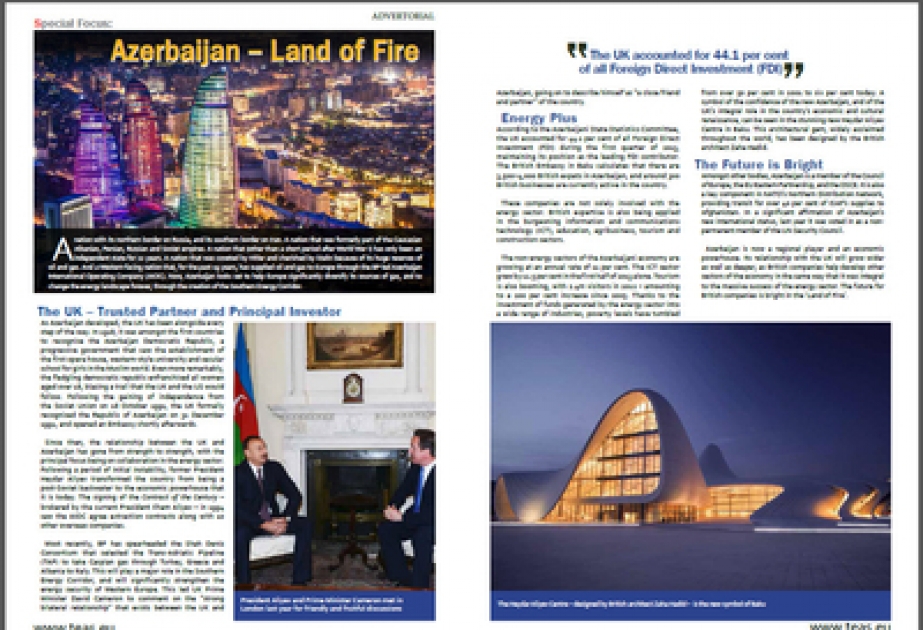
Baku, September 12 (AZERTAC). Politics First, one of the leading specialist UK political magazines, has carried an extended feature article on Azerbaijan in its September issue.
The article emphasizes the close relationship between the UK and Azerbaijan, pointing out British companies - led by BP - have been at the forefront of Azerbaijan`s economic miracle over the last 20 years. The article also maintains that ‘the future is bright’ for further development of the relationship. The article reads: “A nation with its northern border on Russia, and its southern border on Iran. A nation that was formerly part of the Caucasian Albanian, Persian, Russian and Soviet empires. A nation that (other than a short period after World War I) has only been an independent state for 22 years. A nation that was coveted by Hitler and cherished by Stalin because of its huge reserves of oil and gas. And a Western-facing nation that, for the past 19 years, has supplied oil and gas to Europe through the BP-led Azerbaijan International Operating Company (AIOC). Now, Azerbaijan looks set to help Europe significantly diversify its sources of gas, and to change the energy landscape forever, through the creation of the Southern Energy Corridor.
As Azerbaijan developed, the UK has been alongside every step of the way. In 1918, it was amongst the first countries to recognise the Azerbaijan Democratic Republic, a progressive government that saw the establishment of the first opera house, western-style university and secular school for girls in the Muslim world. Even more remarkably, the fledgling democratic republic enfranchised all women aged over 18, blazing a trail that the UK and the US would follow. Following the gaining of independence from the Soviet Union on 18 October 1991, the UK formally recognised the Republic of Azerbaijan on 31 December 1991, and opened an Embassy shortly afterwards. Since then, the relationship between the UK and Azerbaijan has gone from strength to strength, with the principal focus being on collaboration in the energy sector. Following a period of initial instability, former President Heydar Aliyev transformed the country from being a post-Soviet backwater to the economic powerhouse that it is today. The signing of the Contract of the Century - brokered by the current President Ilham Aliyev - in 1994 saw the AIOC agree extraction contracts along with 10 other overseas companies. Most recently, BP has spearheaded the Shah Deniz Consortium that selected the Trans-Adriatic Pipeline (TAP) to take Caspian gas through Turkey, Greece and Albania to Italy. This will play a major role in the Southern Energy Corridor, and will significantly strengthen the energy security of Western Europe. This led UK Prime Minister David Cameron to comment on the “strong bilateral relationship” that exists between the UK and Azerbaijan, going on to describe himself as “a close friend and partner” of the country. According to the Azerbaijani State Statistics Committee, the UK accounted for 44.1 per cent of all Foreign Direct Investment (FDI) during the first quarter of 2013, maintaining its position as the leading FDI contributor. The British Embassy in Baku calculates that there are 3,500-4,000 British expats in Azerbaijan, and around 300 British businesses are currently active in the country. These companies are not solely involved with the energy sector. British expertise is also being applied in the burgeoning information and communications technology (ICT), education, agribusiness, tourism and construction sectors. The non-energy sectors of the Azerbaijani economy are growing at an annual rate of 11 per cent. The ICT sector grew by 11.5 per cent in the first half of 2013 alone. Tourism is also booming, with 2.4m visitors in 2012 - amounting to a 200 per cent increase since 2005. Thanks to the investment of funds generated by the energy sector into a wide range of industries, poverty levels have tumbled from over 50 per cent in 2001 to six per cent today. A symbol of the confidence of the new Azerbaijan, and of the UK`s integral role in the country`s economic and cultural renaissance, can be seen in the stunning new Heydar Aliyev Centre in Baku. This architectural gem, widely acclaimed throughout the world, has been designed by the British architect Zaha Hadid.
Amongst other bodies, Azerbaijan is a member of the Council of Europe, the EU Eastern Partnership, and the OSCE. It is also a key component in NATO`s Northern Distribution Network, providing transit for over 40 per cent of ISAF`s supplies to Afghanistan. In a significant affirmation of Azerbaijan`s new international status, last year it was voted in as a nonpermanent member of the UN Security Council. Azerbaijan is now a regional player and an economic powerhouse. Its relationship with the UK will grow wider as well as deeper, as British companies help develop other sectors of the economy in the same way that it was integral to the massive success of the energy sector. The future for British companies is bright in the `Land of Fire`.
The realisation that 40 per cent of the EU`s gas imports originate from Russia has led to concern across Europe, and it is now recognised that Azerbaijan has an important role to play as both a producer and a transit hub for oil and gas from other countries in the Caspian basin. Since the Shah Deniz natural gas field was inaugurated in 2007, Azerbaijan has become a gas exporter, shipping increasing amounts of natural gas via Turkey to Europe. Operated by the BP-led Shah Deniz Consortium, the Shah Deniz gas field holds an estimated 1.2tn m3 of natural gas, according to BP. As stated in the BP Statistical Review of World Energy 2013, new fields currently under exploration could yield a further 900bn m3 (bcm) of gas and 7bn barrels of oil. When Shah Deniz II comes fully on-stream, the BP operated Sangachal oil and gas terminal will become the largest in the world.
Azerbaijan supplies gas to the EU through the only current gas pipeline that avoids Russian territory. The Baku-Tbilisi-Erzurum (BTE) pipeline transports natural gas from the Shah Deniz I gas field in the Caspian Sea, through Georgia to Turkey. The route bypasses Armenia, due to the ongoing Armenian occupation of the Azerbaijani region of Nagorno-Karabakh and the seven surrounding districts. Running parallel to the BTE is another Azerbaijani pipeline, the Baku-Tbilisi-Ceyhan oil pipeline (BTC), which opened in July 2006. This pipeline exports oil from Azerbaijan, and up to 600,000 barrels a day from Kazakhstan, along a 1,040-mile route from Baku to the Turkish Mediterranean port of Ceyhan and then on to Europe.
A major development occurred on 30 June this year when the State Oil Company of the Azerbaijani Republic (SOCAR) announced its alliance with the Shah Deniz Consortium to construct the 541-mile Trans-Adriatic Pipeline (TAP). The Consortium includes BP, Norwegian Statoil, French Total, Belgian Fluxys, German E.ON, and Swiss Axpo. TAP is expected to carry up to 20bcm of gas from Azerbaijan`s Shah Deniz field to Europe per year. The pipeline route runs through Greece and Albania, across the bottom of the Adriatic Sea, ending in Italy. From there, the gas will be transported to some of the largest European markets, such as the UK, Germany, France, Switzerland and Austria. Azerbaijan and Turkey have a separate deal to carry the gas from Azerbaijan to the Turkish city of Kipoi, on the border with Greece, via the planned Trans- Anatolian Pipeline (TANAP).
It has been estimated that Azerbaijani gas production could reach as much as 32bcm per year by 2025; chief among the gas fields that would need an export pipeline is the offshore Absheron field, said to contain up to 300bcm of gas. Production is expected to come on-stream by 2020. TAP construction is due to start in 2015, with launch expected in 2 018.
Azerbaijani culture has experienced a renaissance since the nation gained its independence from the Soviet Union, having previously been briefly independent from 1918-20. Since hydrocarbon revenues started having an impact, large amounts have been spent on renovating some of the most impressive buildings in Baku from the first oil boom of the late 19th and 20th Centuries. This saw some of the best architects from Paris, Moscow, Stockholm and other progressive cities coming to Baku to design outstanding palaces for the Nobels, Rothschilds and local entrepreneurs. After years of air pollution, these amazing buildings are being restored to their glory of over a century ago. But Baku is certainly not living in the past. It is giving carte blanche to today`s architects to realise some eye-catching and totally unique constructions. These include the remarkable Baku White City Project, built on reclaimed industrial land, undertaken in collaboration with such UK-based companies as Atkins and Foster and Partners; the Zaha Hadid-designed Heydar Aliyev Centre, with its remarkable undulating design; the Flame Towers, three multi-use skyscrapers emblazoned with LED-lit flickering
flames that recall the Zoroastrian heritage of the nation; the new Carpet Museum, which resembles an unfurling carpet; the Baku Crystal Hall, constructed for the 2012 Eurovision Song Contest; and the under-construction Khazar Islands project, comprising 41 artificial islands, a Formula 1 racetrack and the 1km-high Azerbaijan Tower, destined to be the tallest in the world.
Much of the substandard Soviet-era housing is being developed and replaced by the latest high-quality apartment blocks and hotels - including the five -star Kempinski, Four Seasons, Hyatt and Hilton. It is no wonder that the tourism industry has quadrupled since 2005.
And when visitors are in Baku, there is no shortage of things to do. There is a panoply of bars and nightclubs, In addition to the Baku Jazz Centre, the State Academic and Ballet Theatre, State Philharmonic Hall and much else besides. The Old City is an UNESCO-protected site, and this includes the 12th Century Maiden Tower, which is a symbol of the city. Culture has played an important role in revitalising a sense of national identity, with mugham - a complex form of folk music incorporating a high level of improvisation - receiving state support. This is performed in various venues around the city, with the most outstanding performers appearing at the International Mugham Centre. Due to some similarities of approach, jazz and jazz-mugham are extremely popular in Azerbaijan, and the Baku Jazz Festival attracts top-flight performers from around the world each year.
Outside of Baku, the natural scenery of Azerbaijan is a delight. Despite being the size of Austria, the country experiences nine of the 13 world climate classifications. A simple drive out of the capital can take the tourist through desert, semi-arid conditions, small towns that are cut off by snow for large periods of the year, and hair-raising roads around the majestic Caucasus Mountains. The town of Gabala - in the north of the country - is currently being developed into a tourist resort, and facilities include a ski slope, amphitheatre atre and a theme park.
The food in Azerbaijan is acknowledged as being the most delicious in the Caucasus, due to its incorporation of fresh fruit, vegetables, succulent meat and home-baked bread. All visitors to the country should experience such delicacies as plov, a rice-based dish incorporating such ingredients as apricots, plums and lamb, or dolma, which is seasoned lamb, mixed with leeks and rice and stuffed and wrapped into aubergines and tomatoes, and also vine leaves. These are then followed by paklava (a nut and honey-based dessert), all washed down with a cup of chai (black tea) - or even a glass or two of local wine or brandy!.”
Other news in this section


