Yangtze's 'living fossil'
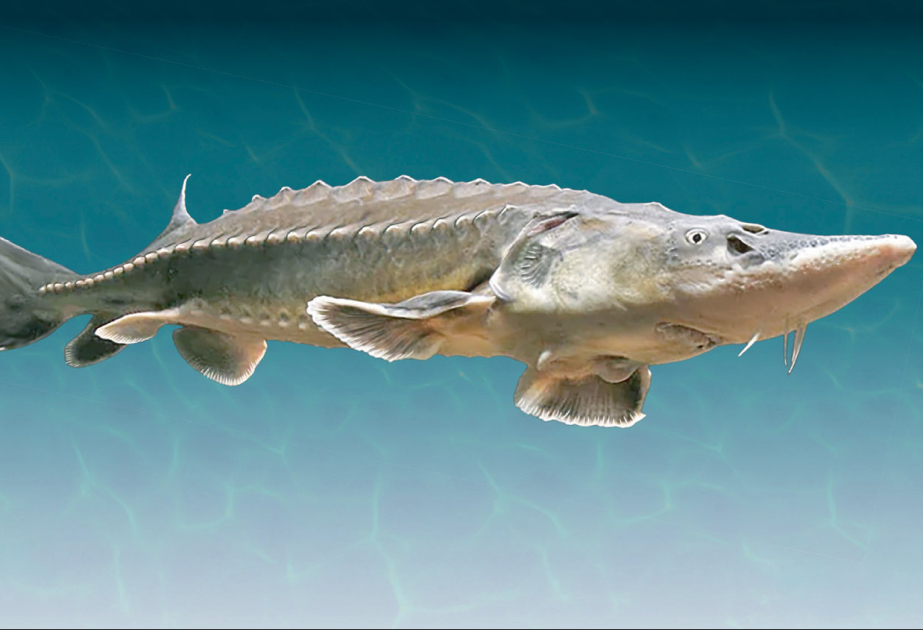
Baku, September 14, AZERTAC
As protection of the planet's flora, fauna and resources becomes increasingly important, China Daily is publishing a series of stories to illustrate the country's commitment to safeguarding the natural world.
In a high-stakes effort to save one of the world's most ancient fish species, Chinese scientists have built a self-sustaining captive population of the Chinese sturgeon — a critical breakthrough as the wild population teeters on the brink of total collapse.
Researchers have successfully raised third-generation sturgeon in captivity, meaning the artificial population can now reproduce on a large scale without taking a single fish from the river, according to Wu Jinping, an associate researcher at the Yangtze River Fisheries Research Institute of the Chinese Academy of Sciences.
Chinese sturgeon have existed for over 140 million years and coexisted with the dinosaurs during the Early Cretaceous period. They are often referred to as "living fossils" because their body shape and physical features have remained largely unchanged for tens of millions of years.
The breakthrough is of great significance for the conservation of the ancient species, Wu said, adding that stock enhancement has become one of the most effective measures to replenish resources in the wild.
With support from the Ministry of Agriculture and Rural Affairs, since 2024 China has released millions of artificially bred Chinese sturgeon back into the wild each year. Some 1.05 million Chinese sturgeon were released in 2025, and over 500,000 were released in the first half of 2026.
"Sustained, large-scale releases of high-quality sturgeon of different sizes can help meet the need to replenish the natural population," Wu said.
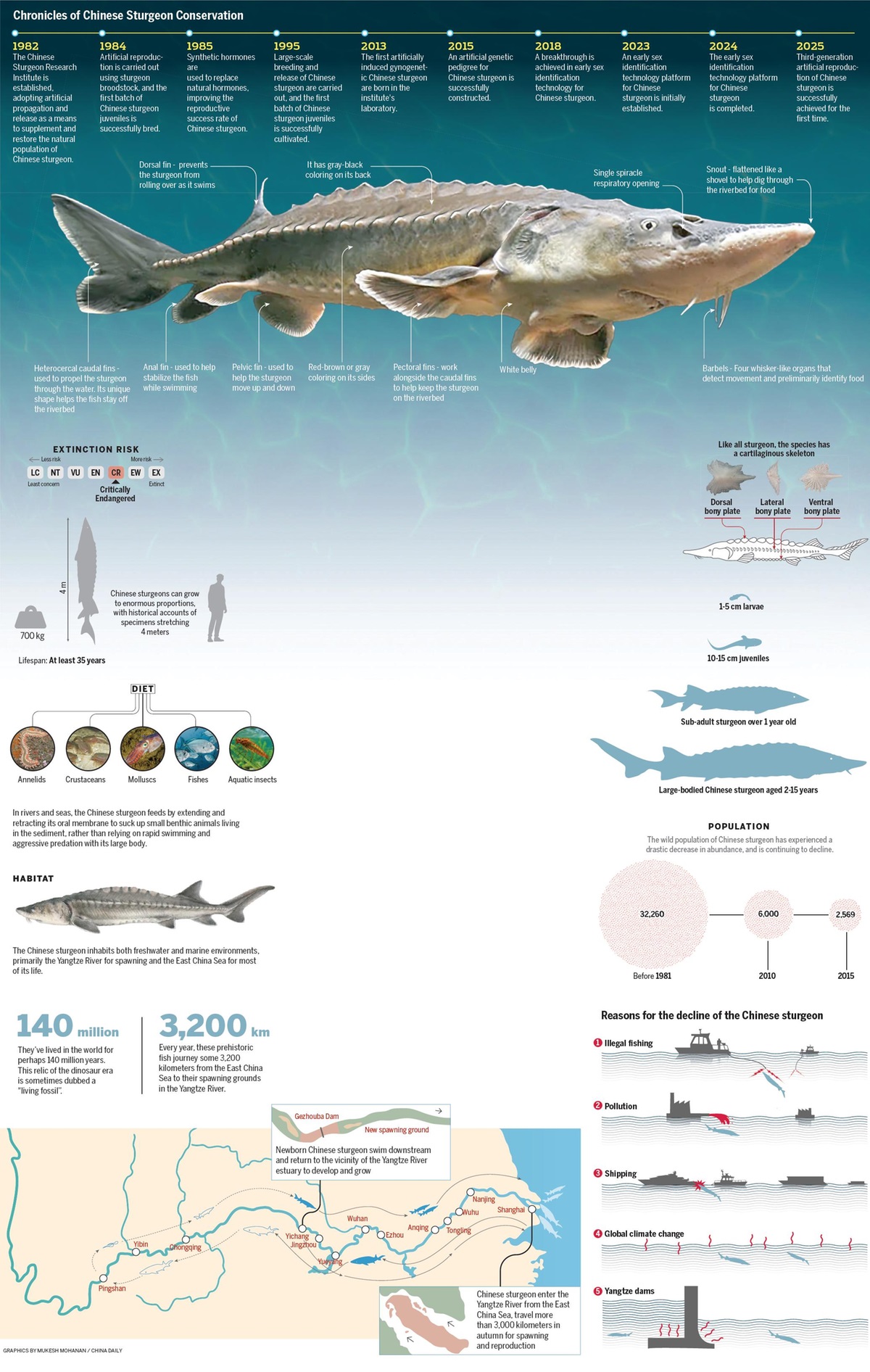
The Chinese sturgeon, an iconic species of the Yangtze River ecosystem, has been under severe pressure in the wild for decades. When the Gezhouba Dam was completed in 1981, it isolated the sturgeon from a 600-kilometer stretch of the lower Jinsha River and upper Yangtze River, which served as their major spawning grounds.
In 1982, a new spawning ground was discovered in a roughly 4-km river section between the Gezhouba Dam and Miaozui — which became the species' sole known breeding site.
However, this last refuge proved unable to sustain consistent reproduction, according to Wu, who said the first documented interruption of natural spawning occurred there in 2013. Although the breeding was rediscovered in 2014 and 2016, no natural spawning activity has been recorded since. Recent monitoring results show that the number of adult Chinese sturgeon migrating to the spawning ground below Gezhouba has fallen to just over 10 in each of the past three years. Hydroacoustic surveys detected 11 spawning adults in 2023, 10 in 2024 and 11 in 2025, he said.
Wu said the wild population is declining sharply and is on the brink of extinction. The halt in natural reproduction means the population cannot replenish itself effectively without intervention.
Restoring the wild population still faces major challenges, he said. While artificial breeding and releases can provide important support, scientists must further identify the key factors restricting natural reproduction.
He called for efforts to restore the ecological functions of key habitats, including engineering measures to improve the terrain and substrate of spawning grounds. Hydrological regulation should also be explored to create suitable conditions for spawning, including appropriate water temperature, water level, sediment concentration and flow velocity.
Monitoring of the species' marine life history should also be launched, Wu said, noting that stronger protection of key habitats across the sturgeon's life cycle will be essential for the long-term recovery of the species.
Other news in this section


