China completes world's third robotic arm-assisted heart transplant
Baku, October 16, AZERTAC
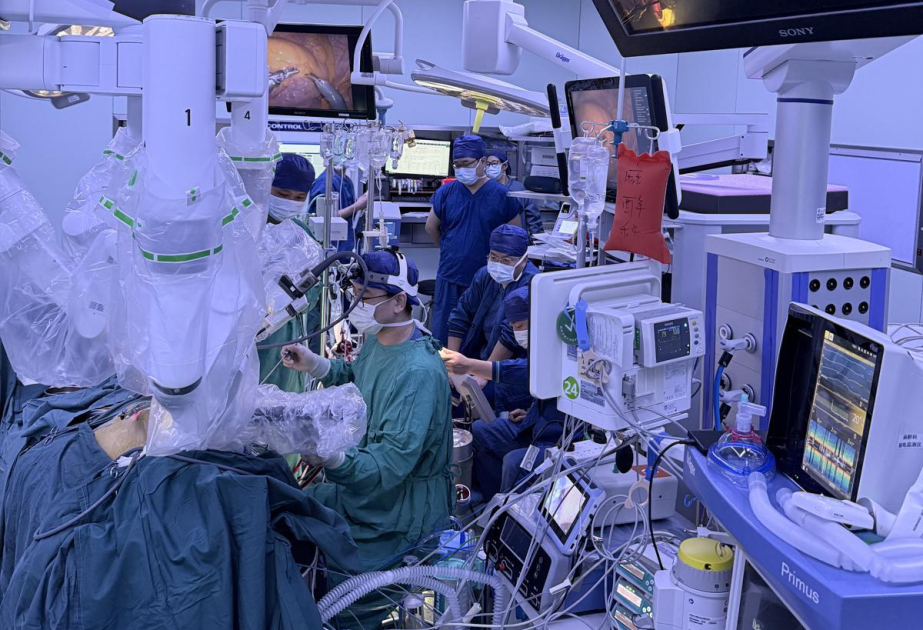
A 67-year-old patient recently received a heart transplant from surgeons operating robotic arms in his chest and making minimal incisions, according to China Daily. The surgery is the first of its kind completed in China and the third in the world, and it offers a new and safer surgical option for patients with end-stage heart failure.
A traditional heart transplant requires surgeons to split the sternum fully to open the chest, remove the failing heart, and implant a replacement. The procedure can trigger hemorrhaging and calls for an incision longer than 20 centimeters.
For patients with long-term heart failure and multi-organ injury, such surgery is highly risky, and many struggle to recover. In fact, conventional heart transplantation has a short-term postoperative mortality of between 5 and 10 percent, according to Yan Yang, director of the cardiovascular surgery department at the First Affiliated Hospital of Xi'an Jiaotong University in Xi'an, Shaanxi province.
Yan and his colleagues conducted the surgery on Oct 5 to treat an elderly man facing heart failure. He was unable to lie flat and developed severe swelling in both lower legs, alongside multiple underlying illnesses such as coronary heart disease, multiple lacunar cerebral infarcts, and emphysema.
"The extensive trauma from splitting the sternum can easily lead to serious complications including heavy bleeding, sternal infection, and delayed healing, making the procedure extremely high-risk. So we believe robot-assisted minimally invasive surgery was more suitable for him to survive and recover," Yan said, adding that heart transplantations are becoming more common as the population ages.
The procedure is in its early stage, but Yan believes it may eventually become routine as doctors switch over for the multiple benefits. In addition to the less invasive nature, the surgery can be performed remotely, even by doctors who are thousands of miles away. "Perhaps one day, through our continued efforts, we may truly make it possible for robots to perform heart transplants autonomously," he said.
Before the surgery, the doctors held repeated discussions and conducted simulation drills. Using three-dimensional image reconstruction, they were able to experiment with where to make an incision, how to move the machine safely inside the body, and which heart implantation approach was best.
During the operation, the surgeons made a single incision of approximately 8 cm between the ribs, without having to break the sternum. Two additional tiny trocar holes were created on the chest wall to allow the robotic arms to enter the thoracic cavity.
Within a magnified, three-dimensional display, Li Yongxin, deputy director of the cardiovascular surgery department, controlled the robotic arms with his thumbs and index fingers to carefully dissect the diseased heart. After removing the native heart, he implanted the donor heart and connected the major blood vessels inside the chest. Hypothermic preservation of the donor heart was maintained throughout the procedure.
According to Yan, robotic arms have greater rotation range, stability, and dexterity than human hands, and they can execute movements that humans cannot.
The donor heart resumed beating, and the patient was transferred to the Intensive Care Unit for postoperative monitoring. He was weaned off the ventilator the same day, whereas most heart transplant patients require one to two days on ventilation.
Using robots in heart transplantation remains in the early exploratory stage. Saudi Arabia did the first surgery in 2024 for a 16-year-old patient, and the United States did it in 2025 for a patient in their 40s.
Yan said the operation makes it easier for patients to get the treatment they need. "The core advantage of the robot-assisted transplantation is that it preserves the integrity of the thoracic cage, significantly reduces surgical trauma, shortens the recovery period, and lowers the risk of infection," Yan said, adding that this technique is particularly suitable for high-risk patients with end-stage heart failure who are elderly, burdened with multiple underlying conditions, and unable to tolerate the highly invasive conventional sternotomy procedure.
Li said the result was better than expected. "The patient can get out of bed and walk around every day now. His heart function has fully recovered, and he has more energy than before surgery," he said. With the procedure out of the way and the riskiest aspects mitigated, the team can put more energy into monitoring if the patient's body rejects the heart and helping him through rehabilitation.
According to Li, conventional surgery may require two to three months just for the bones to heal, but with this novel procedure, they are able to return to their pre-surgery state in just two to three weeks. With one to two months of recovery, they can get back to normal life.
Other news in this section


