The world’s oldest rock art discovered in Indonesia
Baku, January 22, AZERTAC
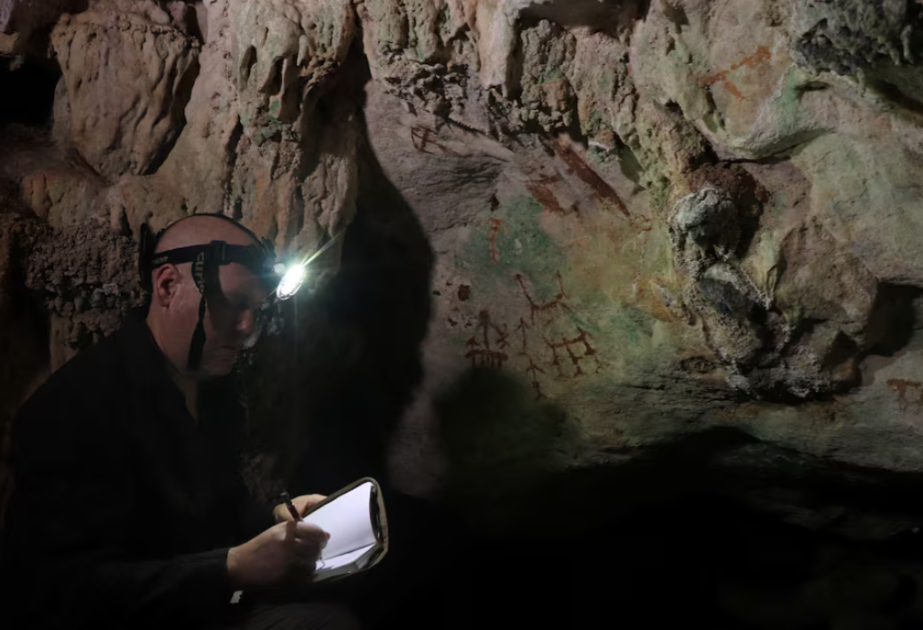
On Muna, a tropical island off southeastern Sulawesi, Indonesia, lies a cave decorated with prehistoric paintings, according to National Geographic. Locals call it Liang Metanduno. They visit the archaic art gallery to marvel at depictions of flying human figures, boats filled with passengers, and mounted warriors drawn with red, brown, and sometimes black pigment.
In 2015, Adhi Agus Oktaviana, an archaeologist at Indonesia’s National Agency for Research and Innovation (BRIN), travelled to Liang Metanduno in search of a much older form of human artistic expression, one that predated the birds, pigs, and horses painted on its walls only a few thousand years ago.
On the ceiling near a brown scribble of a chicken, Oktaviana found it: two hand stencils, one of which had a pointy finger like an animal claw.
Using a new dating technique, he and National Geographic Explorer Maxime Aubert, an archaeologist and geochemist at Griffith University in Australia, along with other colleagues, tried to determine the artwork's age. They discovered that the claw-like hand stencil is at least 67,800 years old—the oldest rock art attributed to modern humans found so far. They reported their findings Wednesday in Nature.
“The age of the hand stencil in Muna shows that early modern humans who inhabited Nusantara during the Late Pleistocene epoch already had sophisticated cognition,” says Oktaviana, referring to the area that is now the Indonesian archipelago.
The newly dated Muna art is about 16,600 years older than the rock art the researchers previously documented in the Maros-Pangkep caves in Sulawesi, and about 1,100 years older than hand stencils found in Spain believed to have been drawn by Neanderthals.
“This is the strongest piece of evidence that our species was present in [the] Indonesian archipelago at that time and they playfully and imaginatively transformed a human hand mark into something else,” Adam Brumm, an archaeologist also at Griffith University and a coauthor of the paper, said during a press conference.
The researchers also dated hand stencils found in two other caves on the surrounding islands. Their analysis shows the stencils were created between 44,500 and 20,400 years ago. That suggests the ancient inhabitants of Indonesia continued making rock art for tens of thousands of years until the peak of the last ice age, when sea levels were lower, and a chunk of Southeast Asia was part of an exposed landmass called Sundaland. The authors add that the findings may provide clues to better understand the population that crossed land bridges and hopped across islands to become the first inhabitants of Australia some 65,000 years ago.
To figure out how old the hand stencils are, the researchers used a technique developed by Aubert and others called laser-ablation uranium-series dating, which allows for the accurate dating of ocher-based rock art. This method uses a laser to collect and analyze a very tiny amount of calcium carbonate deposits that formed on the top of a pigmented layer.
At Southern Cross University in Australia, they used the technique and dated the claw-like hand stencil to between 75,400 and 67,800 years old, and the other hand stencil to around 60,900 years ago.
The Muna finding adds to recent discoveries of rock art in Indonesia that offer insight into early human intelligence. In 2019, Aubert and Oktaviana reported finding rock art depicting theriantropes—human figures with animal heads and tails—hunting warthogs and Sulawesi’s endemic dwarf buffalo, anoa. The narrative scenes, later found to be 51,200 years old, show that early humans living in Indonesia were capable of imagining non-existent beings. The newly dated hand stencils in Muna show signs that the artists who painted them also had this same cognitive ability, the researchers say.
Other news in this section


