Vusal Gasimli: Armenia will be held responsible under international law
Baku, November 13, AZERTAC
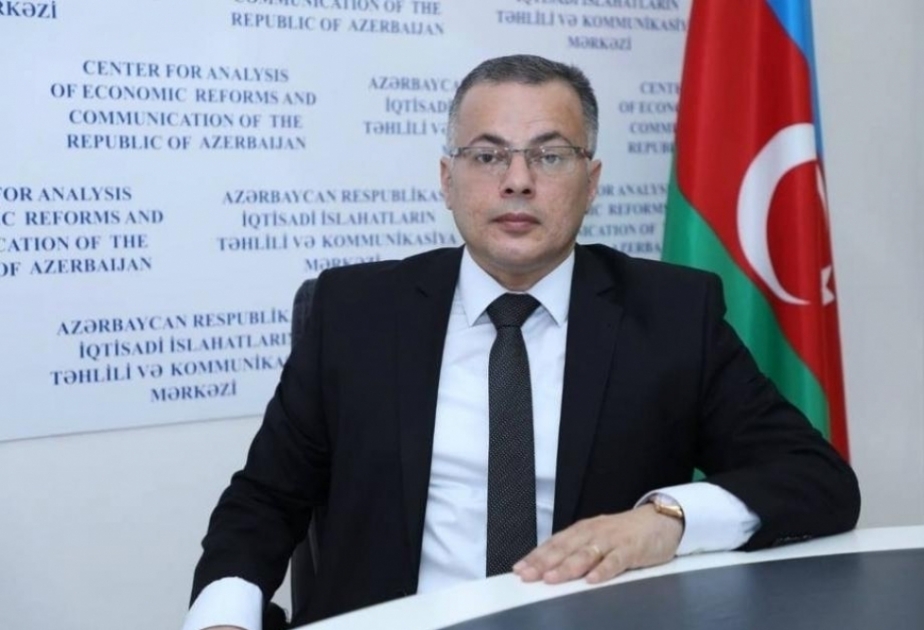
During the Patriotic War, by violating international legal norms, Armenia inflicted damage on civilians and civilian facilities located on the territory of Azerbaijan outside the combat zone. The Center for Analysis of Economic Reforms and Communication conducts systematic studies of Armenia's aggression against Azerbaijan, especially regarding the responsibility under international law. Executive Director of the Center for Analysis of Economic Reforms and Communication, Doctor of Economics Vusal Gasimli answered questions on this issue.
AZERTAC presents the interview.
-How can be the aggression of Armenia against Azerbaijan assessed through the prism of international law?
With the involvement of international experts, Azerbaijan will accurately calculate the damage caused by Armenia to our land, water resources, forests and minerals, as well as our property and cultural wealth.
For the damage caused to the peaceful Azerbaijani population, Armenia can be held accountable for violation of various areas of law, such as humanitarian law, the right to peace and human rights.
As a branch of common law, humanitarian law was formed earlier than the legal framework governing human rights. The "law of Geneva", based on the Geneva Conventions signed in 1949, "law of the Hague", based on the Hague Conventions (1899 and 1907), and some resolutions of the UN General Assembly set the basis of humanitarian law. Law of Geneva protects those who did not take part in hostilities, including the wounded, prisoners, civilians and others. The law of the Hague restricts and prohibits certain methods and means of warfare in order to prevent violence.
The Geneva Conventions consist of four parts, which deal with the treatment of the wounded in war, the victims of naval battles, prisoners of war and the protection of civilians in time of war (4th Convention). The International Committee of the Red Cross monitors compliance with the Geneva Conventions.
The "legal custom norms" on the protection of civilians during war, which is regulated by the 4th Geneva Convention, were approved by the UN and are customary applicable to all states or legalized by most of them. The legal custom norms are applicable to all states regardless of the ratification of the legal framework by them. In other words, the legal custom norms, for example, such as the protection of civilians in time of war, apply to states that have not ratified the Statute of the UN Court. From this point of view, it is possible to hold Armenia accountable for the crimes committed against Azerbaijan.
Some legal custom norms are considered more significant and accepted as peremptory norms (jus cogens), compulsorily applying to all. Although legal custom norms are not applied once the conflict with the legal basis of the state itself, peremptory norms are considered as an exception. Thus, these norms are considered important and unconditional obligations in the international arena, even if they are not legally confirmed by the state itself or reflected in any other way. These norms regulate such issues as international crime, crimes against humanity, aggressive politics (occupation) and aggressive war, genocide and slavery.
-Can we say that peremptory norms were violated against Azerbaijan?
That were exactly the facts of violation of peremptory norms, which have unconditional force in international law, against Azerbaijan. So, first of all, international law assesses the occupation of 20 percent of Azerbaijan’s territory as an aggressive policy, and the mass murder of people during this process speaks of the fact of waging an aggressive war or even of genocide, regulated by another peremptory norm. An important point is that the party that started the war is considered to be waging an aggressive war. That is, the international law does not consider the party that takes action in response to such military treatment as the one carrying out an aggressive war.
Aggressive war also leads to a violation of the Hague Conventions. These conventions prohibit the use of weapons and substances causing unnecessary suffering, the destruction and seizure of enemy property without military necessity, robbery and confiscation. As you know, the Armenians committed serious violations against Azerbaijan on all the points of these bans. There are recorded facts of use of white phosphorus shells and cluster munitions by Armenians firing them on the areas inhabited by civilians, as well as robbery and complete destruction of property belonging to our people in the occupied territories of Azerbaijan. Attacks with cluster munitions in densely inhabited areas also testify that the enemy violates the Convention on Cluster
Munitions. The use of cluster bombs against civilians in Ganja, Barda and other setllements led to mass losses.
-How are Armenia’s acts of vandalism towards cultural, historic and religious monuments of Azerbaijan reflected in the international law?
The Hague law also requires taking all possible measures for protecting cultural monuments and medical institutions. These requirements are reflected in another international legal document - the Convention for the Protection of Cultural Property in the Event of Armed Conflict. We should emphasize serious violations of the Armenians in this direction as well. The Armenians destroyed almost all historical and religious monuments in the occupied territories of Azerbaijan, or, showing no respect to our religion, kept pigs in the mosque. In addition, during 6-week conflicts, Armenians damaged more than 20 religious sites and historical monuments during armed attacks on Azerbaijani lands outside the occupied territories.
-How can Armenia be hold accountable under international law?
International legal responsibility obliges a subject of international law to eliminate the harm caused to another subject of the same category by the violation of international law, and to compensate for the damage caused. The types of responsibility of Armenia towards Azerbaijan include reparations, restitution, compensation and satisfaction. This responsibility is realized in two ways: tangible and intangible, each of which has different forms. Reparation is a process of remedying damage from the losing side that caused the damage to the winning side. Restitution requires the re-establishment of the situation that had existed before the commission of an internationally wrongful act. As an example of restitution can serve the release of illegally detained persons, the return of property confiscated illegally. Compensation, in modern international law, means financial compensation for material damage or moral harm. In international relations, compensation is the most commonly used form of repayment for damage. At the same time, the international law provides for such steps as the formal apology by the opposite party who committed the offense, or in other words, satisfaction, as well as the acceptance of the obligation not to commit such actions anymore.
-Referring to world experience, what can you say about the cases of application of international legal responsibility in practice?
Reparations were first applied after the end of the First World War. Treaty of Versailles of 1919 recognized the responsibility of Germany and its allies. They were held accountable to pay the compensation of 269 billion gold marks, which is equivalent to about 100 thousand tons of gold.
After the World War II, upon decision taken at the Yalta Conference of 1945, Germany and its allies were also obliged with payment of reparations. As a result, about 400 thousand railroad cars filled with cargo, 2885 factory equipment, equipment from 96 power plants, 340 thousand cars, 200 thousand electric motors, 1 million 335 thousand head of livestock, 2.3 million tons of grain, 1 million tons of potatoes and vegetables, half a million tons of butter and sugar, 20 million liters of alcohol, and 16 tons of tobacco were sent from Germany to the USSR. In addition, the telescopes of the astronomical observatory of the Humboldt University, Berlin subway cars, cruise liners and other technological equipment were moved from Germany as reparations paid to the USSR.
As another example can be shown reparation paid by Japan to Indonesia after the conflict between two countries. The peace and compensation treaty obliged Japan to pay reparation equal to 223 million dollars during 12 years.
Moreover, the United Nations obliged Iraq to compensate for the damage and loss caused by the illegal occupation of Kuwait in 1990-1991. To ensure the payment of compensation, the UN International Compensation Commission was established.
-What will be the mechanism for holding Armenia accountable for the crimes it committed against Azerbaijan?
International prosecution is also reflected in the Criminal Code of the Republic of Azerbaijan. From this point of view, the criminal prosecution of Armenians for crimes committed against Azerbaijan can be carried out both in accordance with international law and on the basis of domestic legislation. Complying with domestic legislation, persons found guilty of committing a crime are put on the international wanted list, then, arrested by the relevant authorities of the country where they are in, transferred to the investigative bodies, and brought to justice in the Republic of Azerbaijan. If this is not possible, international law and international courts are considering the ways of resolving this issue.
Responsibility for international crimes in Azerbaijan was first defined in the Criminal Code of 1999. Following the Article 10 of the Criminal Code, criminality and punish of action shall be determined by the criminal law exercised during commitment of this action. It means that the retroactive (reverse) application of criminal law is prohibited. If crimes against peace and humanity, as well as war crimes, are committed after that date, national courts can initiate prosecution.
The General Prosecutor's Office of the Republic of Azerbaijan carries out systematic and praiseworthy work in this area.
As already noted, the crimes committed by the Armenian side are considered an international crime and have universal jurisdiction. It means that relying on their domestic legislation, other countries can prosecute persons who have committed international crimes and conduct legal proceedings in Azerbaijan. For example, in accordance with their domestic law that is precisely based on universal jurisdiction, the prosecution of perpetrators of crimes against humanity and war crimes in Yugoslavia and Rwanda have been applied in practice in recent years in Denmark, Germany and other countries.
-What other forms of international accountability can we apply to?
In this regard, temporary ad hoc tribunals can be mentioned. Such bodies are created temporarily to resolve a specific conflict and bring the accused to justice. Tribunals of this type can be created on the initiative of the UN Security Council or the UN Secretary General following the decisions of the UN General Assembly. In world practice, special tribunals were created for Yugoslavia, Rwanda, Lebanon or Sierra Leone.
The International Criminal Court (ICC), operating under the Rome Statute, which was ratified by 124 countries, ensures that those responsible for international crimes are held accountable. Currently, the International Criminal Court deals with three types of crime: genocide, war crimes and crimes against humanity. Although the atrocities committed by the Armenians during the First Karabakh War covered all three areas under consideration by the court, unfortunately, it was not possible to bring them to the podium, since the Court does not have the right to exercise jurisdiction over any crime committed before the Rome Statute had entered into force. However, the behavior of the enemy during the Patriotic War, waged for the liberation of Karabakh from occupation, violates international law. Thus, for this reason Armenia can be brought for consideration to the International Criminal Court through the UN.
-How can we require payment of compensation from Armenia to Azerbaijan?
The United Nations Compensation Commission (UNCC) was established by Security Council Resolution No.687 in 1991 for ensuring that Iraq pays compensation for illegal occupation of Kuwait in 1990-1991. The Commission secured payment of 350 billion dollars in compensation for 2.7 million claims. The Commission regulates the payment of compensation for six categories of claims.
The International Court of Justice is the highest judicial body of the United Nations, the working principles of which are characterized by a wide range of judicial activities. Its main responsibilities include resolving legal disputes referred to states and providing advisory opinions on legal issues transferred to it by competent international bodies and structures.
Citizens of countries that have ratified the Convention for the Protection of Human Rights and Fundamental Freedoms can apply to the European Court of Justice established under this convention. However, protection under the Convention extends only to the relationship between a person and a government. That is, every citizen of Azerbaijan who suffered loss can bring the Armenian state to justice by filing a complaint accordingly. An appropriate work is going on in this sphere.
- Which steps are taken in the area of assessing the damage caused by Armenia?
Two methods can be applied to assess the damage caused during conflicts. The first is the assessment of direct losses, including the evaluation of the real cost of damage of the destroyed infrastructure. The second is collateral damage, covering an assessment of opportunities and ancillary benefits lost as a result of infrastructure destruction.
Impact assessment methods have been mainly used in various conflicts. For example, in 2019, the United Nations Development Program conducted a results-based impact assessment in Yemen. Also, in 2018, the World Bank conducted an assessment in Iraq to evaluate the damage caused by the war and determine the funds needed to build a new infrastructure system. The damage caused to the infrastructure destroyed by the terrorist organization ISIS was assessed covering various areas, including social and industrial spheres, utilities, destroyed houses, tourist sites, transport, government facilities, ecology, etc.
A State Commission was established in order to assess and eliminate the damage inflicted by Armenia to the civilian population and state property, including infrastructure facilities and business entities, on the territory of Azerbaijan starting from September 27, 2020.
Other news in this section


