Global map catalogs 459 rare continental mantle earthquakes since 1990
Baku, February 6, AZERTAC
Stanford researchers have created the first-ever global map of a rare earthquake type that occurs not in Earth's crust but in our planet's mantle, the layer sandwiched between the thin crust and Earth's molten core, according to Phys.org.
The new map will help scientists learn more about the mechanics of mantle earthquakes, in turn opening a window into the complexities and triggers for all earthquakes.
As reported in a study published in Science, continental mantle earthquakes occur worldwide but are clustered regionally, particularly in the Himalayas in southern Asia and the Bering Strait between Asia and North America, south of the Arctic Circle.
Through analysis of these deep quakes, scientists expect to gain unique insights into the crust-mantle boundary and the behavior of the upper mantle—the source of volcanic magma that partially drives tectonic plate movements.
"Until this study, we haven't had a clear global perspective on how many continental mantle earthquakes are really happening and where," said lead study author Shiqi (Axel) Wang, a former Ph.D. student in the lab of geophysics professor Simon Klemperer at the Stanford Doerr School of Sustainability. "With this new dataset, we can start to probe at the various ways these rare mantle earthquakes initiate."
Continental mantle quakes are too deep to cause much shaking or danger at Earth's surface. But their distinctive origins stand to advance multiple fields of Earth science, which could in turn improve understanding of risks from common, shallower earthquakes.
"Although we know the broad strokes that earthquakes generally happen where stress releases at fault lines, why a given earthquake happens where it does and the main mechanisms behind it are not well grasped," added Klemperer, senior study author. "Mantle earthquakes offer a novel way to explore earthquake origins and the internal structure of Earth beyond ordinary crustal earthquakes."
Above and below the Moho
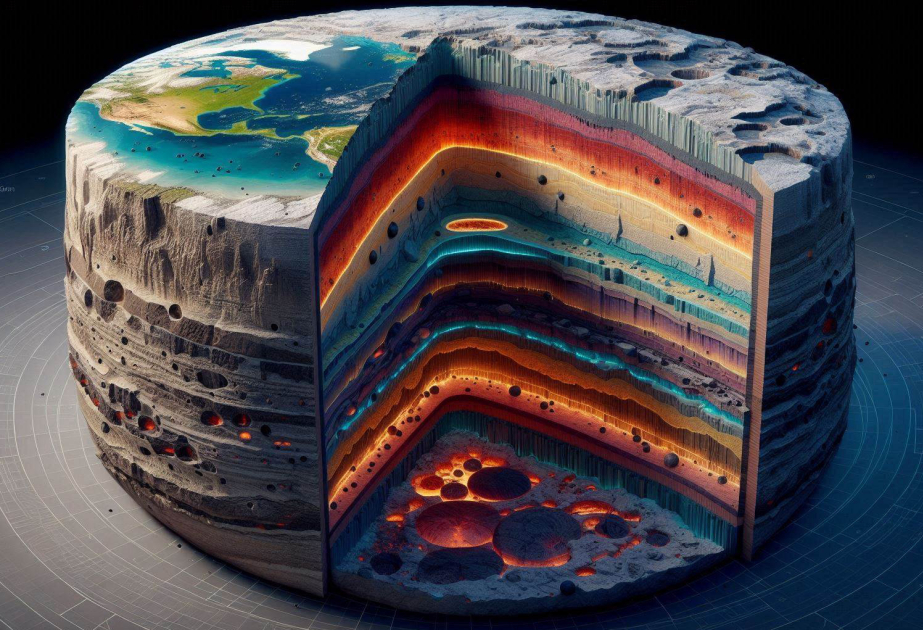
Unlike Earth's cold, brittle crust, the mantle is a warm, semisolid zone of dense rock about 1,800 miles thick that comprises the bulk of our planet's interior. The boundary between the crust and the mantle is known as the Mohorovičić discontinuity, also called "the Moho."
For decades, seismologists and geophysicists have debated whether the viscous mantle could support significant seismic activity. The points of origin of most continental earthquakes measure to depths of roughly 6 to 18 miles, which is squarely above the Moho and thus in the crust.
Noted exceptions are subduction zones, where denser oceanic plates dive under lighter crustal plates, sometimes unleashing quakes from hundreds of miles down. Yet sensor measurements have at times pointed to far deeper, sub-Moho hypocenters under continental landmasses, away from subduction zones, even 50 miles below the Moho.
Based on accumulating evidence, most researchers over the last 10 years have accepted that rare earthquakes do originate in the mantle, perhaps roughly 100 times less often than crustal quakes. But identifying them unequivocally has proved challenging due to a lack of data.
To distinguish mantle earthquakes from crustal earthquakes, Wang and Klemperer developed a method for comparing two types of seismic waves. These vibrations, generated by earthquakes and other phenomena, reverberate throughout Earth as if our planet were a rung bell.
The two wave types are called Sn or "lid" waves, a type of shear wave that travels across the top of the mantle known as the "lid," and Lg waves, which are high-frequency undulations that bounce around easily through the crust. The ratio of the waves' sizes determines their origins.
"Our approach is a complete game-changer because now you can actually identify a mantle earthquake purely based on the waveforms of earthquakes," said Wang.
Rarities galore
By poring over data from seismic monitoring stations worldwide and incorporating other critical information such as crustal thickness, the researchers whittled an initial set of over 46,000 earthquakes down to 459 identified continental mantle earthquakes since 1990.
The total number is conservative, the researchers said. A good deal more mantle quakes would likely be captured by expanding sensor networks, particularly in remote areas such as the Tibetan Plateau that ranges north from the dramatic uplift of the Himalayas.
Other news in this section


