Illegal activity and destroyed history at “Demirli” mineral deposit – INVESTIGATION
Baku, December 17, AZERTAC
The protest action initiated by Azerbaijani environmentalists, representatives of non-governmental organizations, public activists and volunteers demanding an end to the illegal exploitation of Azerbaijan's natural resources and monitoring of the “Gizilbulag” gold and “Damirli” copper-molybdenum deposits has been going on for five days now. Unfortunately, the discussions the monitoring group, which is expected to investigate the illegal exploitation of mineral deposits in the areas where Russian peacekeepers are temporarily stationed, held with the command of the peacekeeping contingent on 3 and 7 December have not yet yielded any results. Despite the demands of environmental activists, conditions for the monitoring to go ahead have not been provided yet. It has been announced that the monitoring did not take place today as a result of yet another provocation. The illegal exploitation of “Gizilbulag” and “Damirli” mineral deposits has been topping the country’s agenda since the first days of December.
AZERTAC is publishing a research by Sabuhi Huseynov, researcher at the Strategic Communication Center, senior specialist of the Institute of History of the Azerbaijan National Academy of Sciences.
The development of the “Damirli” (Armenians call it Kashen - ed.) mineral deposit was started by “Base Metals” JSC, a subsidiary of “Vallex” group of companies, in 2012. The copper-molybdenum ore obtained at the initial stage was taken to an enrichment plant located at the Gizilbulag deposit and processed there. The construction of “Damirli” mining complex commenced in April 2014. After only a year and nine months, the mining complex with an initial processing capacity of approximately 2 million tons of ore per year was commissioned.
Throughout the period of illegal operation, the company managers and political circles of Armenia attempted to portray their work as a lawful undertaking, pledging at early stages that the exploitation of the deposit would not have any environmental implications. In addition, the development of the field was concealed from the international community and environmental organizations.
The fact of the matter is that the site of the deposit was very rich both from a natural and historical perspective. This part of Karabakh had fascinating nature and forests. There were hundreds of historical and architectural sites belonging to the Azerbaijani people in several villages located and around the deposits. Many of these sites were ancient cemeteries, castles, churches, palaces, etc. related to Caucasian Albania.
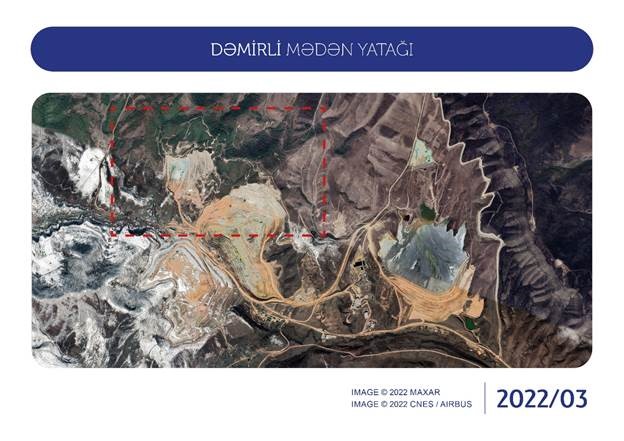
However, while engaging in illegal construction and mining activities in the area in an effort to start production as soon as possible, the company disrupted the natural and historical environment of the area and destroyed all our of its historical, architectural and archeological sites. As if this wasn’t enough, out of more than 850 hectares of land on which the “Damirli” mining complex is located, an area of about 82 hectares of forests, which included some of the most wonderful species of Karabakh trees, was razed to the ground. The political authorities of Armenia somehow managed to conceal this environmental tragedy and the savage destruction of cultural sites from the world.
In fact, the monitoring system of the “Global Forest Watch” organization shows that this environmental tragedy had resulted in the loss of only three hectares of forest cover for some reason. It seems that “Base Metals” and the breakaway regime managed not only to deceive ordinary Armenians living in Karabakh, but also to do that unbeknownst to international organizations.
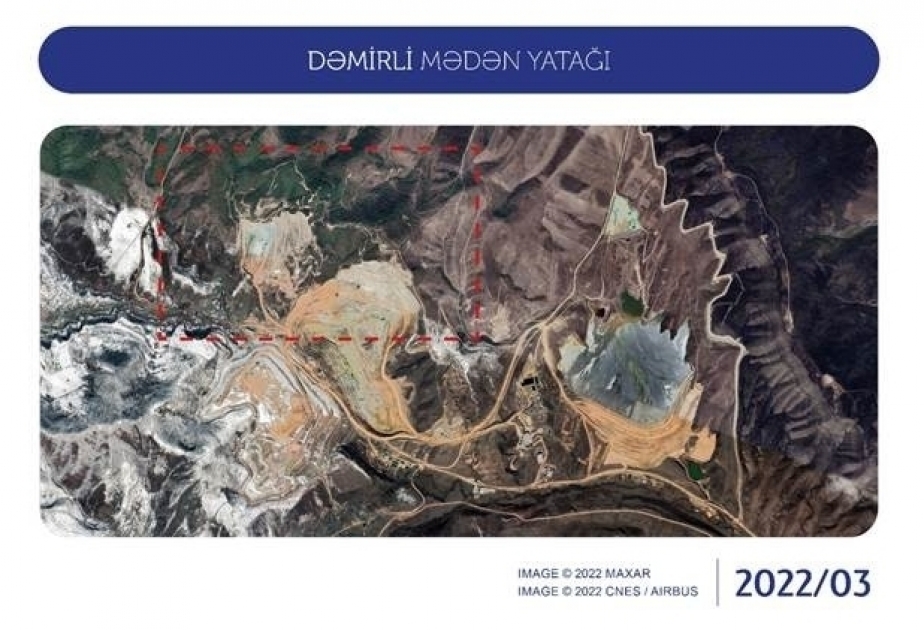
This investigation reveals evidence of barbarism committed during the construction and development of the “Damirli” deposit. To do this, the historical-natural environment of the area was recreated in the Geographical Information System and a comparative analysis of the current situation carried out.
Investigation method - remote sensing
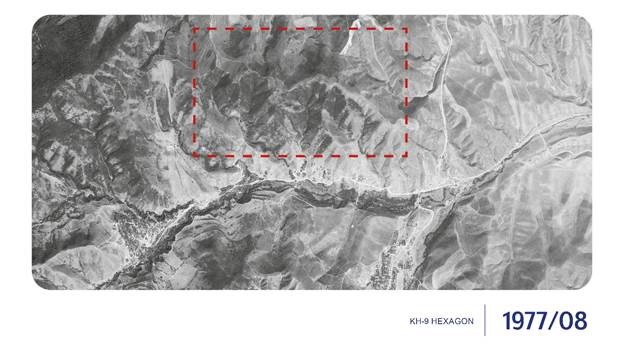
In modern times, remote sensing, especially the analysis of satellite imagery, is highly instrumental in documenting archaeological sites and conducting effective and successful research. Satellite images have recently become a reliable tool for documenting ecological, historical, historical and archaeological, monumental and other sites. The key advantage of this technique is that the researcher gets the opportunity to analyze the area where the site is located without actually visiting it. This investigation uses declassified American satellite images of 1977-1980, detailed maps developed by Soviet topographers, and topographic maps of the General Staff of the Soviet Union published in 1989.
The artificial satellites series known as the Hexagon program consisted of 20 reconnaissance satellites launched by the United States during the Cold War from 1972 to 1986. The satellites were sent into space to provide the United States with high-resolution images of the Earth, in particular to monitor the development of strategic weapons technologies in the USSR after the agreement on the limitation of anti-missile defense systems.
From 1979 to 1986, twenty reconnaissance satellites included in the program took pictures of almost every location of the Earth (including the territory of Karabakh). The satellite images provide information about the condition of any location on Planet Earth 30 or 40 years ago. The images are now stored in a special archive of the US Department of the Interior’s Geological Service. They contain scientific information on the state of natural resources, which is then monitored and analyzed. The Geological Service’s Earth Resources Observation and Science (EROS) Center is a data provider with a total of 29,000 scanned and declassified negatives of KH-9 satellite images. This study uses images of the Earth's locations captured by the KH-9 satellite as part of the Hexagon program.
Prior to the analysis, certain facts that surfaced in the Armenian media during the years of illegal exploitation of the “Damirli” deposit were also examined. In 2012, Armenian media outlet “Heqt.am” published an article on the results of an investigation by journalist Hayk Ghazaryan, “What is in store for the sites located in the territory of the Kashen (Damirli) deposit?”. When the construction of the mine was initiated, both “Base Metals” and the leaders of the breakaway regime were stating that there were no forests in the area. However, the Armenian journalist wrote in his article that this wasn’t the case. The article also stated that there were 2,500 monuments and tombstones in the area. When the matter surfaced in the media, the management of “Base Metals” promised that it would relocate the monuments.
Therefore, we managed to calculate the area of the forest cover as shown on a 1989 map of the area where the “Damirli” mineral complex was built by integrating the military-topographic maps of the Geographical Information System into the WGS-8 coordinate system. It is an area of 280 hectares.
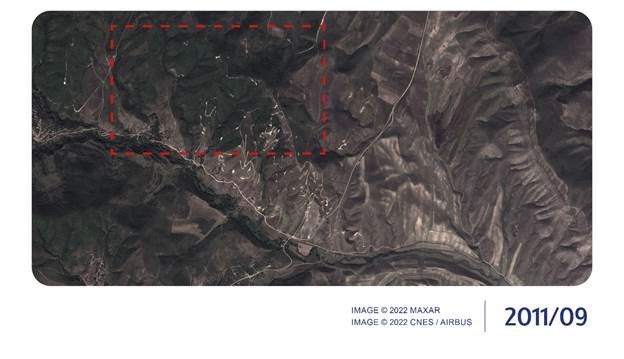
Then the forest area identified on the map was also confirmed by the images taken by the KH-9 satellite on 22 August 1977. A spatial analysis of the forest cover in the area was carried out in the Geographic Information System with reference to both pieces of evidence. If we compare the satellite images of the time when the mine was built with those of the modern era, we will see that “Base Metals” destroyed 82 hectares of forest in 2012-2015.
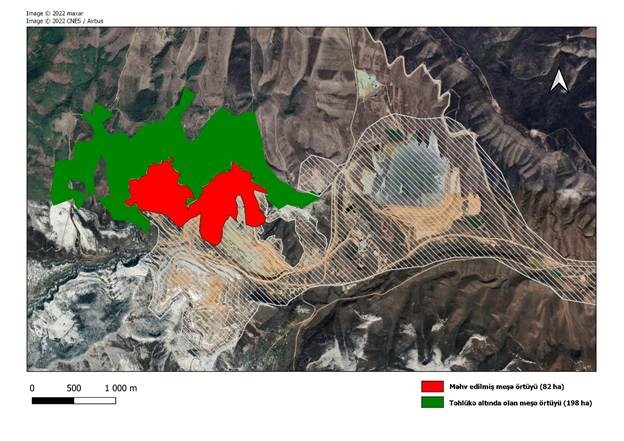
The revealed facts once again confirm the importance of establishing a monitoring group of representatives of the Ministry of Culture of Azerbaijan, scientists and experts to carry out inspections in the area together with environmentalists.
At issue is the destruction of more than 2,500 material and cultural sites on an area of more than 850 hectares we have already examined. These include the fortress of Melik Allahverdi, the Melik of the Cross, the fortress of Melik Israel, churches and other architectural monuments that are relics of the Albanian era, and hundreds of cross stones. The cross stones were Christian monuments belonging to Caucasian Albania and the Melik of the Cross of the later period.
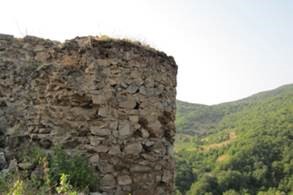
Fortress of Melik Allahverdi, the Melik of the Cross

Albanian grave in Gulyataq village
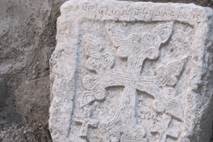
Albanian grave in Janyatag village
There is sufficient evidence in the scientific literature and archive documents on the resettlement of the Armenian population to Janyatag and Gulyatag villages after 1828. The areas populated by Armenians were rich in ancient monuments of Caucasian Albania. Some of them are archaeological sites. Archaeological excavations in the village of Gulyatag, where the mineral deposit was established, began as early as 1896. Back then, the Moscow Archaeological Society seconded a certain A. Ivanovsky to the South Caucasus. He conducted archaeological excavations in several locations around Karabakh, including burial mound No. 81 in the village of Gulyatag. The diameter of the mound was more than 40 meters. The report on these archaeological excavations is known to a number of archaeologists working in the region. At that time, A. Ivanovsky wrote that there were many burial mounds in the territories of Janyatag and Gulyatag villages. The material and cultural evidence he discovered made a significant contribution to further archeological research of the South Caucasus.
Armenian scientists who conducted research in the village of Gulyatag acknowledged that Melik Allahverdi's castle was located in the village. The castle was 34 meters long and 14 meters wide. There were medieval ruins 4 kilometers southwest of the village. In addition, there was a cemetery nearby rich in ancient tombstones belonging to Caucasian Albania.
There were six such monuments in the village of Janyatag, which is famous for its anthropomorphic sculptures of Karabakh. This was established as a result of a research conducted in 1964-1987. However, the stone monuments then mysteriously disappeared. Their fate still remains unknown. In 1973, the number of monuments in the villages of Janyatag, Mollalar and Shafibayli reached 10.
There was a place in Gulyatag village where Karabakh horses were kept at the time of Tsarist Russia. The fate of this historical site also remains unknown.
In 2012, a journalist of Armenian publication “Hetq.am” wrote in his article: “It is not clear why historians of “Artsakh”, who have yet to express an opinion on this situation, remain silent.” The company, which stated during the construction of the mine that the monuments would be moved to a different location, then simply destroyed them secretly under the mine. As a matter of fact, it was not possible to move those monuments to a different location.
Other news in this section


