President Ilham Aliyev attended the opening of the 4th Global Baku Forum VIDEO


Baku, March 10, AZERTAC
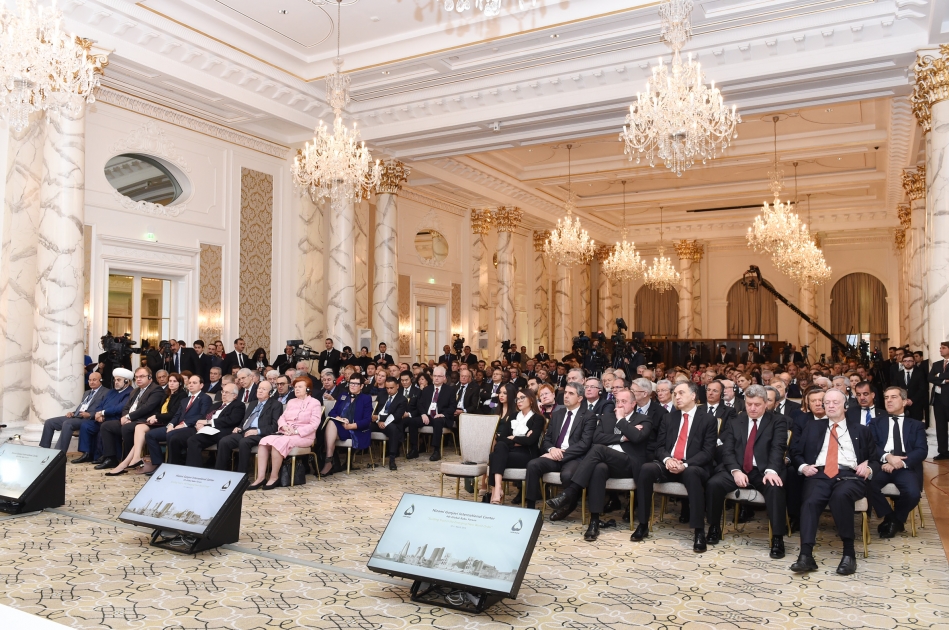
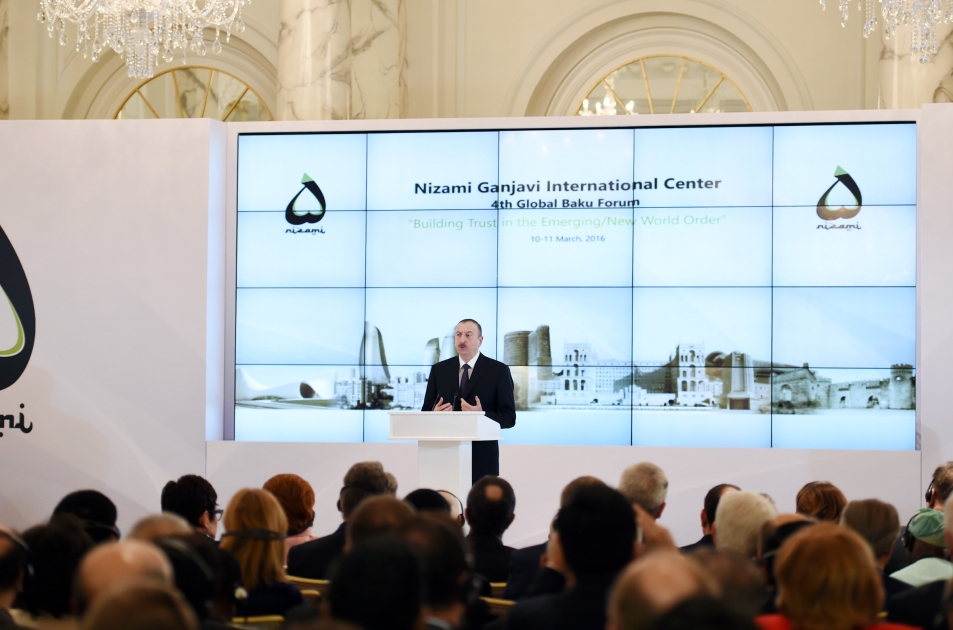
The 4th Global Baku Forum entitled "Towards a Multipolar World" has today kicked off in Baku.
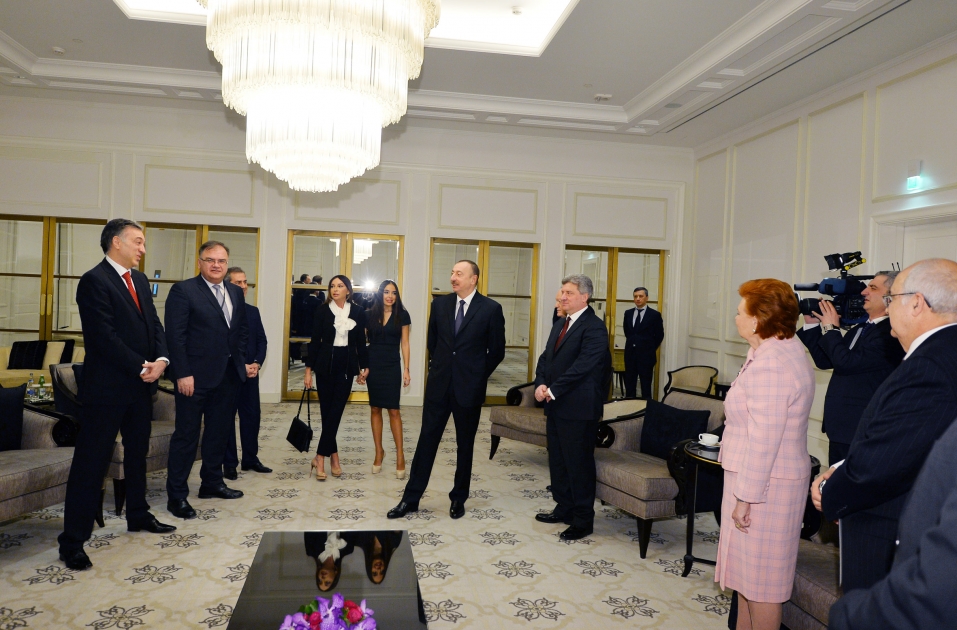
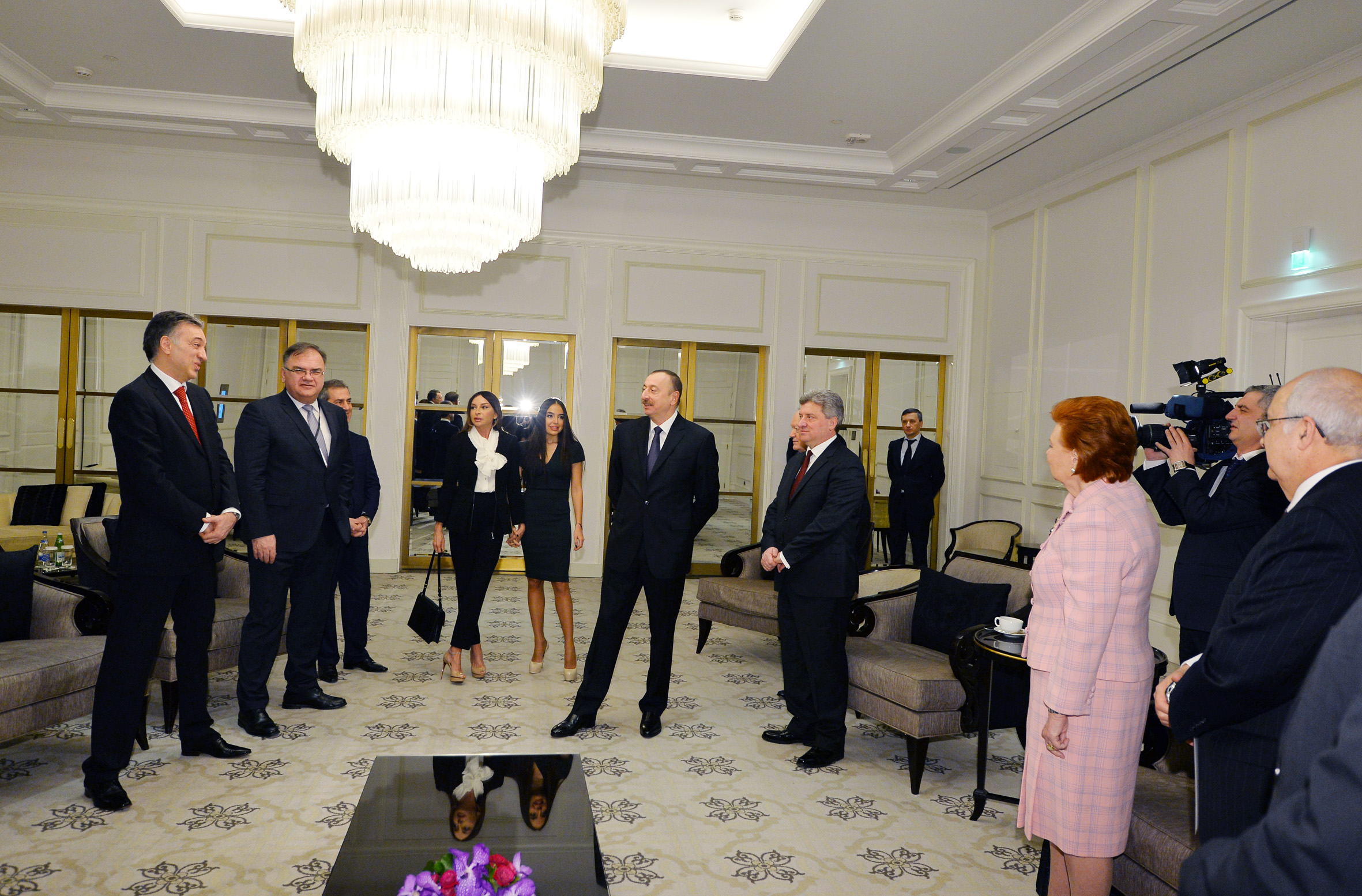
President of the Republic of Azerbaijan Ilham Aliyev and his spouse Mehriban Aliyeva attended the opening ceremony of the forum.
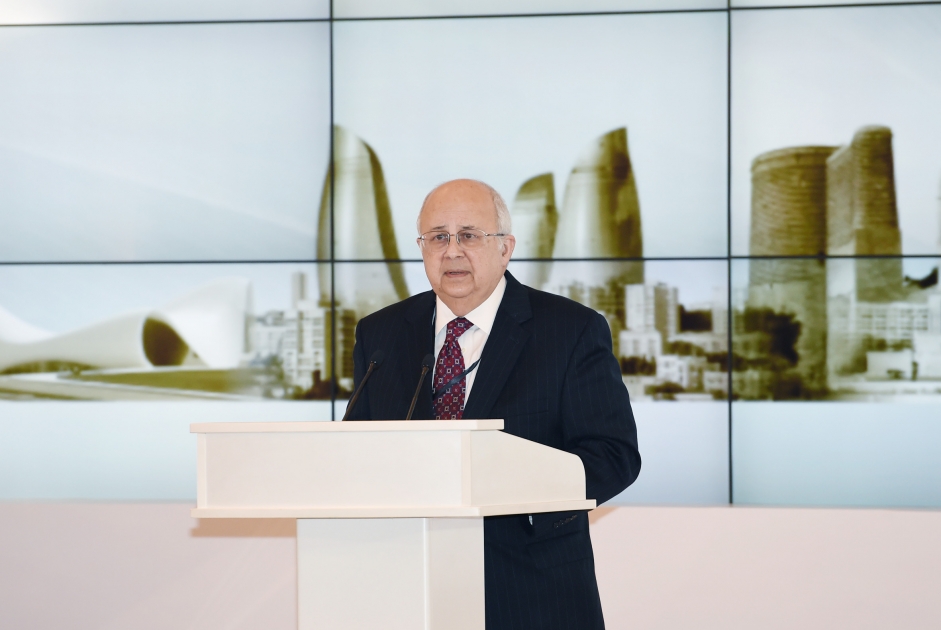
Co-chair of the Nizami Ganjavi International Center, Director of the Library of Alexandria Ismail Serageldin declared the forum open.
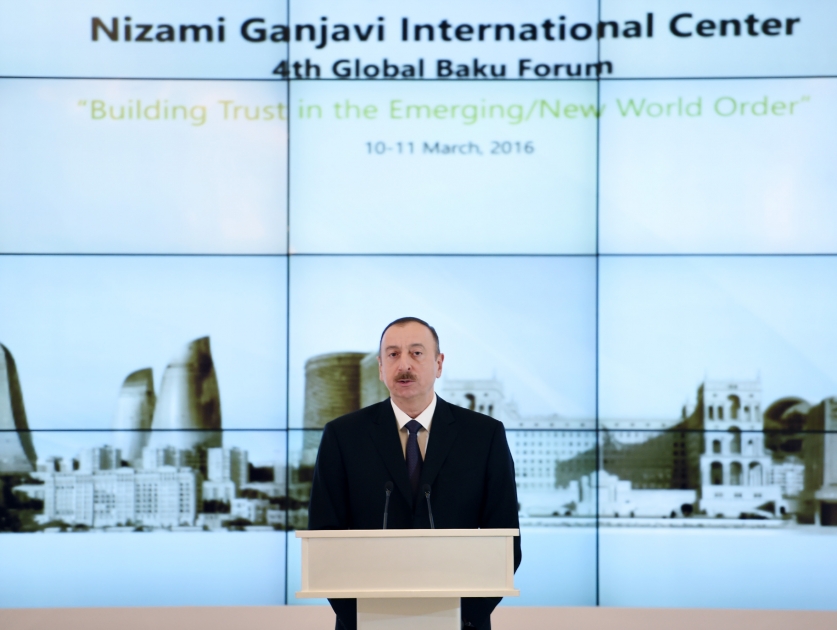
The head of state addressed the ceremony.
Speech of President Ilham Aliyev
Dear ladies and gentleman,
Dear guests,
First of all I would like to welcome you all to Azerbaijan. I am very glad to see you again, and I am very glad that Global Baku Forum becomes a good tradition.
First of all I would like to express my gratitude to Nizami Ganjavi International Center, its board and its co-chairs, Madamme Vaire Vike-Freiberga and Mr. Ismail Serageldin for their outstanding contribution to transforming in a very short period of time Nizami Ganjavi International Center into a world scale international institution.
Today, we will discuss broad issues of international agenda. Of course, the topics of the discussions are very important for all of us, for the whole mankind. I am sure that the guests who participate at the forum will contribute with their valuable thoughts and ideas to the cause of peace, security, predictability in the world. Every international forum, its level mainly depends on the list of participants. We have among our guests more than 50 acting and former heads of state and government, prominent politicians, public figures, experts. Therefore, this actually shows the level of discussions which we will have today and tomorrow.
Situation in the world has changed since we met last spring. We all witness that and, unfortunately, the changes are not in the positive direction. The world didn’t become more safe and secure. On the contrary, it became more dangerous. Situation in our region also changed dramatically. Existing conflicts still remain unresolved. But we have now new conflicts, new areas of confrontation and threats. Therefore, I think that our main goal is to play our role as countries, as governments, as politicians, in order to try to reduce the tensions, in order to try to create the grounds for cooperation, mutual understanding, mutual respect. Otherwise, situation in the future will continue to deteriorate.
Situation in the Middle East, situation in part of Europe, refugee crisis - these are all realities of the recent years. Therefore, I think one of the main objectives of the 4th Global Baku Forum is to address these issues. Especially, taking into account the level of participants and their contribution to the world affairs, their experience, knowledge, that may help to find a way out from the existing situation.
I think we are all united in one objective to promote cooperation, mutual understanding, stability and peace because we are all inter-related. Sometimes it may seem that what we see on TV, these dangerous events happening in the different parts of the world are happening on another planet. But it is just next door. And the crisis of refugees showed that we are all inter-related and every action, every step, every interference in internal affairs of other countries will definitely result in difficulties for those who interfere.
So that, I think, is the main lesson of today’s reality. We all need to respect each other, we need to respect our choice, our territorial integrity, our plans for the future. We all need to interact because the main goal is to reduce tensions and diminish existing threats.
This year Azerbaijan will celebrate the 25th anniversary of its independence. During these years, especially in the early years of independence we suffered from a civil war, from a humanitarian crisis, from occupation, aggression, economic difficulties and actually economic collapse. Azerbaijan became a target for terrorist attacks. Armenian terrorist organizations committed numerous acts of terror in the beginning of 1990s against the civilians, and the conflict between Armenia and Azerbaijan, unfortunately is not resolved.
Though, our country achieved a lot of success during the years of independence and today is developing as a modern, stable, predictable, self-sufficient country. The conflict still needs to be resolved. It needs to be resolved in order to allow a million refugees of Azerbaijan to return to their homes, needs to be resolved to stop violence and establish peace in our region because without that all the countries will suffer. Armenia which continues to occupy illegally the historical part and legal part of Azerbaijan did not benefit from that. The economic difficulties, isolation, migration, poverty are the result of that aggression and occupation. Nagorno-Karabakh is a historic part of Azerbaijan, legal part of Azerbaijan. All international community recognizes Nagorno-Karabakh as an integral part of Azerbaijan. As a result of the conflict one million Azerbaijanis became refugees and internally displaced persons. We were a subject of ethnic cleansing, occupation of almost 20 percent of our territory continues. International organizations, particularly the United Nations and its Security Council, adopted numerous resolutions demanding unconditional and immediate withdrawal of Armenian troops from the territories of Azerbaijan. Unfortunately these resolutions are not resolved, they are not implemented.
Of course, the mechanism of implementation of resolutions of Security Council of United Nations, I think, should be also a special topic of discussions. In some cases, resolutions of Security Council are being implemented within hours or days. But in our case it is more than twenty years. That shows that there is a lack of political will, especially of those countries which adopted these resolutions.
Today negotiation process continues without any success and the main reason for that is that Armenia doesn’t want peace. They want to keep occupied territories under their illegal control, they want to keep status quo unchanged. But this is not possible, status quo must be changed and the countries which are chairing the negotiation process - the three permanent members of United Nations Security Council - on numerous occasions publicly spoke about that, saying that status quo is unacceptable and must be changed. To change the status quo Armenia needs to leave the occupied territories. They need to stop occupation. In the 21st century it is absolutely abnormal from all points of view - political, legal and humanitarian - to occupy illegally the territory of the neighboring country and block the negotiation process.
Therefore, I think that in order to resolve the conflict, first Azerbaijan must become stronger and this is happening, and second international community especially those who have a mandate to deal with this conflict, must show the political will and force aggressor to stop occupation as we see in many other places in the world when aggressors are stopped, punished, sanctioned and forced to stop aggression.
Everything is destroyed on the occupied territories. OSCE sent twice a fact-finding and field assistance admission to the occupied territories and they reflected the real situation and we know that. All our historic monuments, graves, our mosques are destroyed. Today, we have many TV reports about the destruction of historic monuments in the Middle East. Twenty years ago, the same happened in occupied territories of Azerbaijan. The difference is that at that time international community and media didn’t pay attention or probably didn’t have access to that information. But it’s the same. The same story, and the same approach. And this is dangerous, this is dangerous for the future peace and security in the region because if the aggressor is not punished, then they will plan another scenario.
Despite this situation and also humanitarian crisis which we faced in the beginning of 1990s, Azerbaijan successfully develops. By the way, we had the highest per capita number of refugees at that time. One million people became refugees and internally displaced on their own land. At that time the population of Azerbaijan was something more than eight million. So we know how to deal with humanitarian crisis.
At that time Azerbaijan was different from today’s Azerbaijan. It was a very poor country, just a newly-independent state, its economy was ruined, industry collapsed. There were no prospects for the future. So our main goal was to establish a state, to create a strong economy, to open the country for foreign investments and to become part of world market economy.
And that happened. Today the country is stable, we continue the reforms. Political, economic reforms go in Azerbaijan in parallel, all the fundamental freedoms are provided - freedom of expression, freedom of assembly, religious freedom, media freedom, we have free internet, no censorship for almost 20 years and more than 70 percent of our citizens are internet users.
Political freedoms are supported by economic reforms. From 2004 to 2014 Azerbaijan’s economy was the fastest growing economy in the world. We managed to dramatically reduce unemployment and poverty down to 5 percent. Economy became more competitive and according to Davos World Economic Forum Azerbaijan’s economy is number 40 in the world with respect to its competitiveness. We implemented many infrastructure projects including social infrastructure projects to improve living standards of our people and at the same time create better conditions for investments.
We were among the countries which received per capita one of the biggest amount of direct foreign investments primarily into oil and gas sector. Now our goal is to attract investors to non-oil and gas sector. Reduction of dependence on oil and gas was part of our reforms. As a result of these reforms today oil and gas makes only something more than 30 percent of our GDP and about half of our budget revenues. So the target is to completely reduce dependence on oil and gas. As I said recently, for Azerbaijan the post oil period already started. Not because we reduced the production but because the price of oil collapsed four times. Therefore, it is absolutely new situation. No country in the world was prepared for that. Nobody could even imagine that it will be so dramatic and the oil prices will fall four times. And it happened within one year. So we have to work very actively and efficiently in order to reduce negative impacts of this situation. Now our financial situation is again stable, predictable. By the way I’d like to inform you that our budget is based on the price of oil of 25 dollars per barrel which is a kind of a guarantee from any kind of economic complications. We have a substantial amount of reserves in our oil fund and that allows us to find a way out from this situation with minimum risk.
At the same time, this situation forces us to be more efficient with reforms, and the big package of reforms which is already introduced, by the way, is supported by the International Monetary Fund. So we are on the right track. We are dealing now mainly with the issues of diversification of economy, finding the new areas of economic development. One of them is transportation infrastructure. We work already in this area for many years, but it is new for international community. We are building the transportation network which will allow Azerbaijan to have a strong position in this region in the future.
Our geographical position is very preferable. So investments in transportation infrastructure including railroads, airports, seaport allow us to be a crossroad of transportation infrastructure. The East-West transportation corridor has already started to work, and hopefully this year we will finalize the connection of railroads between Azerbaijan, Georgia and Turkey. Thus Europe and Asia will have a new, the shortest transportation route and the first container train from China to Europe already passed through Azerbaijan. So this is a new Silkroad with a modern infrastructure, and we made a proposal to our partners to have single tariffs in transportation in order to make this route attractive.
Another transportation route which we are actively working on with our neighbors and partners is North-South transportation route. This will allow cargos to be transported from Pakistan, India, Iran, Azerbaijan, Russia, Northern Europe. Azerbaijan is investing in the modern infrastructure and hopefully very soon this route also will be in operation. So all these routes are crossing our territory and, of course, this increases the geopolitical importance of our country. This will generate additional revenues which we will use for development of our country in the future.
Of course, energy sector remains very important for our economy and now more important for energy security. Just late this last month, on 29th of February we had in Baku in the same room the second meeting of the Advisory Council of the Southern Gas Corridor, which we call a project of the 21st century. It is a mega-project, one of the biggest infrastructure and energy projects in Europe initiated by Azerbaijan. Azerbaijan plays a leading role in that project as initiator, organizer, and investor. This is a project of 45 billion dollar investments. We established a strong team of countries and companies.
The purpose of having this Advisory Council was to coordinate our efforts and to meet the targets of implementation of this project because it will be implemented in stages. Southern Gas Corridor is a project of four elements: production, gas from the new field, huge gas field of Azerbaijan, and then three integrated gas pipelines. That will allow us to connect Baku and Italian ports with the 3500 km pipeline.
Of course, it’s a huge investment and at the same time this project needs coordination. So in this room on February 29th, eleven countries plus European Commission signed a declaration which underlines the key and strategic role of Azerbaijan as a main enabler of the implementation of the Southern Gas Corridor. We really established a team of countries. I will name the countries in accordance with the route of the pipeline: Azerbaijan, Georgia, Turkey, Greece, Bulgaria, Albania, Italy are members of the Southern Gas Corridor project. We have two more signatories to declaration - Croatia and Montenegro, which, I am sure, will join the team in coming years, and also the high representatives of the governments of the United States and United Kingdom and the vice-president of European Commission. So we have 12 signatures, which actually shows that the Southern Gas Corridor already is a reality.
This is a project of energy security, energy diversification, free competition. I think this is how energy projects should be implemented. Our main goal is to implement the project and to treat it as a commercial project. Sometimes issues related to energy security are too much politicized and we are against of that. Politics and energy should be separated. Energy should not be used as a political tool. At the same time, political instruments interfering into the business development also sometimes create complications.
Therefore, this is a project for Azerbaijan to be able for decades ahead to explore its natural resources to diversified markets. For Europe it means additional source of gas which Europe will need because we all need the demand of European consumers. Though today we see the economic difficulties in the world, and this is temporary. The price of oil will not remain at this low level. Economic growth will generate activities. Therefore, the demand for natural gas in Europe will only grow. And there will be enough room for everyone. I think that the producers also need to coordinate their efforts in order to avoid unnecessary competition because producers have their own goals and consumers have their own goals.
I think that in the project of Southern Gas Corridor we managed to provide the balance between producers, transitors and consumers. So it’s a win-win situation. That’s why it develops successfully. To implement such a huge project with so many participants in a short period of time, in a time when the oil price is down and you have to spend billions, is a serious challenge. Energy security will definitely dominate the political agenda. I think the example which we show in Southern Gas Corridor demonstrates that when energy and politics are separated you can achieve success.
This year in Azerbaijan is a year of multiculturalism. For centuries people of different nationalities, ethnic roots, religions have lived in Azerbaijan in peace and dignity. And we are proud of this situation. We are proud that during the years of independence these positive tendencies became only stronger. Multiculturalism, religious tolerance is a state policy in Azerbaijan. And at the same time, this is also reflection of the mood of the society. And that’s important because state policy and general atmosphere in Azerbaijan in this respect is not different.
In 2008 we launched Baku process when we invited the ministers of culture of members of Islamic Cooperation Organization to participate at the meeting of the ministers of culture members of the Council of Europe for the first time. And that worked. Now, Baku process became a reality. We organize numerous events in Azerbaijan, promoting the values of multiculturalism - World Religious Leaders’ Summit, Humanitarian Forum, twice intercultural dialogue Forum. This April, in one month we will have the 7th Global Forum of Alliance of Civilizations organized by United Nations.
Azerbaijan’s experience in this area is highly appreciated by leading international organizations, by international community and it demonstrates that multiculturalism is alive, it has a future. But I think that politicians, those who can influence on public opinion, including media representatives must be more responsible. Of course, I think that the role of media in this respect must be more positive because unfortunately, what we see in the news mainly is pictures of confrontation, refugee crisis and difficulties in that regard.
This leads only to alienation. We cannot afford alienation because, as I said before, we are all interconnected, we are all living on the same planet and the distance between Europe and the Middle East as we all see is not very long. And even if it is long, it does not prevent people from finding or trying to find shelter and to save their lives, lives of their families. Therefore, I think the concentration on the positive examples of multiculturalism and promotion of these values will help all of us because no country, no nation can live in the future in isolation. We are all interconnected. Absolute majority of the countries of the world have multi-ethnic, multi-religious population. We must be proud of that.
Last month we were celebrating the inauguration of Imamzade religious and historic monument after restoration, renovation and new construction. It is one of the sacred places in the Muslim World, which is by the way situated in Ganja, the motherland of Nizami Ganjavi, and which Azerbaijani people protect since the 8th century. The new mosque was build there, and we had a ceremony. I invited all representatives from all the regions of Azerbaijan and at that ceremony along with myself other speakers were leaders of traditional religions of Azerbaijan. Leader of Azerbaijani Muslims, leader of Azerbaijani-Russian Orthodox Church, leader of Azerbaijani-Jewish community and leader of Catholic Church. They not only participated, but spoke in front of the audience. Then we jointly moved into the newly-built mosque, and were there together. This is how it works in our country. That was a message to our society, that was a message to our people, that was a message to our world.
A couple of months before, in one of the biggest mosques of Azerbaijan, Shia and Sunni Muslims prayed together. It was named a Unity Namaz for the first time. This also demonstrates the real situation here where there is no distinction neither inside the Muslim community, nor inside our society. And this is a reality of Azerbaijan, this is probably one of our biggest assets and this is a main guarantee for successful development because without this consensus, without unity we cannot achieve success. And we want to achieve more success, we want to continue to modernize our country and only based on these common values of friendship, multiculturalism, we can achieve that.
Last year Azerbaijan hosted the inaugural European Games, in 2012 we hosted Eurovision Song contest, Baku was announced the capital of Islamic culture and next year we will host Islamic Solidarity Games. Azerbaijan is a member of Council of Europe, member of Organization of Islamic Cooperation. It is a bridge between cultures, between traditions, between religions. This is our responsibility. We play this role first of all in order to provide successful development of our country and also in order to create most stable and predictable situation in the region.
I am sure that discussions on the important topics of the program will contribute a lot to positive development in our region, in the world.
I wish the forum success.
Thank you.
X X X
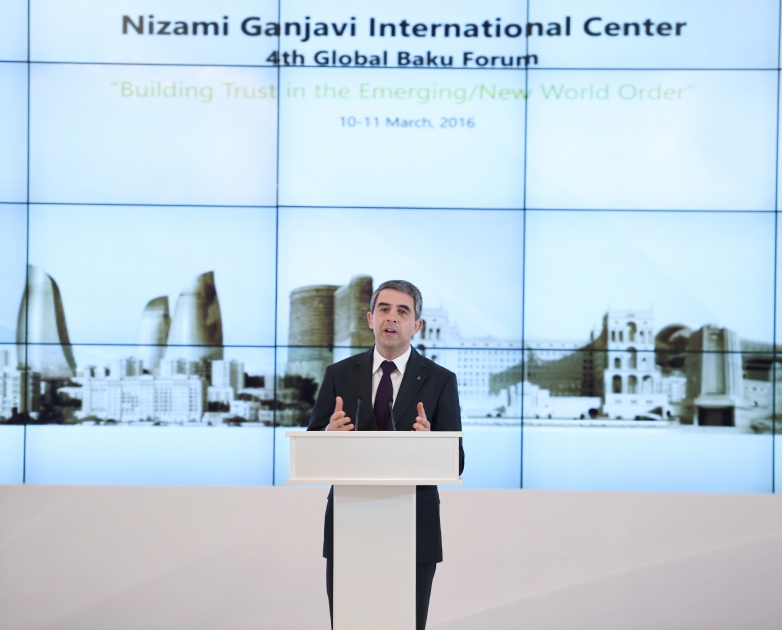
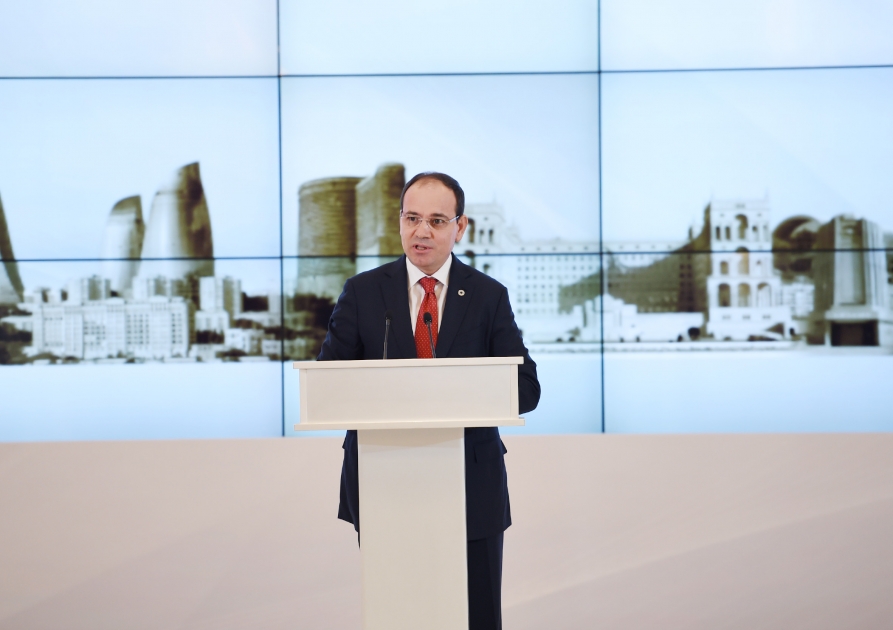
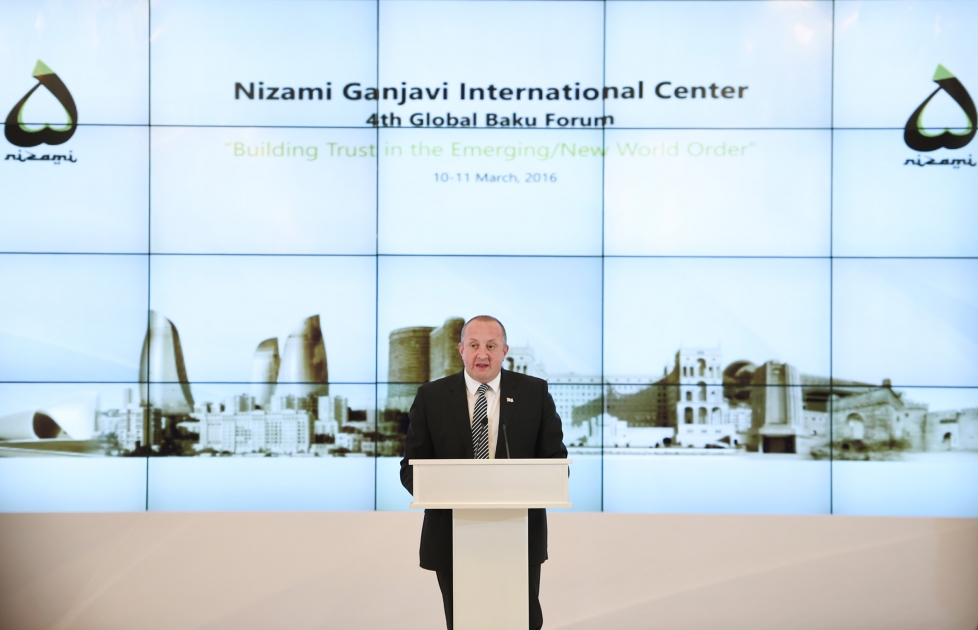
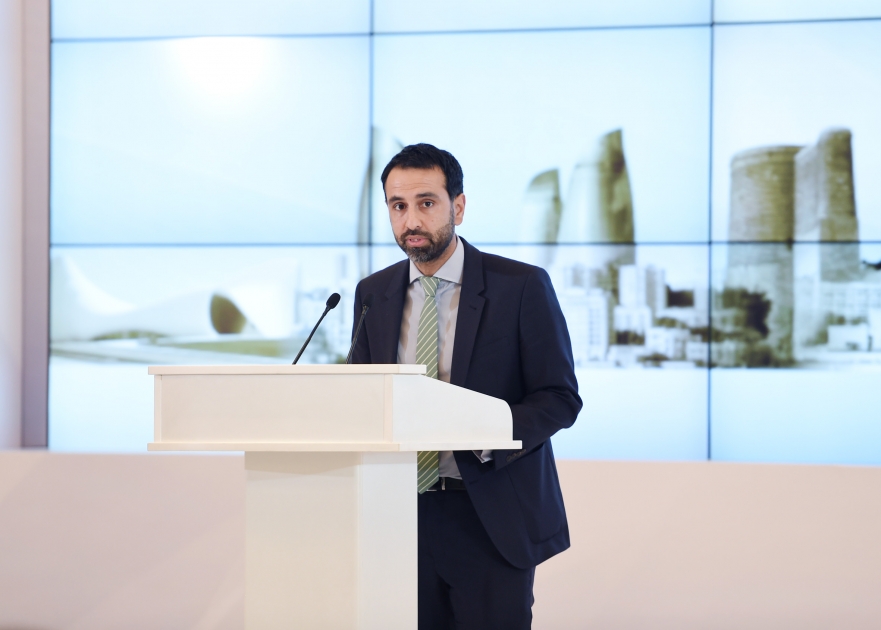
The event heard speeches from Bulgarian President Rosen Plevneliev, Albanian President Bujar Nishani and Georgian President Giorgi Margvelashvili.
UK Ambassador to Azerbaijan Irfan Siddiq then read out British Prime Minister David Cameron's message to the forum participants.
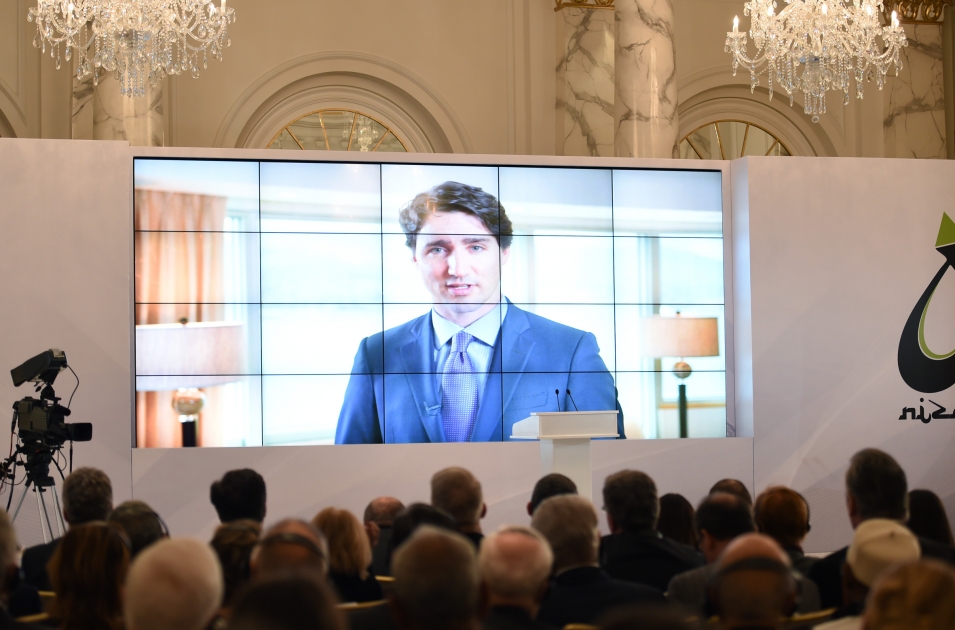
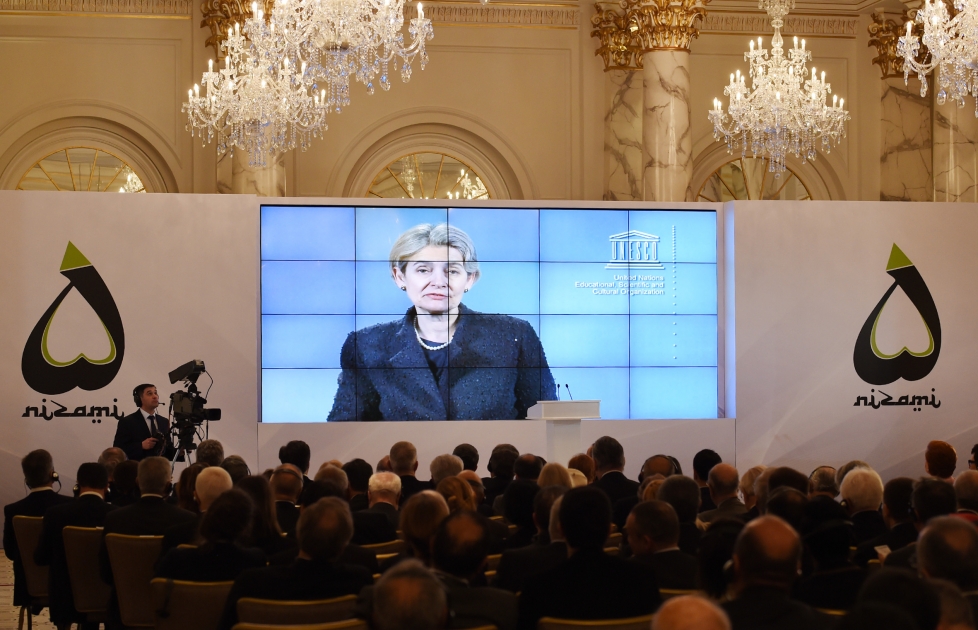
The ceremony also featured video addresses by Canadian Prime Minister Justin Trudeau and UNESCO Director-General Irina Bokova.
Former Latvian President, co-chair of the Nizami Ganjavi International Center Vaira Vike-Freiberga then made a speech.
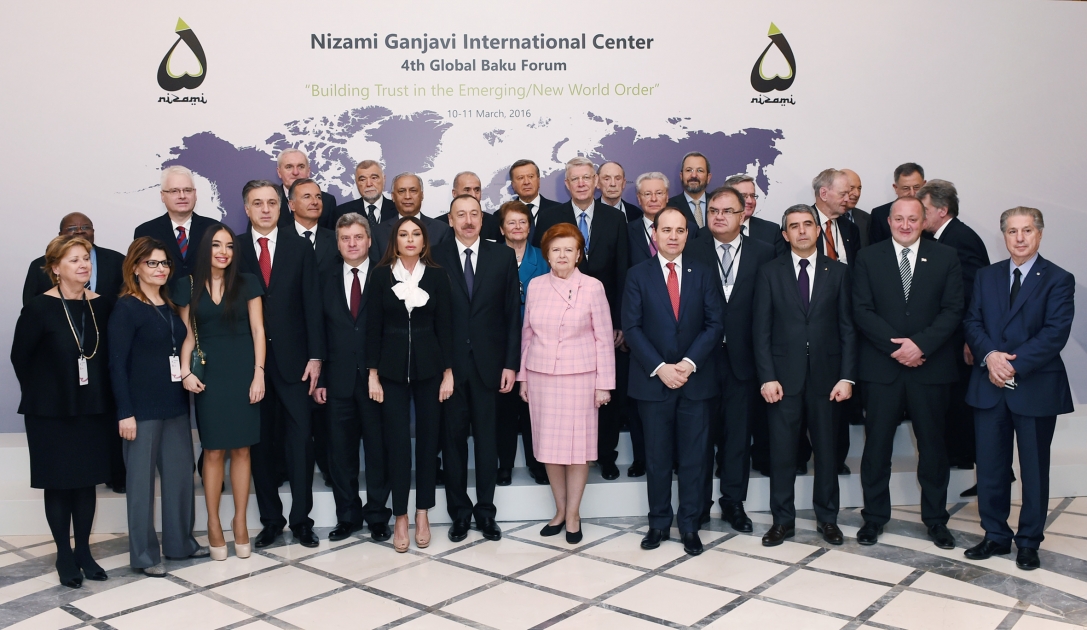
Then official photographs were taken.
The fourth Global Baku Forum is organized by the Nizami Ganjavi International Center in partnership with the Interaction Council, the Club of Madrid, Library of Alexandria, the Club of Rome and World Academy of Science and Culture.
Over 300 delegates from 53 countries attend the forum.
The two-day forum will focus on topical issues such as the role of interreligious dialogue in conflict prevention, migration, multiculturalism and integration, global security. The forum's agenda also includes prospects for energy and global management issues.
Other news in this section


VIDEO

