Commonspace.eu: Time to relaunch the debate about EU-Azerbaijan relations
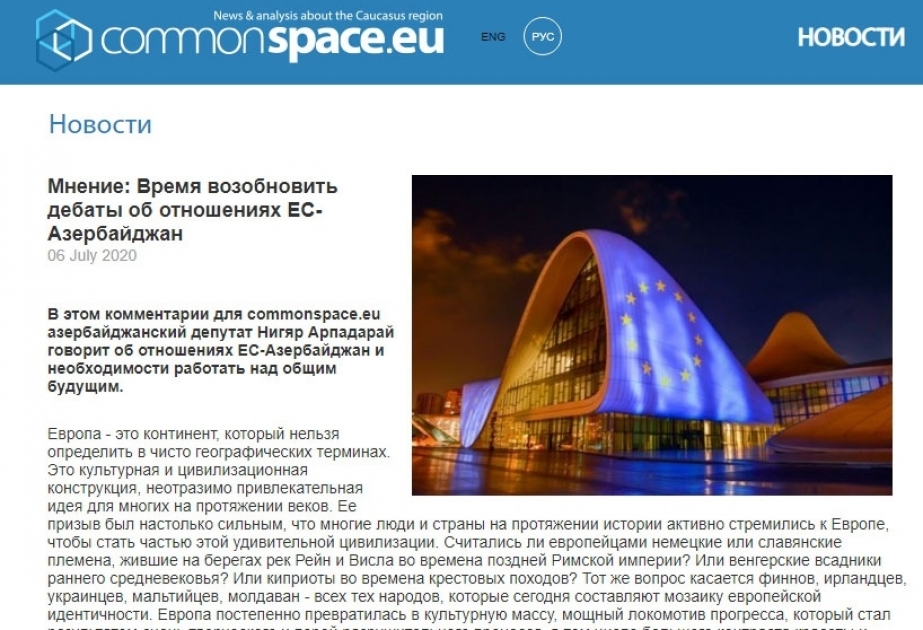
Baku, July 7, AZERTAC
The Commonspace.eu portal has published an article by Azerbaijani MP Nigar Arpadarai who discusses EU-Azerbaijan relations, and the need to work for a common future.
The article reads: “Europe is a continent which cannot be defined in purely geographical terms. It is a cultural and civilizational construct, an irresistibly attractive idea for so many going back centuries. So strong has been its appeal, that a number of people and countries over the course of history have actively chosen to gravitate towards Europe to become part of this amazing civilization. Were German or Slavic tribes living on the banks of the Rhine and Wisla rivers during the late Roman Empire considered Europeans? Or Hungarian horsemen of the early Middle Ages? Or Cypriots at the time of the Crusades? The same question applies to Finns, Irish, Ukrainians, Maltese, Moldovans - all those peoples who today comprise the mosaic of European identity. Europe gradually built itself into a cultural mass, a powerful locomotive of progress that came to be through a very creative and at times destructive process, including the great contrast of the beauty and pioneering achievements of the Renaissance with two devastating World Wars.
Europe throughout most of history was very much defined through its Eastern border. In a certain sense the definition of this border is also a claim of how far European identity extends. So, this leads to the question: where does this border lie? Or, as it is sometimes put, where does Europe end?
In the 5th Century B.C., Herodotus defined the borders of Europe as lying at the Azov Sea and Colchian Phasis River (today called the Don River in Russia). The medieval concept of Europe's boundaries was far more modest compared to today, with Europe's eastern edge by and large defined by what is now modern Austria and Poland. It wasn't until the mid-18th Century that the Swede, Von Stralenberg, dared to draw the European border along the Ural Mountain Range and the Volga River, a border line that is still largely accepted today. This brave geographical innovation coincided with the rapid 'Europeanisation' of Russia during the reign of Peter the Great and the growth of European influence all over the world.
In other words, Europe's geographical border was always a reflection of its strength or weakness - politically, militarily and culturally. The continent as we know it today is a kaleidoscope of people who arrived in waves over the course of millennia - mostly from Asia - and subsequently settled, changed and formed the unique picture of today's Europe.
Why have I gone to such lengths in describing the way Europe's eastern border was and is determined? The answer is very simple. This has to do with how I identify myself.
I recently conducted a small research and inventoried the currently available 'scientific' outlines of the Europe-Asia geographical border and discovered 18 different versions, four of which show the border as going through the territory of my own country, Azerbaijan. These were solely modern interpretations of Europe's Eastern border, disregarding various historical versions that further confuse matters.
Thus, according to some geographers, I am European. Others say I am half-European, and some place me firmly in Asia.
These different interpretations reflect the fact that Europe is currently in search of itself. Following the demise of the USSR in the late-20th century, we - the people of the former Soviet Union - witnessed a huge European tide wash on to our shores in the form of the OSCE, Council of Europe, European football championships, EBRD, as well as numerous EU Commission and NATO projects and activities.
It was all about "the ghost" of Europe in Azerbaijan for me - at the time a law student at Baku State University. We, the young people of our country (I was in my teens then), believed sincerely that the European future of our country was a given. It was, to us, the only option and sooner or later, Azerbaijan and its neighbors from the South Caucasus and Western parts of the former Soviet Union would surely become integral parts of the pan-European federation and European security system, following closely on the heels of the former communist countries of Eastern and Central Europe. I worked for the EU TACIS project, and was a board member of the Forum of Azerbaijani Students in Europe. At the beginning of my career, I was privileged to help the EC Special Envoy to Azerbaijan in establishing the EU Delegation in Azerbaijan. The European agenda was thus an unalienable part of my life in 2000s.
I believed that Europe meant opportunities, freedom and development and that there was no better choice for Azerbaijan and its people than to become part of this family of nations. In 2001, when Azerbaijan was welcomed as the 43rd member of the Council of Europe, it felt like there was no turning back from our European future.
20 years have since passed and what faces us now is a very different picture. Azerbaijan's European dream has largely faded, and Europe's presence in my country is merely nominal, visible only through some routine EU projects and its Diplomatic Mission, the establishment of which I had the privilege to participate in as a local member of staff in the late 2000s.
It is probably fair to admit that this perception is, at least partially, personal, and has to do with the fact that I am now in my late 30s and no longer possess the unbridled enthusiasm and naivety of youth.
However, it is also a very obvious the consequence of the change in attitude by the EU towards our region. The EU expansion phase of 2004-2013 consumed a lot of energy and time of the European institutions. As a result, it began to focus less on our countries, and the political developments in the region such as the Georgia-Russian war. Deteriorating relations with Turkey and the Russian-Ukrainian conflict put further strain on the EU's bond with its Eastern partners. In the new sense of divide that emerged, Azerbaijan ended up on the other side of the fence, for a whole set of reasons both objective and subjective. I don't have any intention to play the blame game as I see no value in going down this road, but the fact remains that the European tide in our part of the world has retreated, with no imminent sign of it returning any time soon.
We are still members of various integratory formats such as the OSCE and the Council of Europe (CoE). We have a parliamentary interface with the European Parliament and our football clubs compete with various level of success in European tournaments. But the current dynamic is very different, and there is little or no desire for further gravitation towards Europe at this moment.
One can say that if there is no political will to integrate on either side then perhaps this is the way it should be? On the other hand I sincerely believe in Europe's big mission. Europe has a lot to offer in terms of traditions of rule of law, culture, parliamentarianism, inclusivity and social dialogue and it is in Azerbaijan's natural interest to benefit from it, and contribute to it. One can ask, does Europe need Azerbaijan, a relatively small country on the shores of the Caspian Sea with a nominally Islamic population? As far as I can say, the answer is obvious.
Europe faces enormous challenges. Some have only recently emerged due to the crisis caused by the coronavirus pandemic. Some have piled up over the preceding years. These challenges are both internal and external and call for a new vision. I will not digress into discussing internal EU issues as I believe it is not polite to visit a neighbor and provide unwelcome analysis of relations between its family members. Instead, let me dwell on the external issues, in particular with regards to our part of the world.
It is quite obvious that the prospects of the EU and wider Europe depend to a large extent on whether the former can come up with a meaningful Eastern strategy. Such a strategy should undoubtedly include new long-term deals with large neighbors, such as Russia and Turkey. But it should also have a clear-cut policy towards other countries in the region, who are now referred to in the EU internal documents under the vague concept of the 'Eastern partnership'. Launched in 2009, this programme is yet to deliver the results expected, especially in the case of Azerbaijan, its most eastern participant.
As a non-partisan member of Azerbaijani parliament and a strong advocate of the European "direction" of my country, I believe that a relaunch of this agenda will take substantial political will and vision on both sides. But it is possible and necessary.
Firstly, EU-Azerbaijan, and in a wider context, EU-South Caucasus relations should be built on mutual economic interest. The South Caucasus is not a particularly large market per se, but it is a gateway to Central Asia and a route from Europe to China. The Black Sea-Caspian Sea transit route through the South Caucasus has transformed substantially from the times of the long forgotten TRACECA (Transport Corridor Europe-Caucasus-Asia) project, an initiative of the European Commission in the 1990s, and whose secretariat has been hosted by Azerbaijan since 2001. Even after the EU scaled down its participation in this project, Azerbaijan continued to work on the corridor and invested substantial resources in new infrastructure - including a major port on the Caspian Sea as well as a network of roads and railways. This, apart from the existing huge energy corridor consisting of oil and gas pipelines and the infrastructure built up over the years from Azerbaijan to Southern Europe.
Similar projects were implemented in Georgia and other Central Asian countries. In other words, the region is in a different connectivity readiness status compared to the times when there was an active dialogue about the revival of the medieval Silk Road route. It is safe to say that in the long run TRACECA made a positive impact and catalyzed change. It is now time to reap the benefits by expanding trade and movement of goods along this route. It is symbolic that during the last few months there were a number of pilot container trains from different parts of China going through the newly built ports of the Caspian Sea and the new BTK railway connecting Georgia and Turkey, sponsored by Azerbaijan.
The Chinese are fast to act and benefit from these developments and it is in the interest of Azerbaijan and the EU to find a balance in which the East-West corridor will serve as an engine of economic growth and stability for all participants, be it China, Russia, Turkey or the EU, and not as a tool of economic or political expansionism in the region. To achieve it, both the EU and Azerbaijan should work actively on a common connectivity and trade development agenda.
Another common interest is the European security system. Azerbaijan is a victim of an ongoing occupation. Approximately 20% of its territory is currently under the control of the Armenian army, which has resulted in the displacement of the entire Azerbaijani population previously living there. Towns and villages have been turned into dust; farming and pasture lands left empty. We as a nation live with the consequences of war and know its price. A few days ago, the Chair of the European Parliament Delegation to the South Caucasus and the Rapporteurs on Armenia and Azerbaijan issued a joint statement condemning the intention of Armenia to build a road connecting Armenia and the occupied lands of Azerbaijan, thus consolidating its grip on these illegally occupied lands. This statement - which was hardly noticed in Brussels - has had a substantial impact on public opinion in Azerbaijan, and reinforced the pro-European agenda in my country. Europe, which has a firm stand on the Nagorno-Karabakh conflict resolution based on international law, de-occupation and the return of refugees and IDPs, is as a result inevitably going to have a much more positive influence in Azerbaijan, both at government and public level.
Another aspect of the EU-Azerbaijan relationship is the dialogue on human rights. On this issue Azerbaijan also interacts with Europe through its membership of the Council of Europe. Human Rights progress is an on-going and never-ending process in each European country. Each society faces different challenges, but all are united by the same goal. Supporting and pushing for positive change and resisting human rights degradations are what the Council of Europe should be about. Its role was instrumental in my country, for example, in bringing about such a pivotal step as the abolition of the death penalty. This achievement was made possible due to the healthy climate of mutual respect and engagement that existed within the organization during the membership negotiation phase and the early stages of Azerbaijan's membership.
We should do our utmost to return to that feeling of working towards a common future during the complex yet exciting times that we live in.”
Other news in this section


