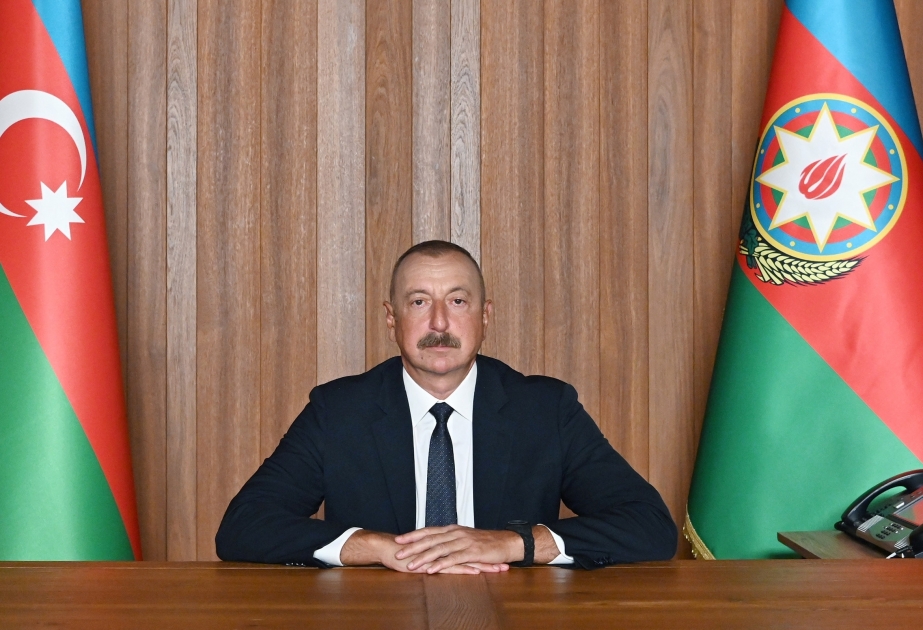
Speech of President of Azerbaijan Ilham Aliyev in video format was presented at the annual General Debate of the 76th session of the UN General Assembly VIDEO
Baku, September 23, AZERTAC
The annual General Debate of the 76th session of the United Nations General Assembly at the level of heads of state and government continues.
On September 23, the speech of President of the Republic of Azerbaijan Ilham Aliyev in a video format was presented during the General Debate.
Speech of President Ilham Aliyev
Mr. President,
Mr. Secretary-General,
Distinguished Heads of State and Government,
I congratulate Mr. Abdulla Shahid on his election as the President of the 76th session of the United Nations General Assembly and wish him every success in fulfilling his duty. I also express my sincere gratitude and appreciation to Mr. Volkan Bozkir from brotherly Turkey for his leadership as the President of the 75th session of the General Assembly.
The COVID-19 pandemic continues posing serious challenges for the whole world. From the very beginning, our government has been taking robust and practical measures to protect the population and to minimize negative impact of the pandemic.
Azerbaijan has launched immunization campaign since mid-January this year. Vaccine doses used per 100 people makes more than 80 percent.
The socio-economic stimulus package worth almost $2.7 billion has been released to support COVID-affected people and business.
As a result of well-planned measures, the situation with pandemic has been kept under control and the quarantine regime has been gradually eased in our country. Azerbaijan’s extensive efforts against the pandemic have been internationally recognized. In 2020, the World Health Organization hailed Azerbaijan as an exemplary country in fighting the pandemic.
Azerbaijan carried out all these activities with its own financial resources. We have also made voluntary financial contributions to the World Health Organization in the amount of $10 million and provided financial and humanitarian assistance to more than 30 countries to support their fight against the coronavirus. Furthermore, we have provided more than 150,000 vaccine doses to 4 countries, free of charge.
Azerbaijan is advocating for a stronger global solidarity to overcome the pandemic. In its capacity as the chair of the Non-Aligned Movement, Azerbaijan has put forward a number of global initiatives. In May 2020, Azerbaijan held Summit-level Meeting of the Non-Aligned Movement’s Contact Group in response to COVID-19. During the Summit, I suggested, on behalf of the Non-Aligned Movement, the convening of the Special Session of the United Nations General Assembly in response to coronavirus at the level of the heads of state and government. This initiative was supported by more than 150 UN Member States and the Special Session took place on 3-4 December 2020. I express my gratitude to the Secretary-General Mr. António Guterres and all States supporting our initiatives.
On numerous occasions, Azerbaijan has publicly expressed its discontent with stockpiling of vaccines by some wealthy countries. We reiterate our dismay on the persistent “vaccine nationalism” and deepening inequality in access to vaccines between developing and developed countries. Such actions prevent developing countries from protecting their populations. According to international reports, so far, more than 75 percent of the world’s vaccine doses have been purchased by 10 wealthy countries, while vaccine coverage of low-income countries is less than 2 percent.
To call international attention to this challenge, Azerbaijan, on behalf of the Non-Aligned Movement, initiated a resolution on ensuring equitable and universal access for all countries to vaccines in the UN Human Rights Council, which was unanimously adopted this March.
Azerbaijan plans to initiate a resolution at the UN General Assembly on the same topic during this session.
We believe that there is a need to take strong, cohesive and targeted global actions to recover better from the COVID-19. In this regard, we suggest establishing a UN High-Level Panel on Global Recovery from the COVID-19, which could prepare recommendations on global measures for post-pandemic period.
This year marks the 60th anniversary of the establishment of the Non-Aligned Movement. With a unanimous decision of 120 NAM Member States, Azerbaijan undertook the responsibility to chair the Movement for three years at its 18th Summit of the Heads of State and Government held in Baku in October 2019. Azerbaijan is strongly advocating for upholding international justice, norms of international law and defending legitimate interests of Member States of the Movement. This year, the Member States of the Movement unanimously decided to extend Azerbaijan’s chairmanship for one more year until late 2023. It is a sign of recognition and appreciation of Azerbaijan’s successful and effective steering of the Movement in this challenging time for the whole world.
The implementation of the Sustainable Development Goals is of particular importance for Azerbaijan. Azerbaijan is among 12 countries around the globe and is the first in our region that has submitted its third Voluntary National Review Report on the implementation of the 2030 Agenda.
Scoring 72.4 out of 100 points possible on the SDG achievement index, Azerbaijan ranks 55th out of 165 countries in the 2021 Sustainable Development Report with the best result in the region. The report highlights Azerbaijan’s progress in areas such as poverty reduction, healthcare, nutrition, women’s labor force participation, clean water and sanitation, access to energy, internet usage, threatened species survival, as well as improving population welfare and sustainable development of cities and communities.
Azerbaijan actively participates in building regional connectivity projects, such as East-West, North-South, North-West transportation corridors, thus becoming one of Eurasia's primary and reliable transport and logistics hubs. We have put into operation the Baku International Trade Seaport with cargo handling capacity of 15 million tons per year, which can be increased up to 25 million tons per year depending on the needs.
Azerbaijan ratified the Paris Climate Agreement, with a voluntary commitment to achieve a 35 percent reduction in greenhouse gas emissions by 2030 compared to the base year 1990. Furthermore, we are exploring the possibilities for setting conditional targets for 2050 under the Paris Agreement.
Currently the share of the renewables in the total energy capacity of our country is 17 percent. The target is to increase this number to 30 percent by 2030. Agreements have been signed with three major international energy companies to invest in the construction of three wind and solar power plants with total capacity of over 700 megawatts in the coming 3-4 years. One of these projects will be implemented in the Eastern Zangazur region liberated from Armenian occupation during the 44-day Patriotic War. This 240-megawatt solar power plant will be so far the major foreign direct investment project in the liberated territories of Azerbaijan. I invite other international energy companies to come and invest in green energy in the liberated Azerbaijani territories.
I announced the recently liberated Karabakh and Eastern Zangazur as Green Energy Zone. The liberated territories of Azerbaijan have the proven potential of 7200 megawatts of solar energy and 2000 megawatts of wind energy.
Azerbaijan, along with crude oil and natural gas, recently became an exporter of electric energy. Today, we export electric energy to 4 neighboring countries. Meantime, domestic electricity consumption is rising due to population growth and economic development. During 8 months of this year non-oil industry of Azerbaijan grew 18.4 percent.
Ladies and Gentlemen,
Azerbaijani people is strongly connected to its roots, history, language and traditions. I have declared this year as a "Year of Nizami Ganjavi" on the occasion of the 880th anniversary of the great Azerbaijani poet. In XII century, Nizami Ganjavi propagated in his poetry the ideals and values such as peace, justice, humanism, freedom and equality which coincide with principles promoted and protected by the United Nations.
In Azerbaijan, we cherish and support multiculturalism as a way of life. Azerbaijan is considered as an example of tolerance and peaceful coexistence of representatives of various religious and ethnic groups living in our country.
The UN strongly supports "Baku Process," which was initiated by Azerbaijan in 2008 to strengthen dialogue and cooperation between the Muslim world and Europe. The UN General Assembly's resolutions have recognized the World Forum on Intercultural Dialogue held in Azerbaijan regularly, as a “key global platform for promoting intercultural dialogue”.
Ladies and Gentlemen,
Last September, addressing the UN General Assembly I drew your attention to continuing occupation of territories of Azerbaijan by Armenia and aggressive statements and actions of the Armenian government. Today, a year later, I proudly say that Armenia was defeated on the battlefield and Azerbaijan put an end to the occupation.
Armenia, for about 30 years, kept under occupation almost 20 percent of the territory of our country. The occupation was accompanied with notorious war crimes and crimes against humanity. Armenia committed Khojaly genocide in February 1992, killing hundreds of civilians including 106 women and 63 children. 1275 Azerbaijanis were taken hostage, out of which 150 are still missing. Khojaly genocide has been recognized by 13 countries. Ethnic cleansing carried out by Armenia resulted in more than one million Azerbaijanis becoming refugees and internally displaced persons.
The UN Security Council adopted four resolutions in 1993 demanding immediate, complete, and unconditional withdrawal of armed forces of Armenia from Azerbaijan’s occupied territories. However, these and all other similar decisions adopted by relevant international organizations, including the UN General Assembly, Organization of Islamic Cooperation, Non-Aligned Movement, OSCE, Parliamentary Assembly of the Council of Europe and European Parliament were ignored by Armenia.
While some resolutions of the Security Council are implemented within days, in our case they remained unfulfilled for 27 years, which is a clear manifestation of double standards. There is a need to join efforts to elaborate mechanism of implementation of the UN Security Council resolutions in order to avoid selective approach.
The OSCE Minsk Group was established in 1992 with the aim to find resolution to the conflict between Armenia and Azerbaijan. It could be possible for the OSCE Minsk Group Co-Chairs to accomplish their task if they would take resolute actions for compelling Armenia to end its military aggression against Azerbaijan. Throughout the conflict, Armenia with its attitude and actions demonstrated that its sole aim was to maintain the status-quo and consolidate the occupation. On many occasions I raised the necessity of imposing sanctions on Armenia. Regretfully, there was no international sanction imposed on Armenia to enforce the implementation of the UN Security Council resolutions.
In 2018, the Kocharyan-Sargsyan regime of war criminals was overthrown in Armenia. We had some hopes that the new government of Armenia would seriously engage in negotiations. We were ready to reciprocate any positive signal coming from Armenia. 2018-2019, it was one of the calmest periods in the former line of contact. However, the regime replacement in Armenia was not followed by real changes on the ground in spite of Azerbaijan’s positive actions. The new government of Armenia also opted for the continuation of occupation instead of peaceful neighborhood with Azerbaijan.
During the last 2 years of the conflict, Armenia deliberately destroyed the negotiation process. The Government of Armenia made a number of provocative statements and actions like saying “Karabakh is Armenia, and period” and “Not an inch of occupied land back”. The then defense minister of Armenia openly threatened Azerbaijan with new aggression and occupation of new territories. Armenia put forward unacceptable and groundless so-called seven conditions and demanded to change the negotiations format, to start from the “zero point” and to involve the puppet regime established by Armenia in the occupied territories in negotiation process. Attempt by Armenian government to change the format and substance of negotiations was unpleasant surprise for the OSCE Minsk Group Co-Chairs, whose efforts were paralyzed by irresponsible and dangerous actions of Armenia.
Furthermore, in gross violation of international law, including Geneva Conventions, Armenia was blatantly implementing the policy of illegal settlement of people mainly from Middle East with Armenian origin in the occupied territories of Azerbaijan. Encouraged by the long-lasting sense of impunity, Armenia was also announcing construction of new roads from Armenia to occupied territories to further consolidate the result of its aggression and speed up the illegal settlement.
In July 2020, Armenia perpetrated military provocation along the state border with Azerbaijan. As a result of the artillery strike inflicted on Azerbaijan’s Tovuz district, 13 military servicemen and civilians were killed.
Later in August last year, Armenian sabotage group attempted to penetrate through the former line of contact to commit terror acts against Azerbaijani military servicemen and civilians but it was successfully neutralized.
In my statement at the General Debate of the 75th Session of the UN General Assembly on 24 September last year, I had warned that, “hostile, Azerbaijanohobic statements and provocations of Armenian leadership demonstrate that Armenia is preparing for a new aggression against Azerbaijan.”
Three days later on the 27th September last year, Armenia launched a large-scale attack against military positions and civilians of Azerbaijan. In response, Azerbaijan, using its inherent right of self-defense as enshrined in the article 51 of the UN Charter, started a counter-attack on its own territories against Armenia.
During 44 days, armed forces of Armenia heavily shelled districts and cities situated along the frontline, namely Aghdam, Aghjabadi, Beylagan, Dashkasan, Fuzuli, Goranboy, Tartar. Armenia also fired at Ganja, Barda, Mingachevir, Gabala, Siyazan, Khizi and other cities situated far away from the former frontline. One of missiles was intercepted by Azerbaijani Air Defense Forces in Khizi, close to Baku, which shows that the capital city Baku was also target of Armenian missile attack. Armenia was using ballistic missiles, like Scud and Iskander-M, as well as forbidden white phosphorus and cluster munitions. These war crimes of Armenia resulted in more than 100 civilians, including 11 children being killed, more than 450 wounded. More than 12,000 civilian infrastructures, including private houses in Azerbaijan have been destroyed or severely damaged.
Abided by the fundamental principle of international humanitarian law on the distinction between combatants and civilians, Azerbaijan never reciprocated Armenia’s vicious war crimes by targeting civilians.
Armenia also recruited mercenaries and foreign fighters from abroad and deployed them against Azerbaijan.
During 44-day war Azerbaijan liberated a large part of occupied territories, including cities of Jabrayil, Hadrut, Fuzuli, Zangilan, Gubadli and Shusha. In total more than 300 cities and villages were liberated on the battlefield. Armenia had to sign an act of capitulation on 10 November 2020. Accordingly, Armenia was obliged to withdraw its troops from the remaining part of Azerbaijan’s territories, namely Aghdam, Lachin and Kalbajar regions. Azerbaijan, itself, enforced the implementation of the abovementioned UN Security Council resolutions, probably, it was the first case in the world since the establishment of the UN.
Azerbaijan resolved the 30-year-long conflict and restored its territorial integrity and historical justice by military-political means. The Nagorno-Karabakh conflict was left in the past. There is no administrative territorial unit called Nagorno-Karabakh in Azerbaijan. We have created Karabakh and Eastern Zangazur economic zones by the Presidential decree signed on 7 July this year. Using this occasion, I would like to call on all the UN Member States and the UN Secretariat to avoid using legally non-existing, politically biased and manipulative names while referring to our territories.
The building of multi-layered defense lines and fortifications with long trenches, tunnels and bunkers by Armenia for years in the formerly occupied territories of Azerbaijan proves that Armenia did not intent to return those territories by any means.
During almost 30-year-long occupation Armenia has deliberately destroyed cities and villages, looted and plundered all cultural and religious sites of Azerbaijan turning them into textbook example of urbicide and culturicide. After the Second World War, probably, annihilation of cities in such a magnitude has not happened anywhere else in the world. 9 Azerbaijani cities and hundreds of villages have been barbarically wiped out by Armenia. Armenia attempted to erase the traces of Azerbaijani people living in these territories for centuries. Aghdam city was destroyed to such an extent that it was called as "Hiroshima of Caucasus". After the liberation, our Army could not find a single safe building in Fuzuli city to raise the Azerbaijani flag.
Out of 67 mosques in the territories which were under Armenian occupation, 65 have been razed to the ground and the remaining 2 have been severely damaged and desecrated, including by being used as stables for pigs and cows in total disrespect to all Muslims of the world. Even the graveyards were desecrated, destroyed, and looted.
During visits to liberated territories, foreign diplomats, representatives of international organizations and international journalists have witnessed the barbarism committed by Armenia. The facts of the full destruction of cities and villages, including the cultural and religious heritage sites of Azerbaijani people has been widely documented and broadcasted by international media and independent experts.
Each delegation in the United Nations has been provided with an illustrative book which contains brief information and photos of our towns and villages before and after the occupation. It reflects the total destruction of religious and historic monuments of Azerbaijan.
Armenia has committed severe ecocide in the formerly occupied territories of Azerbaijan. 60,000 hectares of our forests have been destroyed, cut down and taken away, soil and rivers have been polluted and contaminated.
Armenia used water reserves to create an artificial environmental crisis on the formerly occupied territories. In 2016, the Parliamentary Assembly of the Council of Europe adopted resolution entitled “Inhabitants of frontier regions of Azerbaijan are deliberately deprived of water” demanding the Armenian authorities to cease using water reservoirs as tools of political influence or an instrument of pressure. This resolution was totally ignored by Armenia, which continued to use the Sarsang water reservoir as a tool of humanitarian and environmental terrorism. Armenia was intentionally opening the floodgates during the winter months to cause flooding in the surrounding areas and closing them in summer to deprive people and farms from water in the former frontline region.
Armenia has been severely polluting transboundary river called Okhchuchay causing irreversible degradation of ecosystem of the area along the river in Azerbaijan. Regrettably, some foreign companies are also participating in this environmental crime.
Armenia illegally exploited natural resources, including gold and other precious metals and minerals of the formerly occupied lands and exported it to the international markets. Based on solid facts, we have identified companies from different countries illegally exploiting Azerbaijan’s natural resources and conducting other illegal activities in the formerly occupied territories. We have already started taking legal actions against those companies. They will be held accountable for illegally exploiting our natural resources in the formerly occupied lands.
We have around 4,000 citizens registered as missing persons from the first Karabakh War. Armenia must provide us with information about their fate. We have solid proofs that almost all of them have been tortured and killed, and buried in mass graves by Armenian military in violation of international humanitarian law. In April 2021, remains of 12 civilians killed by Armenian war criminals have been identified in liberated Bashlibel village of Kalbajar district in a mass grave.
Armenia must bear state responsibility for military aggression and other grave crimes committed against Azerbaijan under international law and the Charter of the United Nations.
The despotic warlords, who came to power in Armenia as a result of coup d’etat and ruled for 20 years from 1998 to 2018, were completely doomed to failure in achieving their nefarious dreams and goals during the three-decade-long occupation of Azerbaijan’s territories. On the contrary, Armenia has become a failed state, as I had emphasized in my statement at the UN General Assembly in 2017. The country has been weakened to the extent that it cannot even guard its own borders by itself.
“Azerbaijanophobia” promoted by the government is on the rise in Armenia. Racist ideology cultivated in Armenian society based on ethnic hatred and demonization is the root cause of ethnic cleansing and unprecedented vandalism in the formerly occupied lands of Azerbaijan by Armenia.
Despite the regime change in Armenia, the fascist ideology continues to dominate in the country. Successive Armenian governments have glorified Nazism in the person of Nazi general Garegin Nzhdeh who has been turned into “national hero” in Armenia. While the progressive world is fighting against the rise of neo-fascism, the then president of Armenia inaugurated the monument of Garegin Nzhdeh in capital Yerevan in 2016. Azerbaijan defeated not only Armenian occupying forces, but also Armenian fascism. If we see again any danger to our sovereignty, territorial integrity and security of our people we will exercise our legitimate right to self-defense without any hesitation.
Ladies and Gentlemen,
As we have left the conflict behind, large-scale construction work is carried out in the liberated territories. Azerbaijan is building new cities and towns from the scratch by applying the modern urban planning and utilizing the concepts of "smart city" and "smart village".
All this work is being conducted with Azerbaijan’s own financial resources. To that end, $1.3 billion has been allocated from the state budget only this year.
However, the main challenge is the vast presence of landmines planted by Armenia in the liberated territories. Since the signing of the capitulation act by Armenia on 10 November 2020, around 30 Azerbaijani citizens, including 2 journalists were killed and around 130 citizens were wounded. Azerbaijan is among the most heavily mined countries in the world. It slows down the reconstruction process in the liberated territories and return of internally displaced persons to their homes.
Armenia refuses to release accurate maps of minefields. The accuracy level of the maps for three regions which Armenia had to provide is only 25 percent. The international community must force Armenia to provide us with accurate mine maps of all liberated territories.
As the conflict is over, Azerbaijan has already announced its readiness to embark upon the border delimitation and demarcation between Azerbaijan and Armenia, and to start negotiations on peace agreement with Armenia, based on mutual recognition of sovereignty and territorial integrity of each other. Such an agreement would turn our region into the region of peace and cooperation. However, we have not yet seen any positive reaction from Armenia regarding our proposal.
One of the areas that can serve as the cause of peace and cooperation is transportation projects. In this context, the Zangazur corridor connecting mainland Azerbaijan with its inseparable part Nakhchivan Autonomous Republic and Turkey will create new opportunities for our region.
Azerbaijan has created a new reality in the Southern Caucasus region which has to be taken into account by all. Armenia has to make a choice between regional cooperation and illegal and baseless territorial claims against its neighbors. The international community should also play its positive role in this regard and urge Armenia to realize that peace has no alternative. Any acts directly or indirectly supporting revanchism and militarization in Armenia must be ceased.
We hope that long-awaited peace, security and stability will prevail in the Southern Caucuses, at last. Azerbaijan will continue its consistent efforts to contribute and to strengthen regional peace and development.
Thank you.
Other news in this section


VIDEO

