Life-size rock art points the way to oldest human inhabitants of Saudi Arabia — and the desert oases they used
Baku, October 2, AZERTAC
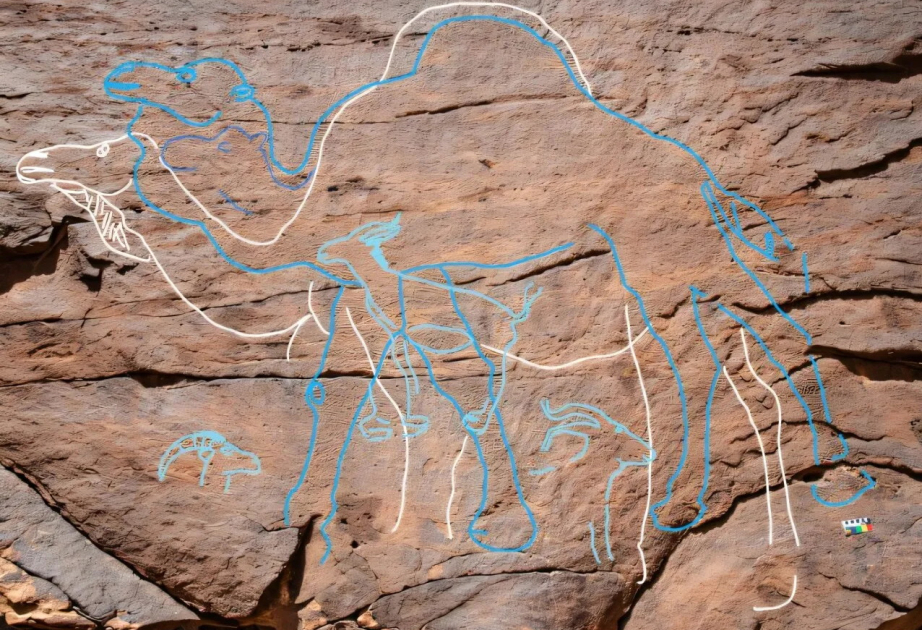
Archaeologists in Saudi Arabia have discovered 12,000-year-old life-sized animal etchings — "monumental rock art" that dates to over 2,000 years before humans were thought to be in the region, a new study finds, according to Live Science.
These highly realistic depictions of camels and other creatures were likely culturally meaningful for these hunter-gatherers, and probably served as waymarkers to help people locate oases that popped up when the area became wetter starting from 16,000 to 13,000 years ago, the researchers wrote in the study, which was published Tuesday (Sept. 30) in the journal Nature Communications.
The rock art could have also marked ancient travel routes or even signified the territory of a group and its intergenerational memory, the researchers said. These findings ultimately show that "humans were able to survive in the desert very early on, much earlier than we thought and in much harsher conditions than we thought," study co-author Maria Guagnin, an archaeologist at the Max Planck Institute of Geoanthropology in Germany, told Live Science.
Importantly, these depictions were commonly of male camels with distinctive bulges around their necks that they form during the mating season and thick winter fur. This suggests that the ancient water sources may have formed in winter, and may have also symbolized the resilience of these animals to the harsh environment, the authors speculated in their study.
The archaeologists excavated directly below four camel engravings to try to determine their age. They unearthed over 1,200 stones, 16 animal bone fragments and three hearths. The team dated these using luminescence dating, a technique that measures when sediments were last exposed to heat and sunlight, and radiocarbon dating, which measures the ratio of different versions of carbon.
These methods revealed that the rock art was between 12,800 and 11,400 years old.
At one excavation site, the camels' legs had been obscured by layers of sediment. When they dug down, the team were amazed to find the stone tool likely responsible for creating the masterpiece, which they dated to around 12,200 years ago. This provides "an indirect date for the engraving," the authors wrote in the study.
They also found arrow points, bladelets and stone beads; but "this isn't just a handful of arrowheads," Guagnin said. A community lived in the region and crafted tools and ornaments typical of the Natufian culture in the Levant, many miles away around the eastern Mediterranean. "They were in contact with the Levant somehow across hundreds of kilometers," she said, and learned about the latest tools and accessories.
Crucially, "some things are imported but then some things are unique," study co-author Michael Petraglia, an archaeologist at Griffith University in Australia, told Live Science. These people were also developing their own culture, with the rock art having symbolic meaning as well as being clear ways of marking routes to water sources, he said.
An analysis of the sediments in the dried up water sources revealed the region had become more humid starting around 16,000 to 13,000 years ago, forming seasonal lakes. This discovery represents the earliest evidence of increased humidity in northern Arabia after the Last Glacial Maximum.
"This is a very exciting study revealing a part of Saudi Arabian history that has so far not been readily visible," Hugh Thomas, an archaeologist specializing in Saudi Arabia at the University of Sydney who was not involved in the study, told Live Science in an email. He said that these results show that "the entire region was populated and that even at this time, it was an interconnected landscape."
Other news in this section


