UN-Habitat Executive Director: At WUF13, Azerbaijan is bringing together regional stakeholders while also contributing valuable expertise
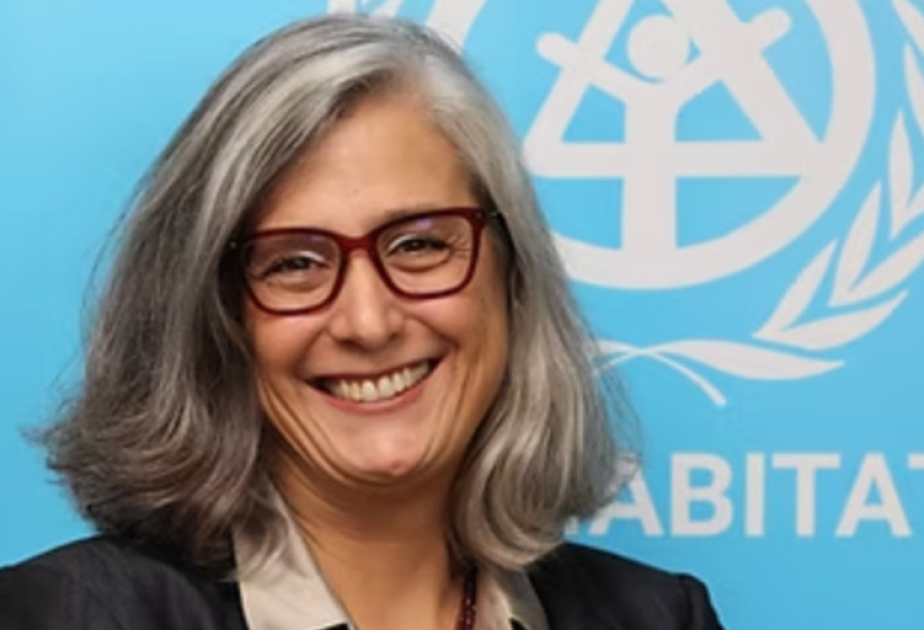
Washington, May 8, AZERTAC
Anacláudia Rossbach, Executive Director of the United Nations Human Settlements Programme (UN-Habitat), shared her insights with the Azerbaijan State News Agency (AZERTAC) regarding Azerbaijan’s hosting of the upcoming 13th World Urban Forum (WUF13), scheduled to take place in Baku on May 17-22.
AZERTAC presents the interview:
- What do you consider the most urgent global challenges facing cities and communities around the world today, particularly in the areas of housing, urbanization, climate change, and inequality?
- I think we can place everything under one critical challenge related to people’s living conditions. If we think about the global housing crisis, we have 300 million people living in homelessness, three billion people living in inadequate housing conditions, and one billion people living in informal settlements. Housing is really at the center of the urban challenges we face today, and it also intersects with the climate crisis. Think about climate-related events: fires, landslides, floods — the impacts are immediately felt by people living in precarious housing conditions. Even the broader impacts of climate change, such as heat waves in cities, are mostly and first felt by people living in vulnerable situations.
Also, when we think about housing needs and the necessity to build new homes, this becomes a critical challenge for cities, because the way housing is built affects natural resources as well as the carbon footprint.
So I would place housing and adequate living conditions at the center of the urban challenges the planet is facing right now.
- In your view, what concrete steps are governments, international organizations, and local communities taking to address these growing global challenges, and where do you still see major gaps?
- There are several layers of action. The first layer is advocacy — disseminating information, communicating, and encouraging public debate within society.
The second layer is normative work: agreeing on policy recommendations on how to address these issues. In this regard, UN-Habitat is facilitating the work of the Open-Ended Working Group on Housing.
Another important layer is technical assistance and knowledge sharing. We need to work on the ground as we speak; we cannot wait much longer.
Projects implemented on the ground should immediately help protect people’s lives, increase community resilience, and at the same time support the design of long-term plans and systemic policy changes. This includes adequate laws and proper local planning systems.
Most importantly, we need to make sure that we all agree on a pathway of policy recommendations.
- What role does the World Urban Forum play in promoting sustainable urban development and encouraging international cooperation to solve these global problems?
- Everything I mentioned will take place at the World Urban Forum (WUF). The WUF will serve as a major platform for dissemination, communication, awareness-building, and creating the kind of global coalition needed to address the global housing crisis and broader urbanization challenges.
We will also have discussions around norms and policy recommendations. As I mentioned, the Open-Ended Working Group on Housing is co-chaired by Azerbaijan — the host of the WUF — together with Somalia.
During the WUF, there will be discussions on policy recommendations for climate-resilient housing.
For the first time, we will also launch a Housing Practices Hub. This initiative is connected to the work of the Open-Ended Working Group on Housing. One of the expected outcomes is the creation of a platform showcasing housing experiences and best practices, and this live platform will be presented during the WUF.
We will also work with universities and partners through a training and capacity-development hub to bring stakeholders together and strengthen the capacities needed in the public, private, and social sectors to address the housing crisis.
In addition, discussions will take place at the ministerial level. For the first time, Azerbaijan is bringing leaders to a World Urban Forum.
Therefore, the WUF will also serve as a political and policy-level platform to strengthen support for placing housing and cities at the center of development discussions.
More broadly, it will be a place where people meet, exchange experiences, access trends and knowledge, and build partnerships.
Essentially, it will be an open space for UN-Habitat to grow as an organization and an enabler for the global urban community. These are the foundations.
- How do you assess Azerbaijan’s hosting of the World Urban Forum, and what significance does it have for regional and global discussions on sustainable urban development?
- Well, Azerbaijan is playing a critical role. First of all, it is bringing together both regional and global stakeholders. As I mentioned, for the first time there will be a Leaders Summit, and ensuring strong participation there is strategically important for us.
We recently opened a new UN-Habitat office dedicated to Eastern Europe and Central Asia, located in Istanbul. Therefore, strengthening our partnerships across the region is also strategically important.
Azerbaijan has been an excellent co-host throughout the World Urban Forum preparation process. Of course, offering the venue itself and hosting participants in beautiful Baku adds significant value to this very important conference.
- Which key issues and priorities are expected to be discussed in Azerbaijan during the World Urban Forum, and how do you assess Azerbaijan’s proposed agenda for addressing global urbanization challenges?
- I think Azerbaijan, as a co-host, is bringing together regional stakeholders while also contributing valuable expertise. There is considerable expertise in urban transformation in Baku itself, particularly in the case of the White City project. This is one of the examples where the climate agenda and the urban agenda intersect. Azerbaijan also hosted COP, which further strengthens its contribution from a climate and resilience perspective.
So, I think Azerbaijan brings strong experience related to climate resilience, rebuilding, and recovery into the discussions and agenda of UN-Habitat.
These are important themes and perspectives that Azerbaijan contributes based on its own experience.
Malahat Najafova
Other news in this section


