DND News Agency: WUF13 in Baku reflects President Ilham Aliyev’s vision for Sustainable Urban Development
Baku, May 18, AZERTAC
Azerbaijan has become not only a hub for international dialogue platforms and major global sports and cultural events, but also a strategic center where ideas are exchanged, decisions are made, deliberations take place, and modern urbanization trends are shaped.
In this context, Baku’s hosting of the 13th Session of the United Nations World Urban Forum (WUF13) is another example of how Azerbaijan, under the leadership of President Ilham Aliyev, has positioned itself on the global stage, where international personalities such as heads of state, global decision-makers, business leaders, thinkers, academics, performing artists, musicians, filmmakers, researchers, media professionals, and youth leaders interact to envision a better future for coming generations.
Sustainable development and ecological balance require proactive and innovative governance, and WUF13, which is being held at the Baku Olympic Stadium from May 17 to 22 under the theme “Housing the World: Safe and Resilient Cities and Communities,” provides an opportunity to discuss the global actions needed to save the world from possible man-made disasters.
To ensure the smooth, secure, and high-level organization of such a large-scale global event, a special Organizing Committee was established in Azerbaijan. From the preparation phase to infrastructure development, every aspect of the forum has remained under the close supervision of the committee’s leadership. The synchronized management of operations and effective coordination between government institutions and international partners are clear indicators of the successful opening of WUF13. As always, President Ilham Aliyev has taken a personal interest in making this global event a precedent for how Azerbaijan successfully steers global issues, events, and dialogue.
Modern urban development has been identified by President Ilham Aliyev as one of the key strategic priorities of Azerbaijan’s socio-economic policy. Preserving architectural traditions while building ecosystems that meet the challenges of modern urbanization constitutes a central direction of state policy. The declaration of 2026 as the “Year of Urban Planning and Architecture” in Azerbaijan further demonstrates the high level of attention devoted to this field.
As a country that consistently keeps global urban development processes in focus, Azerbaijan not only develops theoretical concepts but also introduces innovative approaches and successfully implements them in practice. One of the clearest examples is the large-scale reconstruction and development underway in the Karabakh and East Zangezur economic regions, regarded globally as a unique project in terms of scale, scope, and speed of implementation. In this regard, WUF13 in Baku serves as an invaluable global platform for presenting Azerbaijan’s conceptual urban planning model and the unique practical experience being implemented in the liberated territories.
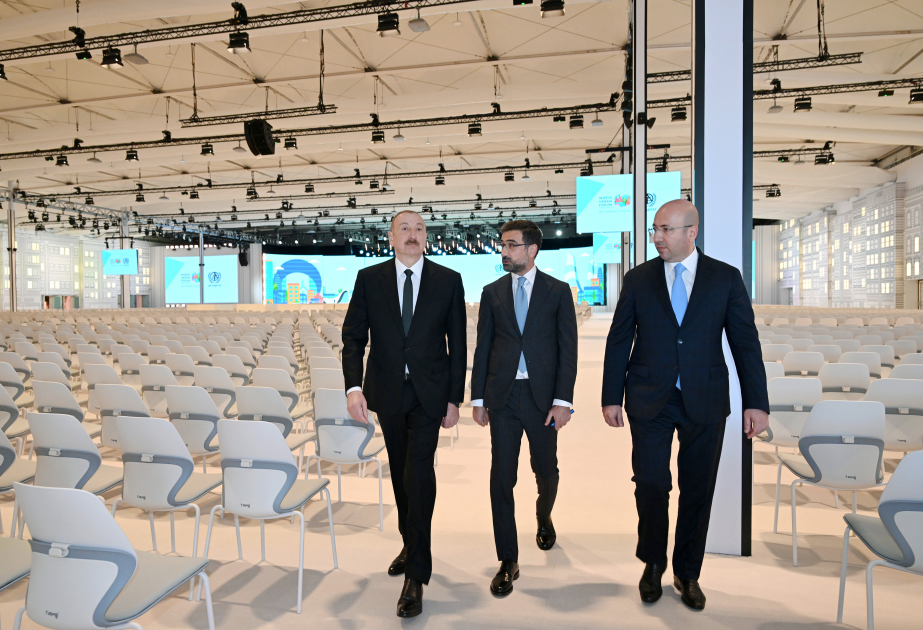
The operational area covering the Baku Olympic Stadium and its surroundings spans a total of 53 hectares. The forum’s logistical and infrastructure arrangements have been planned down to the finest detail in line with the highest international standards. Of the total area, 43 hectares have been allocated to the main event venue, while 10 hectares are designated for transportation terminals and parking-transfer zones.
A fully integrated operational system has been established encompassing registration, sessions, exhibitions, media operations, transportation, technical support, volunteer coordination, and venue services. Special areas have been created for high-level guests, including facilities for receptions, bilateral meetings, lounges, and catering services for state and government representatives. The main hall, where the opening and closing ceremonies will take place, can accommodate up to 6,000 participants simultaneously.
Key themes under discussion at WUF13 include smart and sustainable cities, affordable housing, climate adaptation, green urban development, urban resilience, disaster preparedness, public transport, digital transformation, and inclusive urban governance.
According to State Run Azertac News Agency, speaking during the forum, Malaysia’s Minister of Housing and Local Government and President of the United Nations Habitat Assembly (UN-Habitat), Nga Kor Ming, stressed the importance of accelerating the implementation of the New Urban Agenda.
“The 20-year period set for the implementation of the New Urban Agenda has already reached its midpoint, and the implementation of the goals set for 2036 must be ensured,” he said.
“As we return to our countries after the forum, we must pay greater attention to the construction of homes that meet people’s needs while ensuring connectivity and quality of life,” he added.
One of the major events on the opening day was the Ministerial Meeting on the New Urban Agenda, convened under Azerbaijan’s chairmanship as a new initiative within the WUF13 programme. Representatives from more than 100 countries reviewed progress made under the agenda, discussed existing challenges, and outlined priorities for the next phase of implementation.
Participants praised Azerbaijan for hosting the forum and commended President Ilham Aliyev, along with UN-Habitat Executive Director Anacláudia Rossbach, for creating an international platform aimed at advancing cooperation on sustainable urban development and adequate housing.
Discussions during the ministerial meeting highlighted the need to address housing in connection with broader sectors such as land governance, infrastructure, transportation, public services, climate action, and local economic development.
Delegates also emphasized integrated approaches to strengthening second-tier cities, smaller settlements, and urban-rural linkages in pursuit of balanced territorial development.
The forum additionally focused on the impact of wars, conflicts, and natural disasters on cities and infrastructure. Participants underlined the importance of reconstruction and recovery in post-conflict regions, with Azerbaijan’s post-conflict rebuilding experience presented as a model that could offer lessons for other countries facing similar challenges.
A symbolic highlight of the opening day was the WUF13 Flag Raising Ceremony, during which the flags of the United Nations and Azerbaijan were hoisted in the presence of Anar Guliyev, Chairman of Azerbaijan’s State Committee on Urban Planning and Architecture and National Coordinator of WUF13, and UN-Habitat Executive Director Anacláudia Rossbach.
The opening day also featured several thematic assemblies, including the Women’s Assembly, the World Assembly of Local and Regional Governments, the Grassroots and Civil Society Organizations Assembly, and the Business Assembly.
Another notable addition to this year’s programme was the Global Water Operators’ Partnerships Alliance (GWOPA) Assembly, jointly organized by UN-Habitat, GWOPA, and the Azerbaijan State Water Resources Agency. The biennial assembly was held under the umbrella of the World Urban Forum for the first time.
Hosting WUF13 further positions Baku and Azerbaijan as emerging international platforms for dialogue on urban modernization, sustainable development, and smart city initiatives, while reinforcing regional cooperation on future urban challenges.
It may be mentioned that WUF13 refers to the 13th Session of the World Urban Forum, a major global conference organized by UN-Habitat, the United Nations agency focused on sustainable urban development.
The World Urban Forum (WUF) is one of the world’s largest international gatherings on urbanization and sustainable cities. It was established by the United Nations in 2001 to examine rapid urbanization and its impact on communities, economies, climate, and governance.
The event will continue until May 22, 2026.
Other news in this section


