® Digital Transformation and the Future of Artificial Intelligence: An Interview with Nariman Asadov
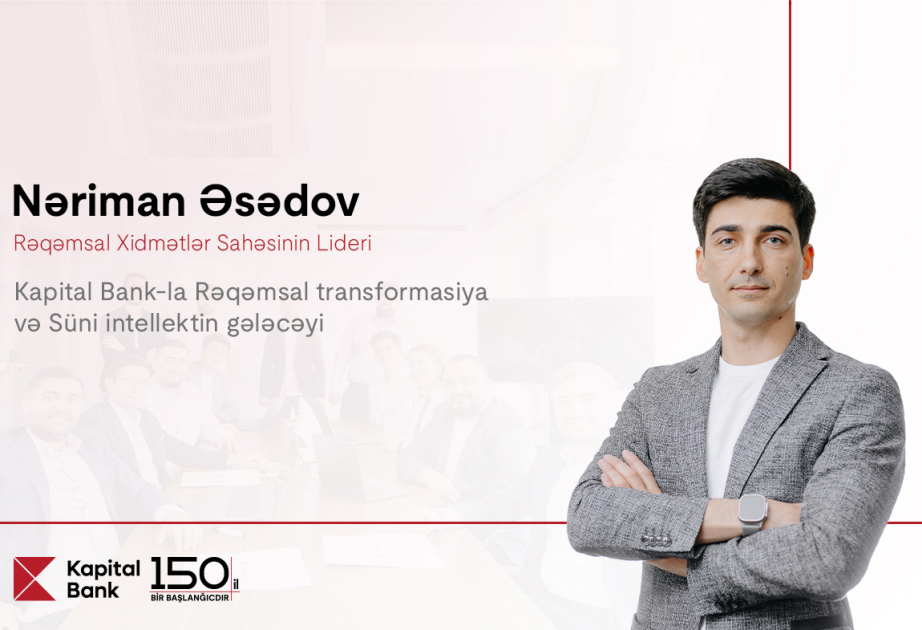
Today, artificial intelligence (AI) and digital technologies are key drivers of modern life and the financial market. These technologies optimize operations, accelerate data analysis, and personalize customer services in the financial sector, among other areas. Kapital Bank is recognized as the first bank in the country to implement digital transformation, offering its customers cutting-edge technological solutions. Our interviewee today is Nariman Asadov, head of the Innovations team at Kapital Bank, which was recently awarded the "Best Use of AI in Digital Transformation" by the renowned financial magazine "Global Finance."
Hello Nariman bey, at a time when AI is being applied in every aspect of our lives, executing such a project and winning an international award must be a great source of pride.
Nariman Asadov: Absolutely. To be honest, when we started the project, our goal wasn't to win an award. We believe success naturally follows from the work process itself. Our main aim was to provide faster, more efficient, and high-quality services to our customers. We regularly conduct customer surveys and service analytics at the bank, and the results drive us to continuously improve service quality and speed by applying new, modern solutions. This is an ongoing process. At that time, we saw a need to automate our service processes and ensure that our customers receive proactive services without waiting in line. Subsequently, we created systems that immediately respond to our customers' inquiries with our AI-powered chatbot and call request service.
By identifying our customers' needs in advance, we offered personalized services that allow us to serve them 24/7. Continuous development and innovation play crucial roles in our project. The banking industry is constantly evolving, and we keep improving our services and bringing new innovations tailored to our customers' needs by following these changes.
Ensuring our customers' secure use of our services is our top priority, and we continuously make updates and improvements in this direction. In short, as technologies evolve, our team evolves along with them, striving towards even bigger goals.
Can you provide more details about the AI algorithms and technologies used in your project? In simpler terms, how does AI work?
Nariman Asadov: We apply various AI algorithms and technologies in the project. First and foremost, we use both speech-to-text and text-to-speech conversion technologies. These technologies enable us to manage incoming requests more efficiently by converting our customers' voice inquiries into text or presenting text-based responses as voice responses. Currently, a part of these technologies, working at 12% capacity, is actively used by our customers.
In our chatbot technology, we have a system that responds to customers' behavior and inquiries. This system analyzes customers' questions and needs, providing the most suitable answers and possible solutions. As a result, we have created an AI-powered assistant that has won a global award. This assistant is a system that immediately responds to customers' questions and requirements, facilitating their interactions with the bank.
One of the greatest advantages of our AI-powered assistant is its continuous training. We regularly train this technology, enhancing its performance to better meet customers' needs. These technologies we created in the country's banking sector also serve to protect customers' information.
Integrating these systems with the bank's internal operations is also important to us. The integration of AI into the services provided within the bank has identified not only the needs of our customers but also those of our team. Therefore, along with the opportunities we offer to customers, we also improved our team and gained new knowledge. As I mentioned earlier, we aim to further develop these technologies in the future to provide faster and more efficient services.
What were the main challenges you faced during the implementation of AI, and how did you overcome them?
Nariman Asadov: Indeed, significant projects are being undertaken in the country regarding AI, achieving excellent results. However, there were almost no such projects in the banking sector. One of the main challenges we faced in applying AI in the banking sector was, as I mentioned, the lack of such models for the banking sector in Azerbaijan and insufficient knowledge of the Azerbaijani language.
Additionally, since the protection of customer information is our priority, it was necessary to train and educate AI ourselves. One of the challenges of this process was the significant resource requirement. There are applications like “OpenAI” available for public use to train AI, but they did not fully meet our needs.
The Kapital Bank team made a great effort in this process, and many of our employees participated in the training of AI. This process continues today, and our AI-powered assistant is being developed further.
With the support of the large Kapital Bank team, we regularly train the digital assistant to overcome these challenges, working diligently to adapt AI to our customers' needs.
As you mentioned, such great successes are the result of teamwork. However, sometimes it is not possible to share success within the team.
It may sound cliché, but I can confidently say that we do not have such a problem at Kapital Bank. We can all rejoice in everyone's success. Not only our innovations team but the entire Kapital Bank team has contributed to the success of our project. Every member has played a unique role and contribution in this process.
Our business analysts identified customer needs and market demands at the beginning of the project. They analyzed customers' behavior and inquiries, planning where and how AI should be applied. The marketing team played an important role in promoting AI-powered services among customers and communicating with them.
I would like to particularly highlight the efforts of our data technologies team. AI-based services are built on data. They work on collecting, storing, and processing large volumes of data. They played a significant role in data analysis and the training of machine learning models.
At the same time, we ensured the development and optimization of analytical models by closely collaborating with the analytics expert center. They conducted continuous analyses to ensure AI works correctly and provides accurate answers to customer inquiries.
In short, thanks to strong collaboration and coordination among the wide range of teams working in different fields at our bank, we successfully implemented the AI project. The participation and contribution of various teams at each stage of this process ensured the project's high quality and full alignment with customers' needs.
What major changes have occurred in the customer experience since the application of AI?
Nariman Asadov: Yes, we have reached the part that gives us the greatest motivation. The time when we feel the result of all our initiatives truly eliminates the sense of fatigue for us. Because we did the first thing at Kapital Bank. At the beginning, the application of AI brought several significant changes in customer experience. The biggest change for our customers was being able to get answers to their questions without needing human assistance and without waiting in line. This provided them with faster and more efficient service.
Initially, of course, our customers had some difficulty adapting to the new system. This was different from the traditional service process they were accustomed to. But soon they started to see the advantages of the new system and adapted to it. Our AI-powered assistant can respond to multiple inquiries simultaneously. This saves our customers' time and improves service quality.
This technology allows us to offer more personalized services to our customers. Our AI systems also analyze customers' questions and behavior, providing more suitable and accurate answers. As I mentioned, our system is continuously trained. This means it learns from questions it couldn’t answer before and gives better answers next time.
The positive change in customer experience in this way is made possible by AI's ability to improve itself and our customers' interaction with technology.
What are Kapital Bank's future plans and goals in the field of innovation and digital transformation?
Nariman Asadov: While I cannot reveal all our future plans, I can say that new beginnings await us. Our primary goal is to maintain the success we have achieved at the same pace. In the future, we will continue to apply new technologies to further improve customer experience. Our main goal is to meet our customers' needs more quickly and efficiently. Additionally, we aim to expand the capabilities of AI and other digital technologies and maintain our leadership in this field.
Our goal is to keep Kapital Bank as an innovative and customer-centric bank at all times. We will continue to take steps in this direction in the future.
What major trends do you think will emerge in digital banking in the near future, and how will Kapital Bank adapt to these trends?
Nariman Asadov: The word "future" itself is very inspiring because, as it appears from the current developments, a very different world awaits us. Trends worldwide show that the concept of digital banking will further develop in the future and become an integral part of people's daily lives. Customers will perceive banking services not just as financial transactions but as a large mechanism that meets their lifestyle and needs.
Among these trends are AI and automation, proactive customer services, more effective protection of personal data, and improved customer experience. In the future, digital banking will offer services tailored to people's daily needs and behavior. Mobile banking applications, voice assistants, blockchain technologies, and services integrated with financial technologies will play an important role in this field.
Kapital Bank is already taking serious steps to adapt to these trends. The large ecosystem that Pasha Holding is working on and the fact that Kapital Bank is at the center of this ecosystem strengthens our future strategies. Within this ecosystem, our customers will be able to integrate digital banking into their lifestyle. Our goal is to make our customers' lives easier. By strengthening our customers' relationship with digital banking, we aim to exceed their expectations and maintain our leadership position in the digital world.
What does winning this award mean for your team, and what is its significance for you?
Nariman Asadov: As the name suggests, winning the "Best Use of AI in Digital Transformation" award is also a success for our country. This award demonstrates the technological advancements happening in Azerbaijan. It shows that we are progressing in line with global developments and are not lagging behind world-class organizations.
The award is also a source of motivation for our team. It inspires us to achieve new milestones and encourages us to pursue even greater success in AI and digital transformation. Ultimately, this award is both a confirmation of our technological advancement and a stepping stone for future achievements. The digital transformation path we have initiated in the banking sector in the country is leading us to great success.
Thank you, Nariman bey. Wishing you continued success.
Nariman Asadov: Thank you very much.
Other news in this section


