WUF13 features session on “Transit-Oriented Development and Urban Green Spaces for Sustainable Urban Development”
Baku, May 20, AZERTAC
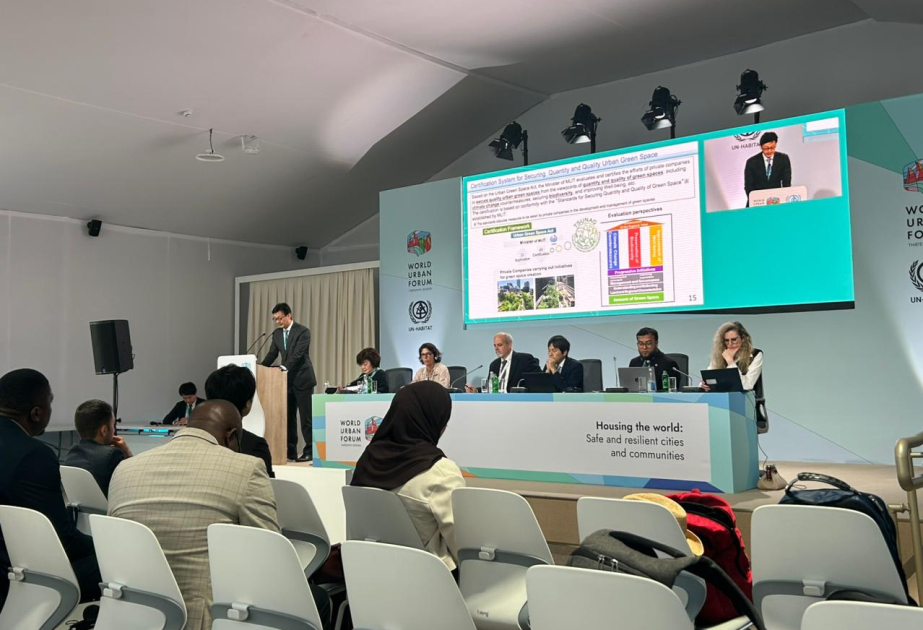
A session titled “Transit-Oriented Development and Urban Green Spaces for Sustainable Urban Development” was held as part of the 13th Session of the United Nations World Urban Forum (WUF13).
The event was co-organized by Japan`s Ministry of Land, Infrastructure, Transport and Tourism, along with the UN-Habitat Regional Office for Asia and the Pacific (ROAP). Participants, including experts from different countries, discussed sustainable urban development, transit-oriented development models, the expansion of urban green spaces, climate change mitigation measures, and approaches to addressing urbanization challenges.
In his address, Stefan Priesner, UN Resident Coordinator in India, noted that around 500 million people currently live in India’s cities, with another 400 million expected to move there over the next 20 years. He noted that urban development is a key national priority, with large-scale programs underway, including major affordable housing initiatives. He added that 12.5 million social housing units have been built and another 10 million approved.
He added that the large number of individual and institutional stakeholders, along with other distorting factors, makes integrated planning more challenging. He noted that there are broad opportunities for cooperation not only within the UN system but also among many other actors in India to support sustainable urban development. He also pointed out that the UN has multiple urban development programmes implemented not only by UN-Habitat but also by other agencies.
Claudia Baranzelli, Coordinator of the Geospatial Analysis team and the Geospatial Lab at the OECD’s Centre for Entrepreneurship, SMEs, Regions and Cities, emphasized that it is important to mobilize private sector funding in finance and investment as much as possible, noting that the public sector alone cannot meet all needs. She also stressed the need to strengthen monitoring and evaluation systems.
Other speakers underscored that the urbanization model should be inclusive, sustainable, and prosperous.
Within the session, attention was focused on Japan’s long-standing “Transit-Oriented Development” (TOD) approach, the integration of urban planning with public transport infrastructure, and international experience in the green transformation of cities.
Other news in this section


