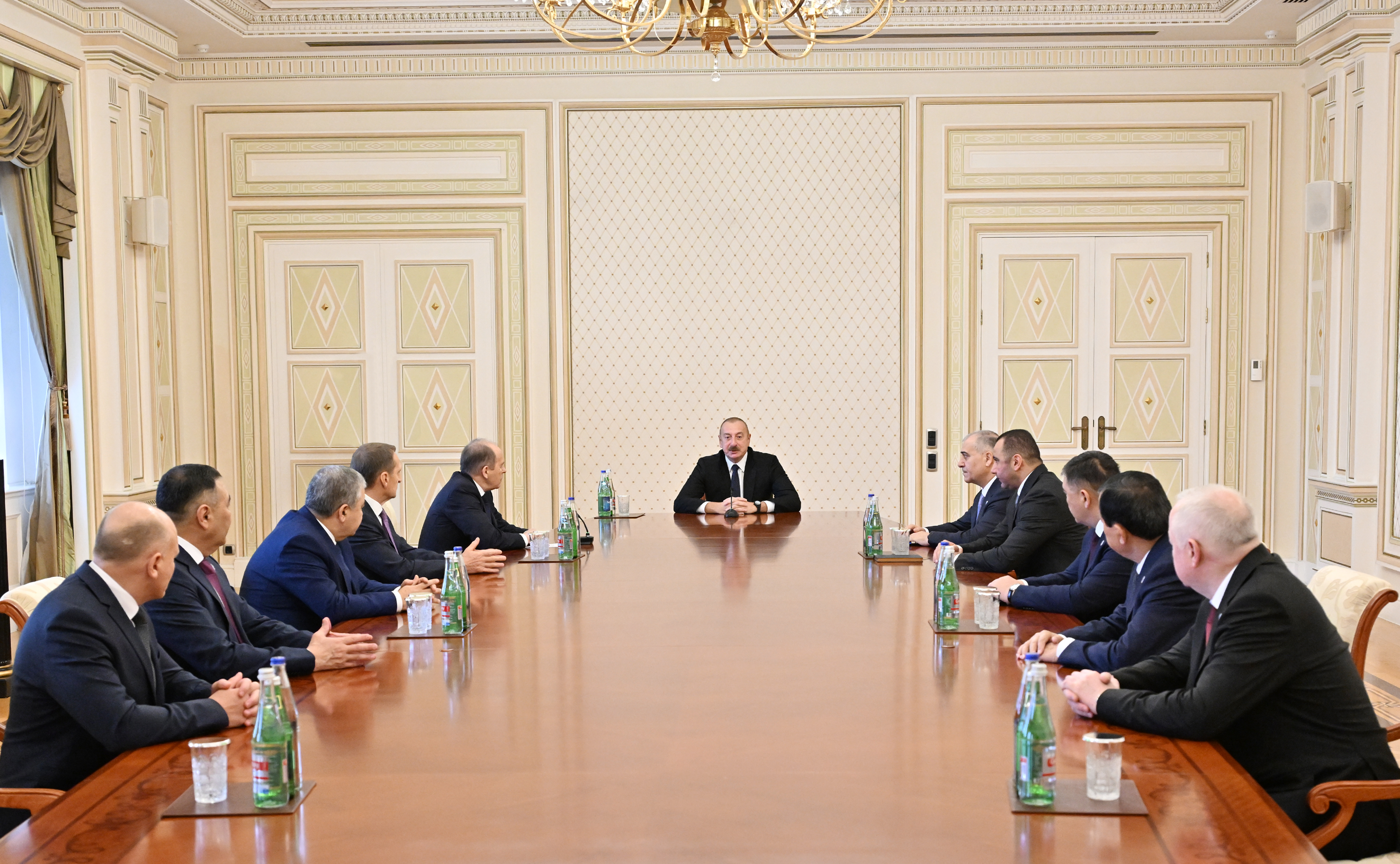
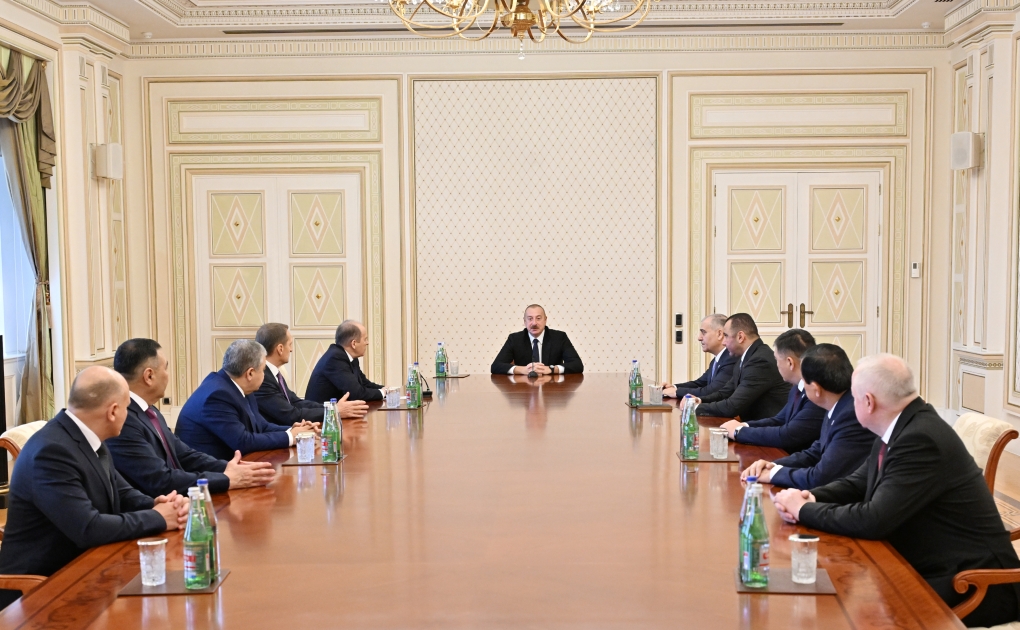
President Ilham Aliyev received participants of 53rd meeting of CIS Council of Heads of Security Agencies and Special Services VIDEO
Baku, October 11, AZERTAC
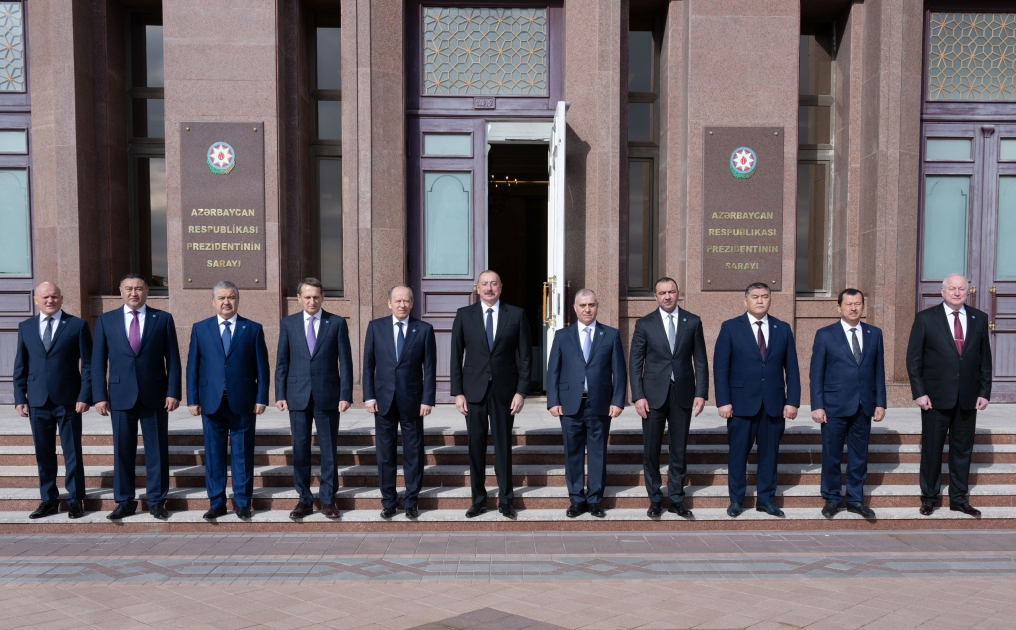
President of the Republic of Azerbaijan Ilham Aliyev has received the participants of the 53rd meeting of the Council of Heads of Security Agencies and Special Services of the CIS member countries - Director of the Russian Federation Federal Security Service, Chairman of the Council of Heads of Security Agencies and Special Services of the CIS member countries Alexander Bortnikov, Director of the Russian Federation Foreign Intelligence Service Sergei Naryshkin, Chairman of the State Security Committee of Belarus Ivan Tertel, Chairman of the National Security Committee of Kazakhstan Yermek Sagimbayev, Deputy Prime Minister of Kyrgyzstan, Chairman of the State Committee for National Security Kamchybek Tashiev, Chairman of the State Security Service of Uzbekistan Abdusalom Azizov, Chairman of the State Committee for National of Tajikistan Security Saimumin Yatimov, Head of the CIS Anti-Terrorist Center Yevgeny Sysoyev.
Welcoming the participants of the meeting, President Ilham Aliyev said:
- I am pleased to welcome our distinguished guests, heads of secret services of friendly states.
I am sure that the event in Baku will serve to strengthen our interaction and make another contribution to further cooperation. It is noteworthy that your meeting is being held on the eve of another CIS Summit, where the heads of state will have an opportunity to communicate and discuss very important issues of our interaction. Azerbaijan has always attached great importance to participation in the CIS. There are very close contacts in all directions, including, of course, the sphere of security. In the challenging international situation, your work, as well as the interaction with your colleagues, is of particular importance, as threats are growing, new centers of instability are emerging, and the stability and security of our countries largely depend on the operational work of your agencies.
I believe that at today's meeting you will also discuss ways of strengthening cooperation. Of course, it is necessary to always exchange operational information. You know better than anyone that information is of great importance, including how quickly it is received and how quickly it is responded to. Of course, the close interaction between our countries creates excellent opportunities for our cooperation to be sincere, targeted, result-oriented and aimed at eliminating or preventing possible threats.
There are, of course, external threats in the regions where our countries are located, and operational work in this direction allows us the opportunity to minimize the risks. It is gratifying to see that public and political stability in our countries is strengthening and our states are successfully confronting many challenges.
As far as Azerbaijan is concerned, we no longer have any internal threats. As a result of the activities carried out three weeks ago, the sovereignty of Azerbaijan has been fully restored and, of course, this opens up opportunities for strengthening security and achieving peace in our region. We are committed to this and believe that there is no alternative to it. Proceeding from the fact that the events of recent weeks are interpreted differently in the media, first of all, in the Western media, I would say in a lop-sided and biased way and do not reflect the history of the issue or the present-day realities, I would like to briefly inform you about what has been happening over the past three years. But in order to make my information more complete, I would like to make a small historical excursion, as it were.
I will begin by saying that an entity called Nagorno-Karabakh never existed in history. There was Karabakh Khanate, which became a part of the Russian Empire in 1805. The Kurekchay Peace Treaty was signed, on behalf of the Azerbaijani side it was signed by the Karabakh khan, his position was called the khan of Karabakh and Shusha Ibrahim Khalil. On the Russian side, it was signed by Royal General Tsitsianov. The text of the Treaty of Kurekchay is available on the Internet and everyone can familiarize themselves with it. There is no mention of the Armenian population or any special rights of the Armenian population in it. In other words, it clearly says again, and historians know it well, that Karabakh is ancient land inhabited by Azerbaijanis who have lived on this territory for centuries, for millennia. After the Kurekchay Peace Treaty, there were two more treaties between Azerbaijani khanates and Russia - the 1813 Gulistan Peace Treaty and the 1828 Turkmenchay Peace Treaty, according to which other Azerbaijani khanates, including Iravan, became part of Russia. Also, these documents naturally referred to Azerbaijani lands. After the Sovietization of the South Caucasus, the Nagorno-Karabakh Autonomous Oblast was created. Why was it created? Because after those 19th century documents, mass resettlement of the Armenian population to the territory of Azerbaijan from Persia and Eastern Anatolia began. And by the time of Sovietization, the national composition of the Karabakh region of Azerbaijan was not the same as it was before the beginning of the 19th century. Based on this, maybe there were some other reasons too, the Soviet power, the Soviet Union created the Nagorno-Karabakh Autonomous Region, not even a republic, but a region within the Azerbaijan SSR. It was exactly one hundred years ago. By the time centrifugal tendencies started to emerge in the Soviet Union, Armenian separatism and aggressive extremism raised its head. By late 1980s, informal extremist organizations were created. Unfortunately, this was not properly assessed by the Soviet leadership and in many cases it was even encouraged by it.
We all remember who was at the head of the Soviet Union in the late 1980s and, naturally, it was impossible to expect anything else. All this led to the fact that the traditional relations of peace, friendship and harmony between the Azerbaijani and Armenian peoples were disrupted, a harmful ideology of national exclusivity and superiority was thrown in and attempts were made to justify claims to the Karabakh land of Azerbaijan. These tendencies were transformed into overt aggression after the collapse of the Soviet Union and the occupation of Azerbaijani lands. As a result, about 20 percent of the territory of Azerbaijan - both the Karabakh region and the former Nagorno-Karabakh region, as well as seven districts that had nothing to do with that autonomous formation, were also occupied. Ethnic cleansing was carried out, more than a million Azerbaijanis were expelled from their native lands and the situation remained as such until the fall of 2020. Azerbaijan tried to resolve the issue peacefully in every possible way. We were engaged in long and fruitless negotiations under the auspices of the OSCE. By the way, the fact that this conflict was not resolved shows that the OSCE is in need of major transformation. We also see in this conflict the inability of the United Nations to use its authority and leverage, because although four resolutions of the UN Security Council were adopted, demanding the immediate withdrawal of Armenian forces from Azerbaijani territory, they were not implemented. We waited for a long time. We had hopes. I was also involved in the negotiations at different stages from 2004, but unfortunately, all hopes collapsed in 2019. Then the prime minister of Armenia said that “Karabakh is Armenia, full stop”, thereby putting an end to all negotiations and making them completely meaningless. Not to mention the fact that it was an open territorial claim to the sovereign state of Azerbaijan, because no country in the world, including Armenia itself, had recognized the so-called “Nagorno-Karabakh Republic”. So this provocative, reckless and I would even say suicidal, as it turned out, step of the Armenian leadership, as well as other provocative actions, including those of military nature, led to the Second Karabakh War in September 2020, which lasted 44 days and ended with the complete defeat of the Armenian army and restoration of the territorial integrity of Azerbaijan. Through the mediation of the Russian Federation and personally President Vladimir Vladimirovich Putin, a Trilateral Statement was signed on the night of 9-10 November, 2020, according to which the territories of the districts adjacent to the former Nagorno-Karabakh region that were still under occupation were also returned to Azerbaijan, and the Russian peacekeeping contingent was brought into the region.
This is a brief history of the issue. And the question may arise: what happened three weeks ago? Well, although the declaration I mentioned was signed, Armenia did not fulfill its provisions, namely, one of the most important provisions said that all Armenian armed forces should withdraw from the territory of Karabakh. This was not done. In fact, it was not done in a demonstrative fashion. Moreover, in the two years from 2020 to the beginning of 2023, when Azerbaijan did not control the border in the Lachin district, huge amounts of ammunition were brought in, amounting to millions, which was revealed quite recently. Mines were brought in and our territory was additionally mined. All this led to the fact that Azerbaijanis continued to die on their own land. Since the end of the Second Karabakh War, we have 315 dead and badly maimed military personnel and civilians. Unfortunately, the number is growing every week.
Our repeated appeals to Armenia to put an end to territorial claims to Azerbaijan received a very strange response, which I would also like to inform you about. A year ago, last October, at a meeting of the leaders of Armenia and Azerbaijan with international partners, a statement was adopted, in which both countries recognized each other's territorial integrity and commitment to the 1991 Alma-Ata Declaration, which confirmed the territorial integrity of our countries. We considered this an important step on the part of Armenia, which would finally give up its territorial claims to Azerbaijan. But, unfortunately, our hopes were in vain. Recognizing the territorial integrity of Azerbaijan in words and on paper, the Armenian leadership actually did the exact opposite. Azerbaijan's repeated appeals to give up provocative actions, unfortunately, were not taken seriously. The situation aggravated even more when on September 2 of this year, the Armenian prime minister sent a letter of congratulation on the anniversary of the establishment of the so-called “Nagorno-Karabakh Republic”. This was a crossing of a red line, which Azerbaijan, naturally, could not tolerate. It was an obvious claim to our territory. On September 9, the so-called authorities of the so-called Nagorno-Karabakh held elections, chose a new leader, which represented complete disregard for the existing realities, and left Azerbaijan with no other option but to conduct anti-terrorist measures on September 19 and fully restore its sovereignty. As a result of the operation, which lasted less than a day, the Armenian army in Karabakh was completely disarmed, the contingent of many thousands - there were from 10,000 to 15,000 of them - was disarmed and full control over the territory was established. At the same time, we have already published a plan for the reintegration of the Armenian population of Karabakh, which is also available on the Internet. An appeal was made to the Armenian population to stay in their homes, because our operation was very targeted. Civilian infrastructure, civilian facilities and civilians were not harmed and, as I said, the whole operation lasted less than 24 hours. It was enough for the illegal armed formations of Armenia to be completely demoralized and, in fact, to surrender. Today, the process of cleansing the territories from bandit gangs is underway. According to our data, there are still certain groups hiding in this territory. After September 20, there were armed provocations in Karabakh. The territory is quite large, with mountains and forests, so we will need time to completely clear the territory from these gangs. This is basically the history of the issue.
What is going on around us? I think you will also be interested to hear our assessment of what is happening from us. Well, let me start by saying that Azerbaijan complied with all humanitarian norms during the occupation, during the second Karabakh war and during the anti-terrorist measures. By the way, this is evidenced by international experts, including the UN mission, which visited the liberated territories just recently, yesterday and before that, about a week ago, twice, and noted that all humanitarian norms had been observed. Nevertheless, Armenian patrons in the West have launched a dirty, provocative and false campaign against Azerbaijan, accusing us of all possible sins. France plays the main violin here, and this is reflected in the statements of officials of this country, attempts to discredit Azerbaijan, an extensive media campaign against Azerbaijan, where everything is turned upside down. Azerbaijan is portrayed as an aggressor, while Armenia is described as a victim. The history of the 30-year occupation, the destruction of all our towns and villages, the Khojaly genocide - all this is naturally ignored and completely false stories are invented. By the way, I must say that just yesterday I was familiarized with a video where a candidate for the US President makes accusations against Azerbaijan, while showing the footage of Armenian missile shelling of Ganja. Just imagine the degree of falsification and cynicism! During the Second Karabakh War, Armenia shelled our cities located hundreds of kilometers away from the conflict zone with long-range artillery, including ballistic missiles, and more than a hundred civilians, including children, were killed. So the so-called candidate, blaming Azerbaijan, shows footage of the Armenian attack on Ganja and Barda. How can we talk to these people and what can we explain to them? They do not want to hear anything. They have their own instructions, which are sent down to them from the center, and they act upon them. That is why now we are facing an unprecedented information war against Azerbaijan. Of course, we are fighting it with our own resources, trying to convey the truth about what happened. But we should realize that the forces are unequal. Countries such as France, which has a long colonial history, have much more media resources around the world than we do.
Nevertheless, using various platforms, international organizations and other ways, we are conveying and will continue to convey the truth about what has happened.
Speaking about France, I would also like to note the destructive and provocative role of the leadership of this country during the entire period since 2020 and now. Numerous accusations, groundless threats and blackmail against Azerbaijan have had no effect. The recent statement by the President of France that Azerbaijan has problems with international law can only cause laughter. Azerbaijan has not violated international law. We fought on our territory, we suppressed separatism, we observed all humanitarian norms and all Geneva Conventions. In fact, international law has been violated for 30 years by France's protégé and today's main ally, Armenia, which occupied the territory of another state. And as the saying goes, one should see the log in one's own eye before seeing a straw in someone else’s eye. One and a half million Algerians were exterminated by the French regime just because they were Algerians and Muslims. That is genocide. Not to mention France's bloody crimes across Africa, in other parts of Africa and around the world. And the fact that France still retains its colonies to this day is incomprehensible. Azerbaijan, as the Chair of the Non-Aligned Movement, and I personally raised this issue at the summits of the Non-Aligned Movement. And this country, which has a bloody colonial past, which some African countries cannot get rid of to this day no matter how hard they try, accuses us of violating international law. This is absurd.
There is also another question. Some countries and international organizations are trying to mediate the normalization of relations between Azerbaijan and Armenia today. I recently said that if this policy is not one-sided and biased, we will accept these attempts. But when we see from the side of France, on the one hand, a flagrant violation of all diplomatic norms, statements bordering on insults, dirty insinuations, provocations and lies, and on the other, attempts to provide mediation services, it does not fit into any logic. We do not need such mediators. That is the first. Secondly, if someone wants to engage in mediation, this should not be a PR exercise, but should actually aim to achieve a result.
I would also like to inform you that on October 12, a day later, at the suggestion of the Russian side, a meeting of the foreign ministers of Russia, Azerbaijan and Armenia was to be held in Bishkek. We perceive the mediation of the Russian Federation with gratitude, because Russia is our neighbor and ally, as well as Armenia's ally. This country is located in our region, unlike those who are thousands of kilometers away. Naturally, the history of relations between our countries naturally presupposes the mediation of the Russian side. We took this proposal positively, and our foreign minister was ready to meet with his Russian and Armenian colleagues. Unfortunately, the Armenian side refused to attend that meeting. Now the question arises: does Armenia want peace? I think not, because if it had wanted peace, it would not have missed this opportunity. The Armenian prime minister flies six hours to Granada, participates in an incomprehensible meeting there, where Azerbaijan is discussed without actually being present, but he can't fly for two to three hours to Bishkek, he has other important things to do. This is what we all have to say openly. Everyone can see that it, but we should talk about it and proceed from it.
Concluding my comments, I would like to say a few words about the normalization of relations between Azerbaijan and Armenia. We are ready for that. We are ready to continue working on the peace treaty. In case the mediation of the Russian Federation is rejected by the Armenian side, I think that direct negotiations between the foreign ministers of Azerbaijan and Armenia may be an alternative. We will analyze any other platforms, taking into account the attitude of these countries, which offer their services, to the truth - not to Azerbaijan, but to the truth and international law.
I would like to thank you again for finding the time to come here. It is a difficult time everywhere, everyone has a lot to do, but the fact that you are in Baku today speaks about your attitude to our country, the level of cooperation between the secret services of our countries and is an important factor of security in the former Soviet Union. I think we should strengthen our cooperation. Historical ties, common past - all these are factors that will contribute to strengthening friendship and mutual support in the CIS. So welcome again, and I wish you success with today's event.
x x x
Director of the Russian Federation Federal Security Service, Chairman of the Council of Heads of Security Agencies and Special Services of the CIS member countries Alexander Bortnikov said:
- Dear Ilham Heydarovich!
First of all, I would like to thank you for the opportunity to hold another meeting of heads of secret services of the Commonwealth countries in Azerbaijan. This is the fifth time we have organized our meetings during the existence of our Council. Azerbaijan has always created favorable and excellent conditions for our council meetings. Of course, we are grateful to the head of the Security Service of Azerbaijan for the work they have done in preparation for our today's event. Let me note that during the time of the Council’s existence, it has proved its relevance. Many issues you have just communicated to the heads of security services - they do exist taking into account the problems we faced after the collapse of the Soviet Union.
Unfortunately, every republic, every sovereign state has, to a greater or lesser extent, experienced the problems that we are discussing on the platform of our Council. These are separatist manifestations, extremist manifestations, terrorist manifestations, and we have been constantly talking about them for years. We have encountered them in one way or another. We are talking about issues that have direct bearing on security, sovereignty and constitutional order of our states, because some problems both inside our countries and external factors have a combined impact on security issues.
It is regrettable that almost all CIS states have recently been facing the issues you have just mentioned. I believe that our meeting today will contribute to the advancement of our joint work in many areas. I would like to thank you once again, Ilham Heydarovich, for the opportunity, for today's meetings, for the guidance you gave us today, for the historical background and justification of the processes that are taking place in the CIS and in the region we are visiting now. This is very important from the point of view of understanding and objective perception of what is happening. Of course, we will do everything in our power to make the most effective and productive use of today's meeting and address the issues of security of our countries in the future. Thank you very much.
Other news in this section


VIDEO