Japan's Nikkei stock index ends up over 5% on U.S.-Iran cease-fire deal
Baku, April 8, AZERTAC
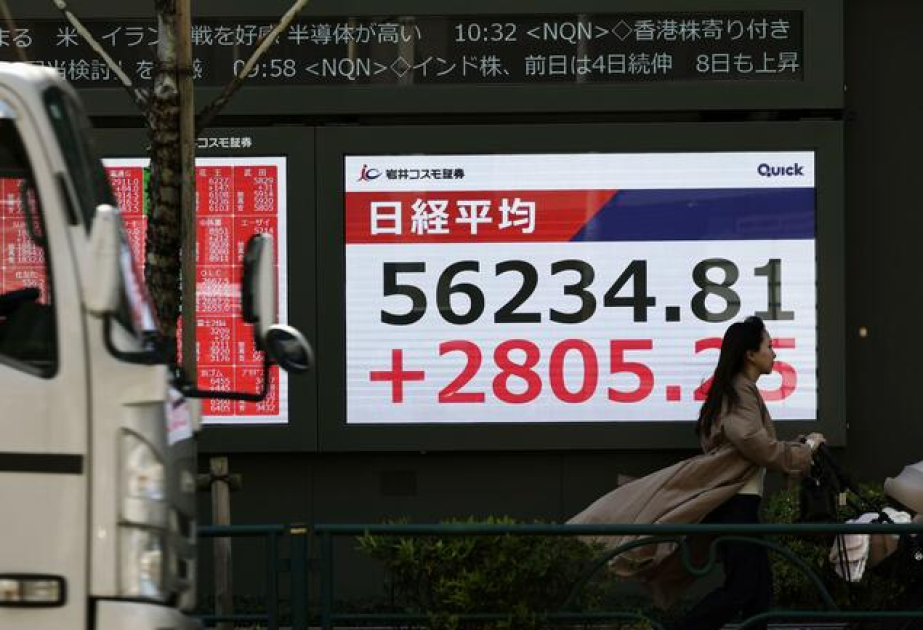
Tokyo stocks surged Wednesday, with the Nikkei stock index ending 5 percent higher on buying driven by eased concerns over the Middle East crisis after the United States and Iran agreed to a two-week cease-fire, according to Kyodo.
The 225-issue Nikkei Stock Average ended up 2,878.86 points, or 5.39 percent, from Tuesday at 56,308.42, marking its third-largest single-day point rise in history and the biggest this year. The broader Topix index finished 121.28 points, or 3.32 percent, higher at 3,775.30.
On the top-tier Prime Market, the main gainers were nonferrous metal, glass and ceramic product and electric appliance issues.
The U.S. dollar dropped sharply to the lower 158 yen range in Tokyo, as investors unwound their flight-to-safety positions in the wake of the latest development in the Middle East.
At 5 p.m., the dollar fetched 158.20-22 yen compared with 159.58-68 yen in New York and 159.86-87 yen in Tokyo at 5 p.m. Tuesday.
The euro was quoted at $1.1694-1696 and 185.01-05 yen against $1.1593-1603 and 185.07-17 yen in New York and $1.1541-1543 and 184.50-54 yen in Tokyo late Tuesday afternoon.
The yield on the benchmark 10-year Japanese government bond fell 0.040 percentage point from Tuesday's close to 2.365 percent, as inflation concerns due to the Middle East tension receded.
U.S. President Donald Trump's announcement on a conditional cease-fire with Iran, just hours before the Tokyo stock market opened, spurred a strong rally throughout Wednesday, with the benchmark Nikkei index at one point gaining nearly 3,000 points.
Investors snapped up stocks on hopes crude oil supply will stabilize, dealers said, with Trump saying the United States will refrain from attacking Iran for two weeks on condition that Tehran allows commercial shipping to safely transit the Strait of Hormuz, through which about 20 percent of the world's oil supply flows.
The U.S. benchmark West Texas Intermediate crude oil futures fell below $100 per barrel, lifting market sentiment.
"There might be a sense of urgency among investors not to miss the chance of buying," Toshikazu Horiuchi, equity strategist at IwaiCosmo Securities Co., said. Stocks have shown volatile movements amid the twists and turns of the Iran war, which began in late February.
But Maki Sawada, strategist in the Investment Content Department of Nomura Securities Co., said market players are not fully assured of whether the reopening of the Strait of Hormuz will become permanent.
"Uncertainty over crude oil supply still remains, and it is also unclear whether there will be progress in negotiations between the two countries," she said.
Other news in this section


