“AFTER AZERBAIJAN`S PRESIDENTIAL ELECTION: THE LOOK AHEAD” SECOND PART
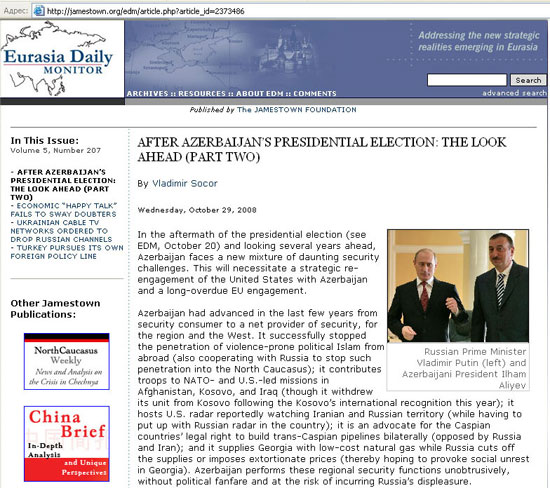
 The Washington-based Jamestown Foundation`s publication, the Eurasia Daily Monitor, issued the second part of the article “After Azerbaijan`s Presidential Election: The Look Ahead” by political analyst Vladimir Socor.
The article says Azerbaijan had advanced in the last few years from security consumer to a net provider of security, for the region and the West. It contributes troops to NATO- and U.S.-led missions in Afghanistan and Iraq; it is an advocate for the Caspian countries` legal right to build trans-Caspian pipelines; and it supplies Georgia with low-cost natural gas. The author stresses “Azerbaijan performs these regional security functions unobtrusively and without political fanfare.”
The article also says From Azerbaijan`s perspective, the United States remains the security provider of the leader in energy diplomacy. The United States, the European Union, NATO, and Turkey need to make plans for protecting the energy transit corridor. Such measures could include government-backed risk insurance and credit guarantees for investments, unambiguous political commitments. The necessity of such measures can no longer be ignored if the West intends to revitalize its Caspian energy agenda. The specific measures would differ in the case of Azerbaijan, where military protection measures are not called for at this stage, from those in Georgia where a military presence is needed. In both countries, however, conventional and unconventional threats to the energy infrastructure must now be seriously considered and security planning adjusted accordingly for the region.
The United States also needs to demonstrate fair treatment of its close partner on the basis of shared strategic interests. By failing, however, to provide credit guarantees for the Kars-Tbilisi-Baku (KTB) railroad project, and opposing the Azerbaijan-initiated resolution on territorial integrity in the UN General Assembly, Washington seemed to take its close partner for granted, while allowing sectional lobbying to override those shared strategic interests. The U.S. policy process as such could only gain credibility through the removal of legislation under the Freedom Support Act (Section 907) which penalizes the target of ethnic cleansing while implicitly excusing the perpetrator of that operation in the Armenia-Azerbaijan conflict. That unresolved conflict remains the most painful issue for Azerbaijani society, a fact often underappreciated by Western policy makers.
Following presidential elections in Armenia and Azerbaijan, the Russia-Georgia war, and high-level Turkey-Armenia contacts, momentum is building in the talks toward a stage-by-stage solution to the conflict between Armenia and Azerbaijan.
This U.S.-encouraged process offers a chance for Armenia to extricate itself from strategic dependence on Russia and open direct outlets to the outside world.
######
Other news in this section


