The moon is even older than we thought
Baku, October 26, AZERTAC
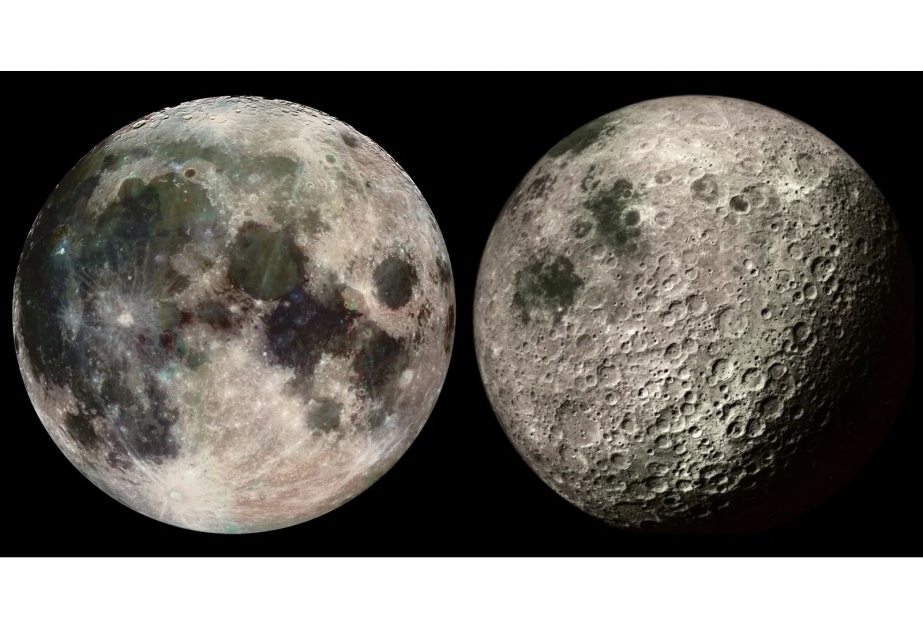
A new study of lunar minerals has captured the last stage of the moon solidifying into rock, according to National Geographic.
Half a century has passed since humans set foot on the moon, but the lunar rocks that they gathered are still revealing important information about Earth’s lambent neighbor. Some of that material has been preserved for decades so that it could be studied with more advanced scientific instruments—and now lunar material collected in 1972 has shown that the moon is millions of years older than previously thought.
By studying the atomic clues trapped in a crystal of zircon, one of the oldest mineral to survive from the moon’s formation, scientists have determined that the moon is at least 4.46 billion years old. The age, published this week in the journal Geochemical Perspectives Letters, bumps previously measured ages back in time by 40 million years—closer to the start of the solar system an estimated 4.57 billion years ago.
Pinning down the age of the moon can help scientists chronicle the sequence of events during the critical early days. “Timing is everything,” says first author Jennika Greer, a cosmochemist at the University of Glasgow who worked on the project when she was a graduate student at the University of Chicago. “Our solar system has been around for a while, but a lot of really dynamic processes happened in those first million years.”
When the solar system was young, the infant Earth was moonless, a solitary planet looping around the primordial sun. But Earth’s early days were anything but tranquil. Scientists believe that early in our planet’s history, a Mars-size object slammed into the proto-Earth and rejiggered both worlds.
The heat of the impact liquefied everything—the young Earth and the planetary destroyer—fusing the two bodies into one. Out of this mass flew a smaller ball of molten rock, which fell into a stable orbit and eventually cooled to form the moon.
The moon’s insides congealed into differentiated layers of the mantle and crust. New minerals crystallized out of the rock melt, and one of the last to form were zircons. These crystals capture the final stages of the moon solidifying into rock, marking the beginning of our natural satellite as we know it today.
Counting atoms
Zircons are a favorite mineral among scientists because they’re hardy. These micrometer-size crystals can withstand weathering over billions of years to preserve the geochemical secrets of their birth. They also capture uranium isotopes from the environment as they form, which serve as a timer that starts from the moment the zircons crystallize.
Uranium isotopes decay into lead at predictable rates. By counting the number of lead atoms that form and the uranium atoms that remain, researchers can work out how much time has passed since the zircons hardened from molten material.
The study authors probed the zircons embedded in a lunar rock sample collected during Apollo 17 in 1972, and they constructed a 3D map of the atoms. Tallying the lead isotopes resulted in an age of 4.46 billion years, the oldest age for the lunar crust’s formation yet.
This age was previously determined by Greer's collaborators led by Bidong Zhang and Audrey Bouvier in 2021, but the report drew skepticism. Critics pointed to the fact that lead atoms tend to migrate to form pockets of high or low concentrations throughout the rock. Depending on where one looked, there was a chance that they might come across these unevenly distributed lead sites and miscalculate the zircon’s age.
To assuage these concerns, Bouvier approached Greer’s team to count the atoms again, this time with an ion probe that could sample the rock at a much higher spatial resolution that was used in the previous study. A finer probe would allow the team to identify nanosized regions of enriched or depleted lead atoms, if any were present. But they found none.
“In this zircon, everything was homogeneous, so we didn't even have to worry about that,” says study author Philipp Heck, a cosmochemist at the Field Museum and the University of Chicago. The result confirmed that the previously measured age of 4.46 billion years was accurate.
“It's a very, very nice study,” says Melanie Barboni, a geochemist at Arizona State University who wasn’t involved in the research. Barboni has studied other isotopes in lunar zircons to discover that the moon’s interior first settled into distinct layers 4.51 billion years ago, an episode that preceded the final stages of crust formation captured in the new study.
Barboni says the new research is compatible with her own findings. “A lot of papers propose that the moon formed much later than that, 4.3 billion years, for example,” she adds. “That clearly is not possible with that data.”
The history of the moon and Earth
Pinpointing when the moon solidified gives future researchers a reference point for modeling the moon’s evolution. “Chronology helps us put everything into context,” Greer says. “Then we can start understanding the processes that are going on.” Knowing what happened and when during the moon’s formative years could help explain why Earth’s satellite looks the way it does today.
The true interest in studying the moon lies in what it can tell us about Earth. As celestial companions with a common origin, the fates of the Earth and moon are tied. But like a wily criminal, the geologically active Earth has a penchant for burying and destroying evidence of past events. The moon is a less deceptive partner—the lack of tectonic activity means that geologic records on the surface last for eons.
Scientists can look at the lunar evidence to infer what might have also happened on Earth around the same time. For example, in that fateful collision that formed the moon, Earth was rendered uninhabitable—nothing could have survived such a catastrophic event—and all its water could have boiled off, Greer says. If so, then water must have been returned to our planet at some point, perhaps delivered by impacting asteroids, which also would have left clues on the moon.
While the new study dates the completion of the moon’s formation at a minimum of 4.46 billion years, the entire process, from the planetary collision to the eventual hardening, unfolded over millennia. Zircons represent the final vestiges of the lunar magma ocean—the last chapter of the moon’s violent beginnings and the onset of its more placid epoch.
Both Heck and Barboni wouldn’t be surprised if future researchers find an older zircon that produces an even older age for the moon. Perhaps a more ancient crystal lies among NASA’s lunar stash, though Heck says they’re rare. Or maybe more are waiting to be discovered on the moon where humans haven’t yet trodden.
Several missions are in the works to bring lunar samples back from where no one has gone before. In 2024 China will launch a robotic mission that will return samples from the far side of the moon, and NASA’s Artemis III mission aims to land humans on the lunar south pole in December 2025. The new rocks collected at these sites could help refine the story of the moon’s origins.
Other news in this section


