Analyst: Italy keen on strengthening dialogue between Baku and EU
Baku, October 2, AZERTAC
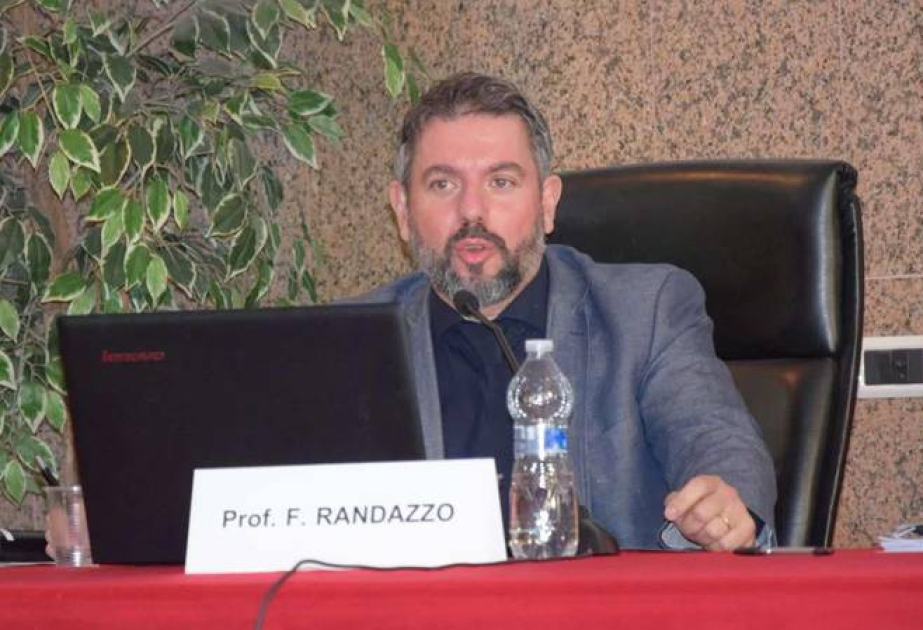
The relations between Italy and Azerbaijan show an example of strategic partnership based on historical roots and increasingly acquiring a multifaceted character, Francesco Randazzo, an Italian analyst in international relations and a specialist in the geopolitics of the post-Soviet space, told AZERTAC.
He noted that the first-ever visit of President of the Italian Republic, Sergio Mattarella, to Azerbaijan, which took place in July 2018, was an important political event that laid the foundation for a new level of bilateral dialogue. The recent visit of Sergio Mattarella served as another confirmation of the consistency and depth of this partnership, reflecting both historical ties and the modern dynamics of cooperation.
The analyst emphasized that the formal beginning of diplomatic relations between the two countries dates back to 1992 — shortly after Azerbaijan gained independence. However, according to him, the real impetus was given in 1997, when President Heydar Aliyev visited Rome. It was then that the first important agreements were signed, laying the groundwork for the development of political, economic, and cultural ties.
Francesco Randazzo highlighted that energy has remained the cornerstone of the Italy-Azerbaijan partnership for decades. Italy has long been Azerbaijan's main trading partner, primarily due to imports of oil and petroleum products. Italian companies played a key role in implementing projects such as the “Contract of the Century” and the construction of the Baku–Tbilisi–Ceyhan oil pipeline. A particularly important step was the decision made in 2013 to build the Trans-Adriatic Pipeline (TAP), which completes the Southern Gas Corridor and provides direct supplies of Azerbaijani gas to the Italian market. According to the analyst, this project secured Azerbaijan’s status as a strategic supplier playing a key role in ensuring the energy security not only of Italy but of Europe as a whole.
The expert noted that in recent years there has been a clear trend towards diversification of cooperation. Since 2017, contacts in the field of defense and security have intensified, which was expressed, in particular, by the signing of a contract in 2023 for the supply of Italian tactical transport aircraft C-27J, manufactured by the Leonardo company, to Azerbaijan. This event, according to Randazzo, became an important milestone, indicating growing trust between the countries and a desire to expand the partnership beyond traditional areas.
The humanitarian aspect of bilateral relations is also beginning to play a noticeable role, according to the analyst. In this context, he points to the development of academic and cultural exchanges. The most important initiative was the Italy-Azerbaijan University project in Baku, in which leading Italian universities participate. This initiative not only strengthens the humanitarian component of the partnership but also serves as a tool of “soft power,” demonstrating Italy’s interest in the sustainable development of the region and in preparing a new generation of professionals oriented towards international cooperation.
According to Francesco Randazzo, the agenda of both visits by President Mattarella to Azerbaijan reflected the multifaceted nature of relations between the countries. The Italy-Azerbaijan economic forums, participation in the opening of industrial facilities, and contacts with the academic community emphasize that this is not a standard political dialogue, but a strategic partnership with a long-term perspective. Special attention during these visits was paid to youth, knowledge exchange, and cultural interaction, which, in the expert’s opinion, also testifies to the established and stable bilateral relations.
Francesco Randazzo considered it important to note the global context of bilateral relations. According to him, Italy is interested in strengthening the dialogue between Baku and the European Union (EU), and Azerbaijan is viewed in this context as a key partner in the South Caucasus and Central Asia region. Italian diplomacy, he said, actively supports efforts aimed at stabilizing the situation in the region.
The analyst also draws attention to the historical significance of the signing of the Joint Declaration on August 8 between President of Azerbaijan Ilham Aliyev and Prime Minister of Armenia Nikol Pashinyan, mediated by U.S. President Donald Trump. The document provides for mutual recognition of territorial integrity, establishment of diplomatic relations, and creation of the transport corridor Trump Route for International Peace and Prosperity (TRIPP), which will connect mainland Azerbaijan with Nakhchivan through Armenian territory. According to Randazzo, Italy perceives this as a landmark step towards sustainable peace and development in the region, especially given that many countries are engulfed in conflicts and show insufficient inclination toward diplomatic methods of resolution.
In conclusion, the expert emphasized that Italy-Azerbaijan relations have currently reached a record level of trust and interaction, covering not only the energy sector but also defense, culture, science, and education. Against the backdrop of global challenges, in his assessment, Italy considers Azerbaijan as the most important partner with the potential for strategic influence across the entire region.
Other news in this section


