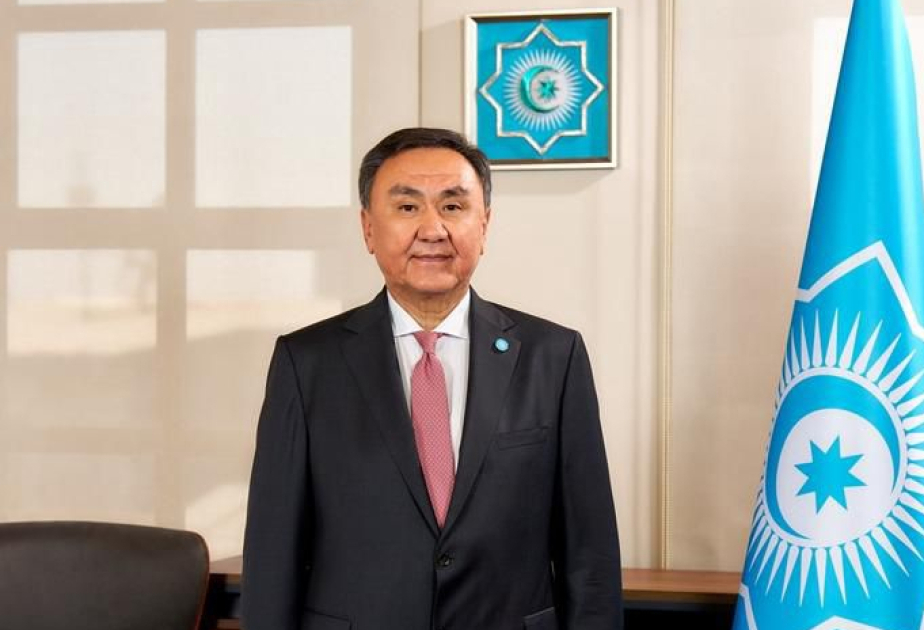
Kubanychbek Omuraliev: We are confident that the OTS will continue its momentum and further enhance its global influence
Istanbul, December 31, Gunel Karatepe, AZERTAC
One of the most significant events of the year was the 12th Summit of the Council of Heads of State of the Organization of Turkic States (OTS), held in Gabala on October 7 under the theme “Regional Peace and Security.” Taking place at a historic moment following Azerbaijan’s restoration of sovereignty and the peace agreement with Armenia, the Summit opened new opportunities for lasting stability and strengthened cooperation across the Turkic World, at a time when regional peace and connectivity have gained renewed global significance.
Looking ahead, we are confident that under Azerbaijan’s Chairmanship — given its strategic position as a bridge within the Turkic World, its political influence, economic potential, and its growing role in regional and global affairs — the OTS will continue to build on the momentum achieved in 2025 and further strengthen its impact and global visibility.
These remarks were made by Secretary General of the Organization of Turkic States, Kubanychbek Omuraliev, on the occasion of the year-end and the New Year.
He noted that 2025 has been marked by significant progress for the Organization of Turkic States. Guided by the Turkic World Vision–2040 and the OTS Strategy 2022–2026, the Organization continued to advance key initiatives aimed at deepening political dialogue, economic connectivity, cultural exchange, and people-to-people ties, thereby laying a strong foundation for the next phase of institutional consolidation and strategic outreach.
Emphasizing that Member States and Observers worked closely to raise the visibility and influence of the OTS on regional and international platforms, the Secretary General stated: “Through high-level meetings, ministerial gatherings, expert consultations, and institutional cooperation, we deepened cooperation across our key areas of work, strengthening the Organization’s capacity to act as an effective platform for dialogue and partnership.”
A key event of the year was the Informal Summit held in Budapest in May. For the first time, such a Summit meeting was hosted in Europe, in the territory of an Observer State. The Budapest Declaration adopted there outlined a new roadmap in economic integration, digital development, and security. This milestone marked an important step in positioning the OTS as a forward-looking platform capable of engaging meaningfully beyond its immediate region.
Equally historic was the first-ever Meeting of the Heads of Government in Bishkek, which produced a Joint Statement and established a permanent format to accelerate the implementation of Summit decisions, thereby strengthening the Organization’s ability to translate vision into action.
Education and science also remained at the forefront of the agenda. The Turkic Universities Union (TURKUNIB), which now includes more than 170 members, continued to expand academic cooperation alongside the Orkhun Exchange Program. Hungary’s decision to allocate one million euros annually to the OTS Research, Development and Innovation Fund made an important contribution to joint investments in human capital and innovation as key drivers of long-term development.
Referring to the 12th OTS Summit in Gabala, K. Omuraliev stated that the Gabala Declaration outlines a comprehensive 121-point roadmap guiding future cooperation across political affairs, foreign policy, security, economic and sectoral development, people-to-people exchanges, institutional coordination, and engagement with external partners. During the Summit, the Heads of State also endorsed the establishment of the “OTS+” format, designed to deepen cooperation with external partners in areas of mutual interest and enhance the Organization’s adaptability in a rapidly evolving international environment.
He emphasized that the joint design of the 12U OTS-SAT Cube Satellite, to be developed under the OTS flag, is of particular importance, underscoring the growing strength of the Turkic cooperation ecosystem. The Secretary General welcomed Uzbekistan’s membership in the Turkic Culture and Heritage Foundation and the decision to grant the Turkish Republic of Northern Cyprus observer status in the Turkic Academy, noting that Turkmenistan’s decision at the Gabala Summit to join both the Academy and the Foundation as an Observer will further deepen regional cooperation.
International engagement remained a key priority. Activities carried out in Geneva, Vienna, New York, and Brussels strengthened relations with global institutions. The “Cleantech Days 2025” held in Istanbul in cooperation with the United Nations Industrial Development Organization (UNIDO) and the Scientific and Technological Research Council of Türkiye (TÜBİTAK) demonstrated the Organization’s commitment to sustainable development, while preparations for the second “Turkic Week” in Vienna are expected to further enhance its global visibility.
The Secretary General noted that high-level visits to Mongolia, Mexico, and the United States expanded the Organization’s external partnerships. The visit to Mongolia marked an important step in advancing OTS–Mongolia relations. In Mexico, the Memorandum of Understanding signed with the International Maize and Wheat Improvement Center (CIMMYT) opened new opportunities in agricultural research, innovation, and food security.
Touching upon his working visit to the United States, he said that meetings were held with senior representatives of the U.S. Administration, Members of Congress, leading analytical and academic institutions, as well as representatives of the business, expert, and diaspora communities, contributing to the strengthening of political dialogue and cooperation in areas including connectivity, investment, energy, innovation, and people-to-people contacts.
Other news in this section


