Ancient sewing needles helped humans survive freezing climates
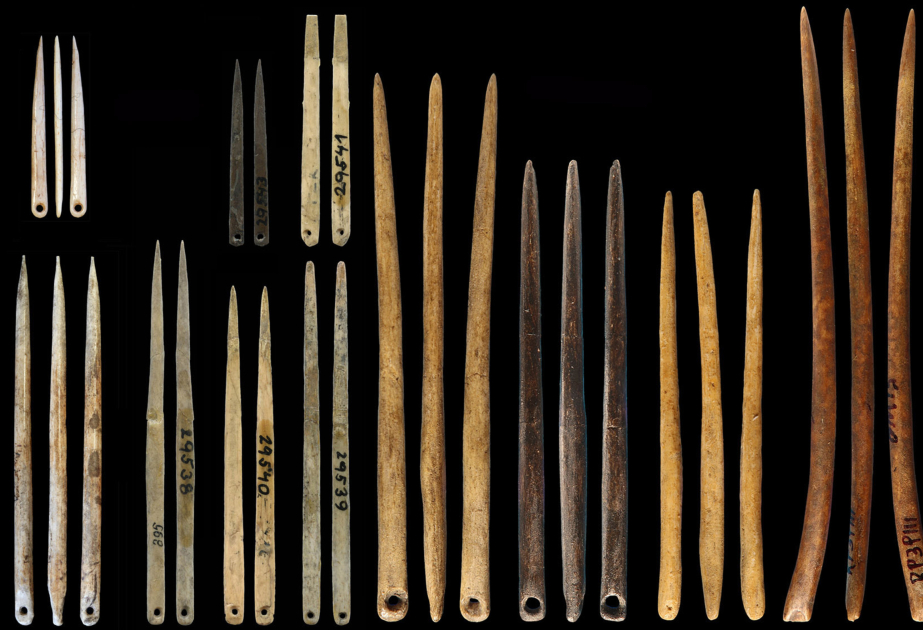
Baku, March 12, AZERTAC
It’s easy to imagine human survival in the Ice Age being driven by big inventions: fire, shelters, hunting weapons, according to Earth.com
But a new study argues that one of the most important technologies for pushing into cold regions may have been almost comically small: the sewing needle.
And it wasn’t just about making clothes. Needles and awls also show up in everything from medical care to fishing and ceremony, suggesting they were quiet multipurpose tools that shaped daily life.
The research was led by McKenna Litynski, a recent PhD graduate in anthropology and adjunct assistant professor at the University of Wyoming.
Survival in cold climates
Around 100,000 years ago, humans began spreading into new regions across the globe, including places with brutal winters.
For a long time, researchers have suspected that this expansion wasn’t only about courage or better hunting. It may have depended on something practical: the ability to make fitted clothing.
The theory is straightforward. If you can sew, you can shape hides into tailored garments that trap warmth better than draped skins. Better clothing means better survival odds in freezing environments.
The problem has been proving that story with evidence, because bone needles and similar tools don’t always preserve well, and ancient behavior is hard to measure directly.
That’s where Litynski’s approach comes in. Instead of relying only on archaeological fragments, she looked at a massive body of ethnographic writing to see how needles and awls were used by real communities in more recent history.
A huge dataset from North America
Litynski drew on hundreds of ethnographic documents written between the 18th and 20th centuries in North America.
These sources include descriptions of daily life, tools, and cultural practices – exactly the kinds of details that let researchers see how objects were actually used.
She then coded the information and ran statistical models to test two big questions: Are needles and awls most closely tied to clothing production? And do mentions of these tools become more common in colder environments?
The results gave strong support to the classic needle theory. Clothing production was the most frequently associated activity.
Furthermore, references to needles and awls increased significantly in colder regions, which fits the idea that sewing technology supported thermoregulation and made life in harsh climates more viable.
Ancient needle use beyond sewing
Here’s the twist: even though clothing production was the most common single activity, it accounted for only 14% of the observations. In other words, needles and awls weren’t just “cold weather tools.” People used them for all kinds of things.
The study found these tools were widely associated with medical suturing, fishing, tattooing, basketry, and ceremonial activities.
That matters because it changes how we should interpret these artifacts when archaeologists find them.
A needle doesn’t automatically mean “tailored clothing,” and an awl doesn’t automatically mean “winter survival.” The same tool could be part of healing practices, craft production, or ritual life.
The broader point is that a technology invented for one purpose can quickly become a Swiss Army knife of the ancient world.
The story of human expansion
The findings still support the idea that needles helped humans survive cold climates. The statistical link between colder environments and more mentions of needles and awls is a strong clue that sewing mattered for survival.
But the study also suggests something deeper: once humans had this technology, they didn’t keep it in a narrow box. They adapted it. They used it creatively. And they folded it into social and cultural life, not just basic survival.
That blend – practical advantage plus versatility – helps explain why a tool like the needle could become so widespread.
Significance of the research
Needles and awls are among the more common artifacts in the perishable archaeological record.
That means they show up often enough to matter, but they’re also tricky because their functions can be misunderstood if we assume they only did one job.
This research offers archaeologists a better framework for thinking about what these objects might mean in different settings, and how environmental pressures and social needs can both shape tool use.
“Ultimately, it is not only the tools themselves that are significant, but also the people who once used these objects in the past,” Litynski said.
“It is through examining needles and awls from different lenses that archaeologists like me can reveal their capacity to unravel the broader story of human ingenuity, adaptability, and cultural evolution over the last several thousands of years and throughout the world.”
It’s a nice reminder that some of the biggest shifts in human history weren’t driven by flashy inventions. Sometimes, they were driven by a sharp little piece of bone, used skillfully – and used for far more than anyone first intended.
Other news in this section


