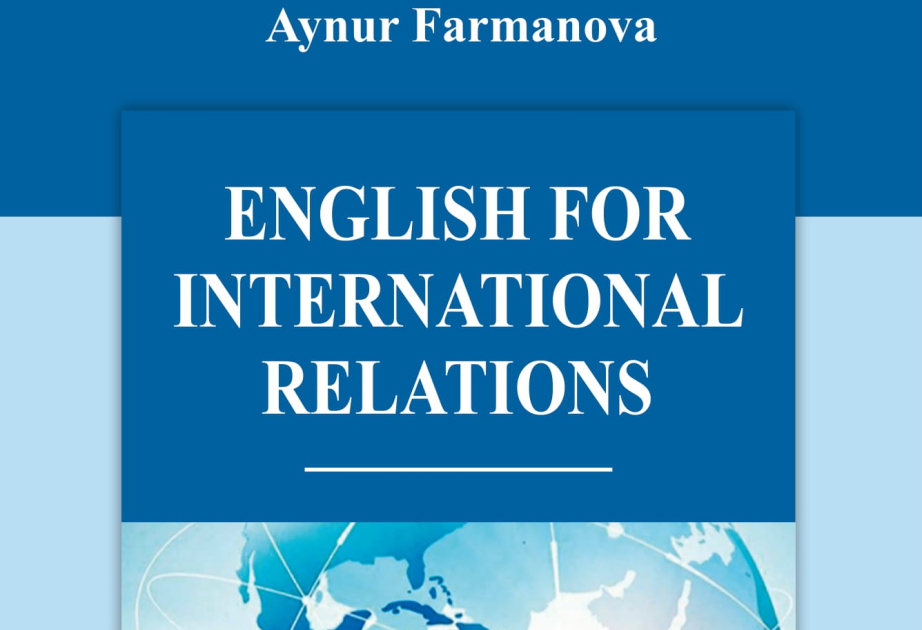
Textbook titled “English for International Relations” published
Baku, December 5, AZERTAC
The textbook titled “English for International Relations” has been published.
In today's modern times, English is widely used as the main communication tool in international relations, global politics, diplomacy, and international organizations. Negotiations, agreements, and diplomatic meetings at the international level are primarily conducted in English. English plays a fundamental role in the field of international relations and is an essential tool for those who wish to work in this area. In the modern era, English plays a significant role not only in world politics but also in the expansion of bilateral and multilateral cooperation between states.
It should be noted that in the academic field, research, publications, and conferences on international relations are primarily conducted in English. International news, analytical articles, and world events are widely disseminated in English through mass media. Furthermore, English serves as a tool for communicating with people from different countries, understanding cultures, and collaborating on global issues.
In this context, the textbook titled “English for International Relations,” prepared by Associate Professor Aynur Farmanova from the Department of Languages at the Academy of Public Administration under the President of the Republic of Azerbaijan, consists of an introduction, 25 major-specific topics, as well as questions, exercises, reading materials, and appendices related to these topics. The selected topics in the textbook are relevant and appropriate to the specialization.
In the modern world’s political arena and the system of international relations, international and regional organizations play an important role in both bilateral cooperation between states and multilateral diplomacy. In this regard, the textbook provides reading materials on the fundamentals of international relations, Azerbaijan’s place in the system of international relations, and the international organizations that play a leading role in world politics. In particular, the section of the textbook devoted to Azerbaijan on the international arena also reflects the topics of military and diplomatic achievements in the Second Karabakh War, as well as the restoration of territorial integrity and sovereignty.
At the same time, the questions and tasks related to each topic included in the textbook, as well as the reading materials, play an important role in helping students master the course in English. In addition, a list of key sources and references essential for a more comprehensive study of the course is provided.
The text book includes the most commonly used abbreviations in publications related to international organizations, along with diplomatic terms, Latin and French-derived words, and geographical names. It also provides definitions from a monolingual dictionary, reflecting both the academic level of the book and its focus, as well as explanations on the use of the relevant words in various expressions.
In this regard, knowledge of the English language is an important advantage for those pursuing education and building a career in international relations. Firstly, the textbook is believed to be useful in helping students demonstrate essential skills such as summarizing, paraphrasing and synthesizing in the process of written and oral speech, be able to read and analyze complex texts appropriate to the specialty; to interpret and analyze complex texts related to their field of study, also enabling them to summarize scientific and socio-political materials they listen to or read; be able to choose writing strategies appropriate to the specified purpose; demonstrate writing samples on various political topics; be able to create business communication in writing; be able to master question intervention, empathetic listening, clarifying information and enriching it with additional details and other technologies to create effective communication; be able to participate in discussions within the scope of the international relations specialty and be able to create business communication orally; be able to prepare presentations in English; to acquire the ability to form coherent, logical and adequate oral and written texts around a specific question.
Other news in this section


