IDD releases spring 2026 edition of Baku Dialogues
Baku, May 14, AZERTAC
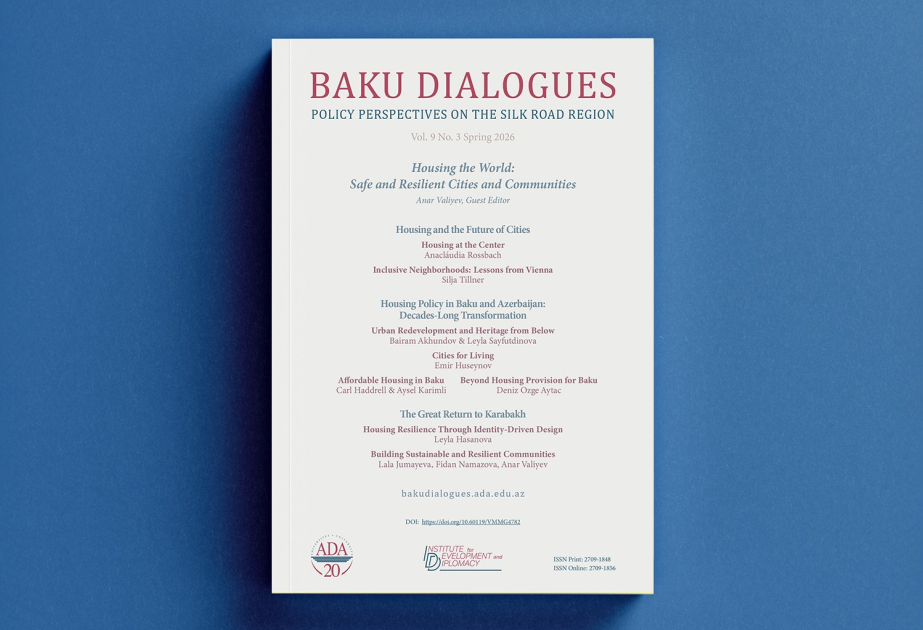
The Institute for Development and Diplomacy (IDD) at ADA University has announced the publication of its latest edition of Baku Dialogues, its flagship English-language quarterly policy journal.
Published under the title “Housing the World: Safe and Resilient Cities and Communities,” the issue coincides with the forthcoming opening of the 13th session of the World Urban Forum (WUF13), bringing renewed international attention to questions of sustainable urbanization, resilient housing systems, and inclusive city development. The guest editor of the issue is Associate Professor at the School of Public and International Affairs, Advisor to the Vice Rector for Academic Affairs, and holder of the Jean Monnet Chair at ADA University, Dr. Anar Valiyev.
The edition brings together analytical contributions examining the future of housing policy, the development of safe and resilient cities, urban transformation processes, and community-building in post-conflict settings. The authors assess rapidly evolving global urbanization trends through both international experiences and the case of Azerbaijan.
The first section of the issue, titled “Housing and the Future of Cities,” explores the role of housing policy in shaping the future of urban environments. In “Housing at the Center,” Under-Secretary-General of UN-Habitat Anacláudia Rossbach analyzes the strategic importance of housing provision in ensuring social resilience and inclusive development. ADA University’s Professor Silja Tillner’s “Inclusive Neighborhoods: Lessons from Vienna” evaluates the key principles of inclusive neighborhood planning through the example of Vienna.
The section “Housing Policy in Baku and Azerbaijan: Decades-Long Transformation” focuses on the evolution of housing and urban policy in Azerbaijan. In “Urban Redevelopment and Heritage from Below,” Bairam Akhundov and Leyla Sayfutdinova examine the relationship between urban redevelopment and the preservation of historical heritage. Emir Huseynov’s “Cities for Living” analyzes human-centered city concepts and contemporary approaches to urban governance.
Affordable housing in Baku is also addressed in detail. In “Affordable Housing in Baku,” Carl Haddrell and Aysel Karimli assess the challenges of housing affordability in the Azerbaijani capital and discuss potential policy responses. Deniz Ozge Aytac’s “Beyond Housing Provision for Baku” explores broader social and urban dimensions of city development extending beyond housing provision alone.
The issue’s final section, “The Great Return to Garabagh,” is dedicated to reconstruction and redevelopment efforts in the liberated territories. In “Housing Resilience Through Identity-Driven Design,” Leyla Hasanova examines the role of architecture rooted in identity and cultural memory in fostering resilient communities. “Building Sustainable and Resilient Communities,” co-authored by Lala Jumayeva, Fidan Namazova, and Anar Valiyev, discusses approaches to creating sustainable living environments in the post-conflict context of Garabagh.
This edition of Baku Dialogues brings together international and regional perspectives on the future of cities, social inclusion, and sustainable urban development, contributing to broader policy discussions across the Silk Road region.
The full issue is available for reading and download on bakudialogues.idd.az.
Other news in this section


